The Birth of Inflationary Universes via 'Wine Glass' Wormholes and Their Boundaryless Counterparts ✛ ✎ ✦
Context
Despite the success of inflation proposed by Guth, how it actually started remains a puzzle. Classical evolution runs into the Big Bang singularity. Quantum scenarios involve either tunneling from an already existing universe (wormholes) or birth from 'nothing' (Hawking and Hartle). These approaches have long been considered independent, but new work demonstrates their deep connection.
Methods
The authors numerically solved Euclidean Einstein equations with matter in the form of an axion field or magnetic charge and a self-interacting scalar with a potential featuring a maximum and minimum. Using the shooting method, they tuned initial conditions to ensure an asymptotically flat or AdS space on one end and a local maximum of the scale factor on the other.
Results
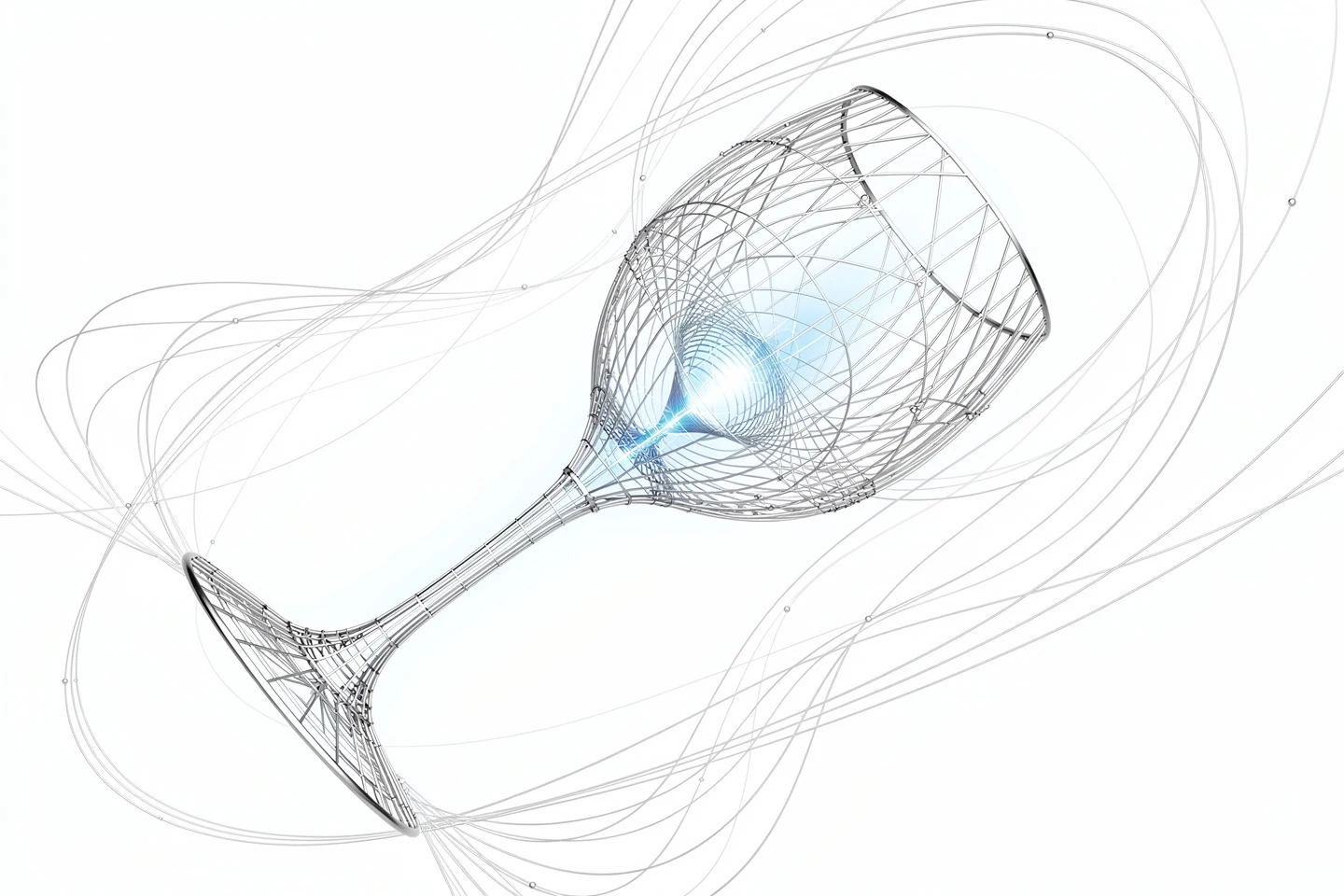
Wormholes were found with a distinctive scale factor shape: 'rim' (local maximum), 'stem' (minimum), and 'base' (asymptotics). The transition in the stem region features extreme spacetime curvature. For small axion (or magnetic) charges, the scalar field starts near the top of the potential, giving prolonged inflation after analytic continuation to Lorentzian signature. The Euclidean action (weight in the Feynman integral) decreases with charge, so universes with longer inflation are more probable. In the limit of vanishing charge, the stem disappears and the geometry splits into two disconnected parts: the no-boundary instanton (de Sitter sphere) and the background space. The weighting coefficient smoothly transitions to -S ≈ 118.4 for the inflationary vacuum at the top of the potential. Exotic solutions with multiple bridges or crossing several barriers were also found, but they are suppressed.
Implications
This discovery blurs the line between two paradigms of quantum cosmology: wormholes and the no-boundary state of Hawking. It hints at the possibility of topology change in quantum gravity and supports the idea that different topologies contribute to the wave function of the Universe. Moreover, it naturally provides initial conditions for inflation.
Future development
Future research may include stability analysis of these solutions, searching for complex (fuzzy) analogs, and exploring their role in determining the integration contour for the gravitational path integral. It is also important to understand how these configurations fit into cosmological measure theory and resolve the problem of initial probabilities.
Impact
The work impacts inflationary cosmology, string theory (via AdS/CFT correspondence), and the interpretation of cosmic microwave background data, which constrains the scale of inflation.
Next steps
Next steps include calculating the perturbation spectrum born in such scenarios and checking against the Kontsevich–Segal–Witten admissibility criterion.
Key open problems
Connection to unsolved problems: the initial conditions problem for inflation, the measure problem in eternal inflation, and the factorization paradox in AdS/CFT.
The knowledge machine's view
This section is addressed to the author of the paper and their colleagues. Neighbouring works were found by meaning-based search across our archive, not by word overlap. We do not review: we show the field around the work.
What the work does
The paper presents numerical solutions of Euclidean Einstein equations with an axion field or magnetic charge and a self-interacting scalar. Wine-glass-shaped wormholes with a local maximum of the scale factor are found, which after analytic continuation give an inflationary universe. It is shown that in the limit of zero charge the stem disappears and the solution becomes the no-boundary Hawking instanton.
Where its strength is
A direct link between wormholes and the no-boundary Hawking state is established, unifying two paradigms of quantum cosmology. The numerical solutions demonstrate a smooth transition and naturally provide initial conditions for inflation.
Where it could go next
- It might be interesting to compare the obtained instantons with the mechanism of black hole creation from 'nothing' considered in a neighboring paper, to see how general the transition between topologies in Euclidean gravity is.based on: Black Holes Born from Nothing, Then Die arXiv:2605.03015
- Nearby there is an analysis where wormholes are also linked to the onset of inflation; comparing the approaches could clarify how the choice of matter content affects the instanton shape and nucleation probability.based on: Universe from a Wine Glass: How Wormholes Ignite Inflation arXiv:2605.13777v2
- One might consider a connection with the work on vacuum decay and the Big Bang: there, nucleation from false vacuum is discussed, which could provide additional context for interpreting the weight factor.based on: Dark Start: How Vacuum Decay Birthed the Big Bang arXiv:2606.06587v1
Worth trying
- Check whether the smooth transition to the no-boundary instanton persists for other forms of the scalar field potential.
- Investigate how the presence of multiple 'stems' affects the nucleation probability and subsequent inflation.
- Apply the shooting method to models with non-minimal coupling of the scalar field to curvature.
Why this may matter
If the connection between wormholes and the no-boundary state turns out to be universal, it could become a bridge between different approaches to the quantum birth of universes and shed light on the role of topology in quantum gravity.
Nearby works in our archive
- Black Holes Born from Nothing, Then Diesimilarity 0.62
- Universe from a Wine Glass: How Wormholes Ignite Inflationsimilarity 0.62
- How to Ignite the Big Bangsimilarity 0.62
- Dark Matter from a Curved Cosmossimilarity 0.61
- Dark Start: How Vacuum Decay Birthed the Big Bangsimilarity 0.59
- Black Holes from the Universe's Infancysimilarity 0.59
The closest work in the archive sits at 0.62 by meaning — the usual level for our corpus.
The scale factor shape of these wormholes resembles a wine glass: a wide bowl (future universe), a narrowing stem (throat), and a base (asymptotics). Hence the poetic name.
In the movie 'Interstellar,' wormholes serve as passages between galaxies, while here they act as cradles for entire universes — albeit only at the quantum level.
Key numbers
- no-boundary instanton weight: ≈ 118.4 (in Planck length units)
- wormhole rim size at low charges: ≈ 1.732 (in units of the inverse inflationary Hubble radius)
- typical throat size for axion charge Q_a=0.02: ≈ 0.1 of the rim size
- maximum allowed axion charge: Q_a V(ϕ_0) < 2
- AdS potential depth: from 0 to -10 (in units of V_top)