How to Create the Perfect Single Photon express
A typical photon source can be likened to a club entrance with a single bouncer. He tries to let people in one at a time, but occasionally couples sneak past. Physicists call this the purity problem: photons must arrive strictly solo, otherwise quantum computing breaks down. Old-school methods ruthlessly blocked pairs, but then brightness suffered, as if the bouncer spent so long checking each person that a long line formed outside. The new approach adds two more bouncers acting in unison. If the first spots a troublemaker, the other two instantly seal the entrance — no pair ever gets in. This triple-control system works fast and flawlessly even in a noisy setting where a lone guard might slip up.
The method requires no complex tuning and promises photon sources that are ideal for quantum computers and precision measurements such as spectroscopy and photometry.
Original abstract
as written by the authors arXiv:2605.21942
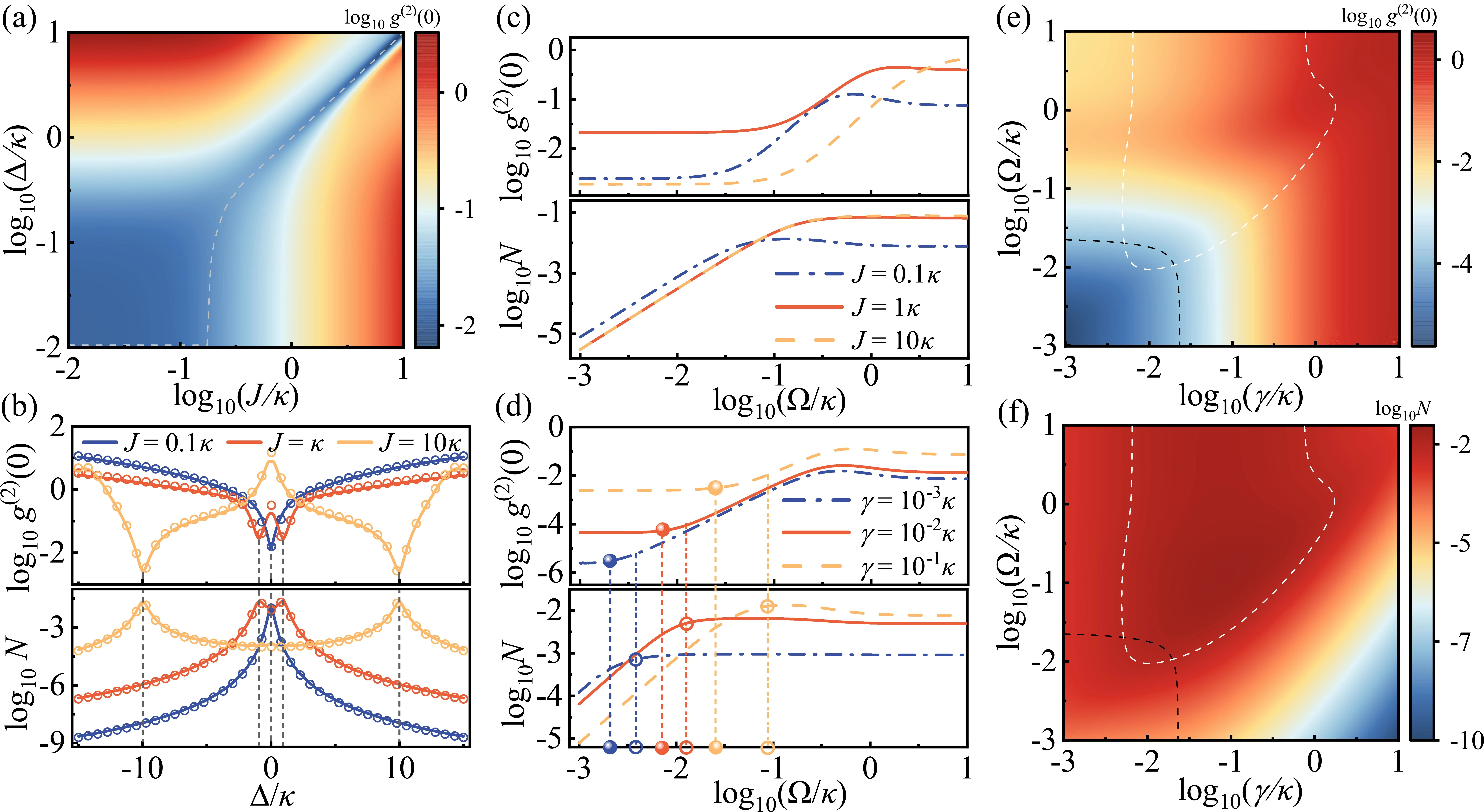
Photon blockade is vital for single-photon generation, but current schemes with conventional and unconventional photon blockade face critical limitations like the purity-brightness trade-off, hindering the generation of high-performance single-photons. To overcome these limitations, we introduce a fundamentally new photon blockade mechanism by utilizing three-body interactions between a single photonic mode and two qubits. This kind of interaction intrinsically cuts off the excitation path to the two-photon state, resulting in a perfect photon blockade effect. The mechanism operates across a broad parameter range, free from the constraints of strong coupling or weak driving. Remarkably, it breaks the purity-brightness trade-off, enabling the simultaneous achievement of extreme purity and high brightness, both significantly outperforming previous mechanisms. Furthermore, this approach demonstrates robustness against thermal noise and avoids unwanted oscillations in the time-delayed correlation function. This work provides a path for generating high-purity, high-brightness, and robust single-photon sources, a key resource for quantum technologies.
To notice light, the eye needs at least ten photons at once, a single one remains completely invisible.