Is light a stream of bullets, or waves? The photoelectric effect declared: bullets. Electrons are ejected from metal only if the light frequency exceeds a threshold, and the energy depends on the color, not the brightness. Einstein's equation E = hf — W precisely describes how much energy the electron retains after escape.
History
Albert Einstein, inspired by Max Planck's quantum hypothesis, introduced the concept of the photon and proposed the photoelectric equation in his March 1905 paper. Experimental confirmation was provided by Robert Millikan in 1916 after years of testing. Einstein received the Nobel Prize in Physics in 1921 precisely for this work.
How it works
The equation underlies photoemission spectroscopy, which allows measuring the work function of materials and surface chemical composition. Applicable for ultraviolet and visible radiation on metals; for the X-ray range relativistic corrections are required, and for semiconductors electron affinity is used instead of the work function.
Fun fact
Einstein received the 1921 Nobel Prize for explaining the photoelectric effect, not for the theory of relativity, which initially seemed too bold.
A laser hits an atom, and tears out an electron. The brighter the light, the stronger the kick, and the faster the electron flies away. That's how the familiar picture works, where light is a smooth wave. But what if the light isn't smooth but 'squeezed,' with quantum fluctuations, like the trembling of a string?
When two black holes merge, ripples spread across the fabric of spacetime — gravitational waves. But what if one of them isn't a run-of-the-mill black hole but something else — an exotic compact object?
On the wall: light and dark fringes. That’s what light looks like when it cancels itself out.
Way back in the 17th century, Christiaan Huygens suggested that light is a wave.
In 2021, the LHAASO observatory registered gamma quanta with energies above a petaelectronvolt from sources like the Crab Nebula — a supernova remnant with a pulsating neutron star at its heart.
A proton bunch flies into a plasma cloud, and leaves behind an invisible trail: an electric wave. This wave can pick up other particles and accelerate them to enormous energies. But controlling it is tricky: there are too many details in plasma behavior.
Imagine an artist whose canvas is an entire planet, and whose palette is molecules drinking starlight. His brush is billions of years of evolution, and his painting is a spectral portrait visible even from another star system.
The thinner the ferroelectric film, the stronger the depolarizing field — a dictate of classical physics. Imagine a pencil balancing on a fingertip: the shorter it is, the harder to keep it upright. Nanoscale polarization likewise strives to vanish.
A surfer glides across the ocean surface until a big wave comes, and then they're flying forward. Similarly, a free electron interacts with light: usually the energy exchange is barely noticeable, but if the surrounding medium begins to oscillate rhythmically, each wave crest pushes the particle harder and harder.
Light hits a crystal and knocks an electron out of its rightful place. A void remains — a hole that behaves like a positive charge. The electron and hole attract each other and circle around one another, like a pair in a slow dance. Such a pair is called an exciton (from the word "excitation").
But this dance is not in a vacuum.
Understanding the photoelectric effect — where light knocks electrons out of a material — is like learning to cook without a recipe. That’s where digital tools help: games provide intuition, and simulations provide precision.
When an electric charge moves with acceleration, it emits electromagnetic radiation, i.e., light — a familiar phenomenon in physics. However, researchers have found that when moving along a specially chosen trajectory, the radiation acquires unusual properties.
Two massive spheres slowly drift apart in empty space. From the standpoint of ordinary mechanics, nothing special is happening. But Einstein's equations say otherwise: accelerating masses stir spacetime itself, and from them spread gravitational waves — ripples that stretch and squeeze everything in their path.
A black hole is a cosmic pocket into which everything, even light, falls. But the pioneering work of John Wheeler, Stephen Hawking, and Roger Penrose showed: sometimes, due to the colossal spacetime curvature, the pocket turns inside out.
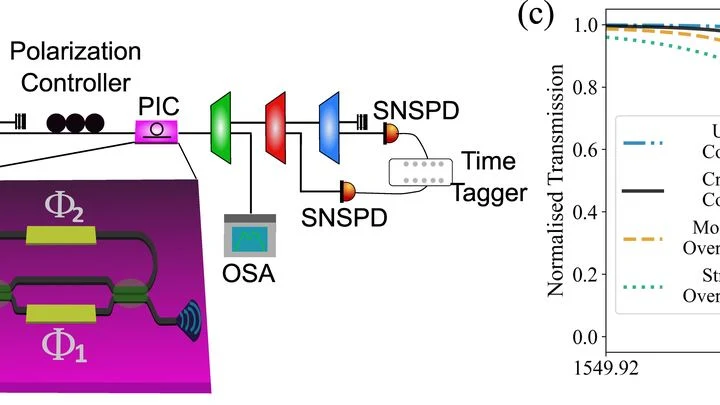
A typical photon source can be likened to a club entrance with a single bouncer. He tries to let people in one at a time, but occasionally couples sneak past. Physicists call this the purity problem: photons must arrive strictly solo, otherwise quantum computing breaks down.
A drop of water stretches in a strong electric field. The deuterium nucleus, a bound pair of a proton and a neutron, behaves the same way, except here the field comes from a passing gamma ray, and instead of just stretching, the nucleus can simply fall apart.
A swing only gets going if you push it in rhythm. Miss the beat, and your effort is wasted. Light interacts with an atomic nucleus in much the same way: a photon is usually absorbed only when its energy exactly matches the gap between nuclear levels. But what if the photon's energy doesn't fit? The authors of a new study have found a workaround.
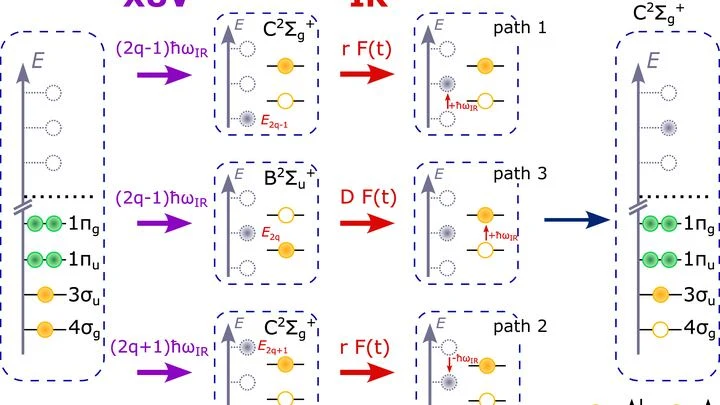
A high-speed camera capable of capturing the motion of electrons is an attosecond interferometer. It sends two laser pulses at a substance with a tiny delay. The first, ultraviolet, acts like a flash, knocking an electron out of the molecule. The second, infrared, like an invisible hand, gently nudges or slows this electron in flight.
A deuterium molecule, two atoms of heavy hydrogen, falls apart under a laser pulse. One electron is ripped away, leaving an ion behind. At that moment, they are still linked: the direction of one immediately tells you which way the other went. This link is called quantum entanglement.
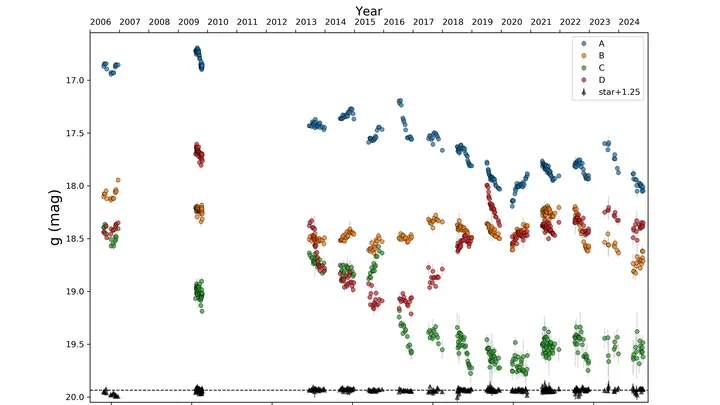
A distant quasar appears as four points of light arranged in a cross. This is how the gravity of a galaxy lying along our line of sight distorts the view: it acts like imperfect glass, multiplying the image. Each point is the same object, but its light travels different paths.
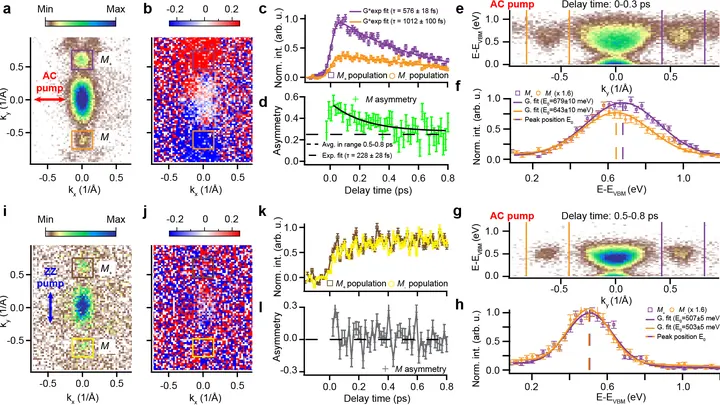
An ordinary sheet of black phosphorus looks like a layered cake of atoms. If you shine a regular lamp on it, nothing special happens: the electrons sit still, like spectators in a dark theater. But a short laser flash lasting millionths of a billionth of a second shakes up that theater.
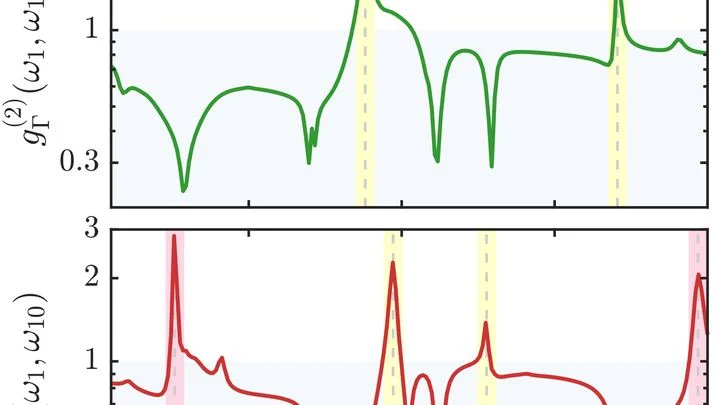
A quantum dot is like a tiny lamp that turns on and off at the command of a laser, emitting exactly one photon at a time. But this light has a quirk: the photons don't interact with each other; they fly independently, like random drops from a faucet.
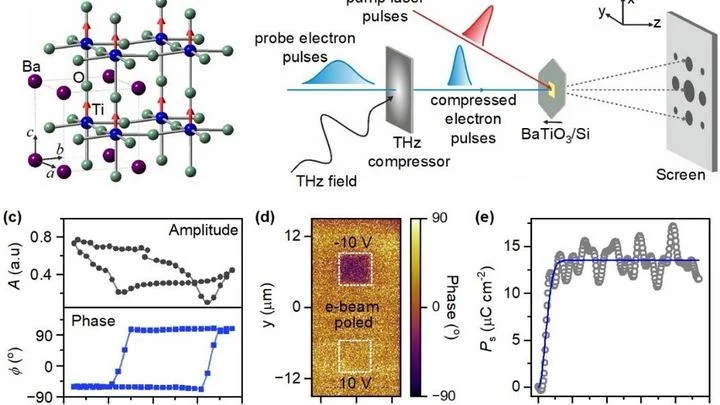
Inside a barium titanate crystal, there's a built-in electric field, like a permanent magnet, but for charges. When a flash of light hits it, electrons are knocked loose and start darting around, colliding with atoms. But the crystal isn't the same in all directions: it has an axis along which the field is strongest.
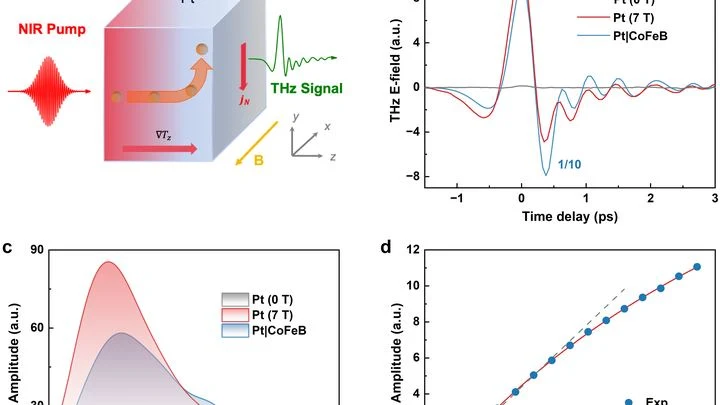
Usually, to generate terahertz waves (light between microwaves and infrared), researchers build a sandwich of different metals. One layer acts as the source, another as the receiver of charges. In such designs, platinum was assigned the role of a simple conductor. But it turns out it can work alone.
When light knocks an electron out of an atom, it flies off like a ball thrown into a crowd. Scientists have long wanted to know the exact moment each electron leaves the atom, but direct measurement disturbed the very process. Now physicists have proposed a method that uses a second light pulse to 'photograph' the moment of the electron's birth.
In a dark room, an atom and light are locked together in a mirrored box. The box is so small that the atom cannot simply release light: they constantly exchange energy, like two dancers who never let go of each other's hands.
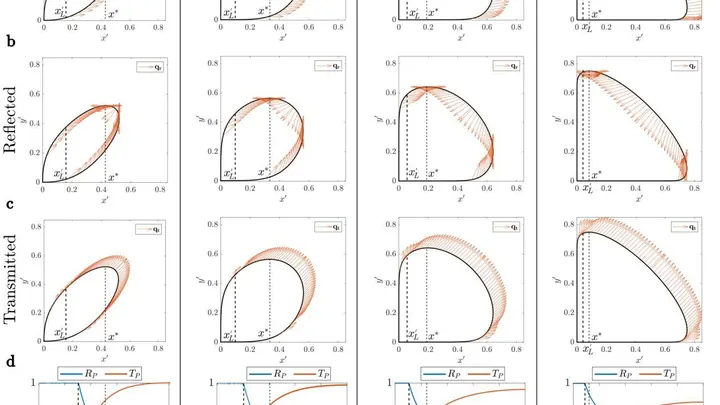
A river flows in one direction, but a wave on its surface travels in the opposite direction. The same splitting happens in hyperbolic materials: the energy of a light wave and its fronts diverge, preventing a sharp lens from being created.
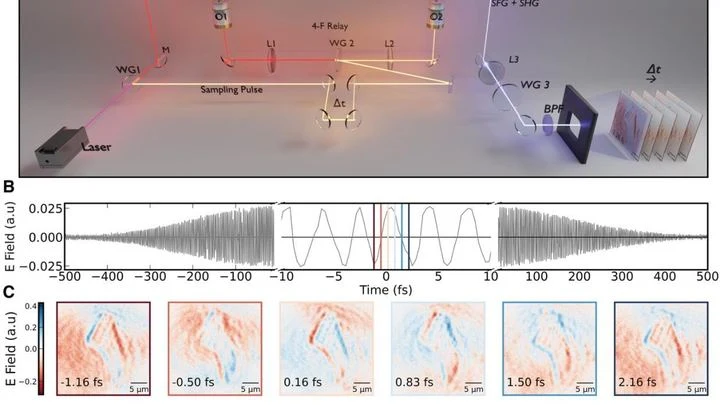
Light is not just a beam but a wave with an electric field that changes at a speed unimaginable to ordinary clocks. Until now, this field could only be measured at a single point, like taking temperature with a single thermometer. Now researchers have created a method that shows the entire field at once, like a thermal imager showing a heat map.
A charged particle spiraling in a magnetic field doesn't stay silent: it emits light. This light is called synchrotron radiation, and it shows up everywhere — from distant galaxies to laboratory accelerators.
If light could be bottled, scientists would have the perfect assembly line: one bottle — exactly one photon, no stray drops. Such single particles of light are needed for quantum computers and secure communication: they carry information that cannot be eavesdropped on unnoticed.
Imagine a vast field of fireflies, each flashing alone rather than in a swarm: that's what the new automated setup is hunting for. It sweeps a laser across the sample like a flashlight and records the color and brightness of the glow at every spot.
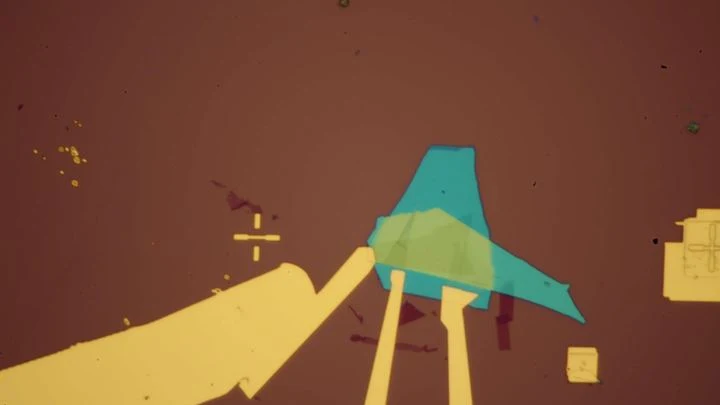
An ultrathin sheet of semiconductor is like the film of a soap bubble, but made of tungsten and selenium atoms. If you poke it with a sharp diamond needle, tiny defects appear at that spot. At low temperatures, these defects start to glow, but not in a continuous stream, rather strictly one photon at a time.
The diffusion equation, a mathematical tool describing how particles spread out in space, has long painted a paradoxical picture: a disturbance, like ripples on Water, instantly engulfs the entire universe. This challenged the theory of relativity, which holds that nothing can move faster than light.
A material just one atom thick and of record purity — only one foreign atom per million — becomes the setting for a remarkable phenomenon. When cooled to near absolute zero, the electrons inside, like musicians in an orchestra, freeze into a strict order, forming a crystal. This state, predicted by Eugene Wigner nearly a century ago, has now been observed in detail.
A muon is like an electron, but about 200 times heavier. When it stops in a piece of silicon, it gets pulled into the atomic nucleus like a nail to a magnet. The nucleus gains extra energy and starts to "boil": various particles fly out — protons, deuterons, tritons, and alpha particles.
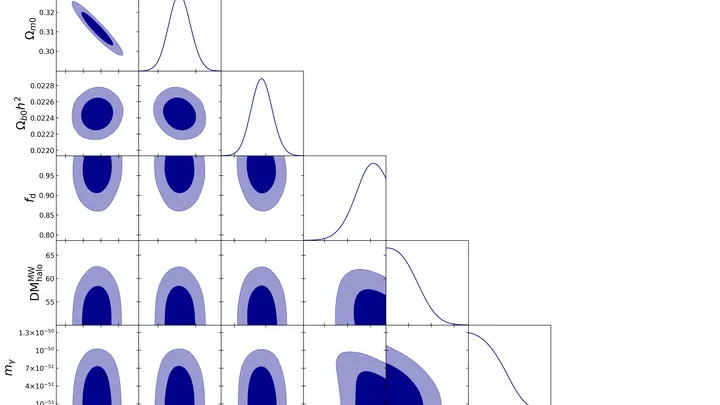
Fast radio bursts are brilliant cosmic flashes that, like a starting signal, set off a race of radio waves across the universe. Astronomers used them as a natural laboratory to test whether the photon, the quantum of light and the carrier particle of the electromagnetic interaction, has mass.
A tiny tungsten tip with a radius of less than a hundred nanometers is the perfect stage for watching a quantum performance. Apply an electric field of a few volts per nanometer, and electrons start flying out of the metal: that’s field emission.
Light strikes a metal plate, and electrons fly out. This is the photoelectric effect, and it works only if the light has enough energy to cross the threshold that holds electrons inside.