Walls That Collapse Faster Than Light express
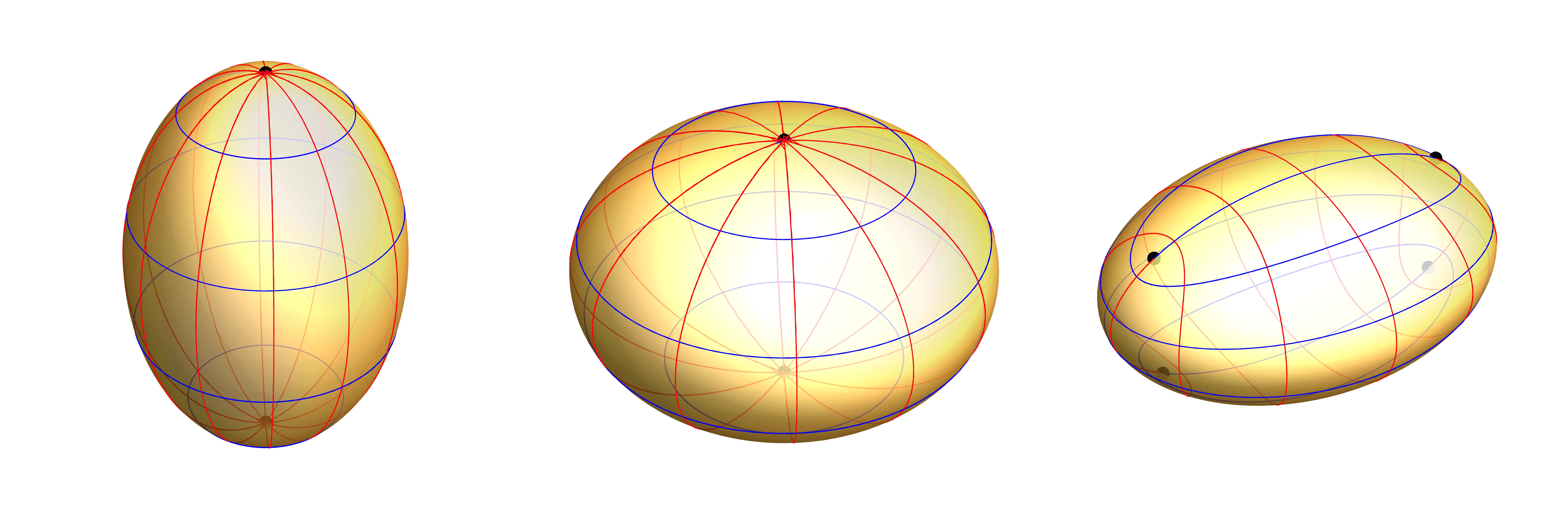
A balloon doesn't deflate all at once: first, dents appear on its surface, which run, merge, and finally the balloon shrivels into a point. Domain walls behave in much the same way — thin partitions that divided space in the first moments after the Big Bang. If such a wall is closed, like a soap bubble, it begins to contract, and wrinkles appear on its surface — regions moving at the speed of light.
The authors of the study examined single closed walls and found that wrinkles come in two varieties. The first is a ribbed edge: a one-dimensional line that slides along the surface at light speed for some time. The second is an instantaneous vertex: a point-like burst where the wall momentarily accelerates to the speed of light and then disappears. Both types arise even from smooth, gentle initial shapes. Their appearance and evolution follow universal laws from the mathematical theory of singularities — the same one that describes how light focuses into bright patterns on the bottom of a cup.
The scientists tested their calculations in two ways. First, in a simplified model where the wall is treated as an infinitely thin film (described by the Nambu–Goto equations). Then, in full-scale simulations based on field theory, where the wall has thickness and internal structure. It turned out that the wrinkle singularities are not an artifact of the approximation: they genuinely appear even in more realistic calculations. Where the surface gathers into a wrinkle, the energy density spikes sharply, as if the tension of the rubber on a deflating balloon became enormous at a single point.
Such energy clumps could have consequences for cosmology. If domain walls really existed in the young universe, their collapse could produce bursts of radiation or even seeds for primordial black holes. The work does not give a definitive answer, but it builds a bridge between abstract geometry and real physics: now we know that wrinkles on walls are not a mathematical curiosity but an inevitable feature of their dynamics.
The theory of singularities, which describes wrinkles on domain walls, originally arose from the problem of how sunlight gathers into bright caustics on the bottom of a cup of tea.
In Frederik Pohl's novel "The Wall Around a Star," a giant domain wall isolates an entire star system, and its collapse threatens catastrophe.