Loop quantum gravity is a theoretical framework that attempts to reconcile general relativity with quantum mechanics by quantizing spacetime itself. Unlike approaches that treat spacetime as a fixed background, loop quantum gravity proposes that space is not continuous but made of discrete, finite 'chunks' or loops. These loops form a spin network, a graph whose edges and nodes represent quantized areas and volumes. The theory predicts that space has a granular structure at the Planck scale, about 10^-35 meters, and that time itself may be emergent rather than fundamental.
History
Loop quantum gravity was developed in the late 1980s and early 1990s by Abhay Ashtekar, Carlo Rovelli, and Lee Smolin, building on earlier work by Roger Penrose on spin networks. It remains an active area of research, though it has not yet been experimentally verified.
How it works
The theory starts by reformulating general relativity in terms of a connection, similar to gauge theories in particle physics. Quantizing this connection leads to states that are described by spin networks. The key innovation is that geometric operators, such as area and volume, have discrete spectra—they can only take on certain quantized values. This avoids the singularities of classical general relativity, such as those at the center of black holes or at the Big Bang, because the discrete structure prevents infinite compression. Instead, a black hole's interior may 'bounce' into a new expanding region, and the universe may have existed before the Big Bang.
In practice
While primarily theoretical, loop quantum gravity informs research on black hole thermodynamics, the early universe, and quantum information, and it may eventually lead to testable predictions for gravitational wave observatories.
Fun fact
In loop quantum gravity, the area of a surface cannot be arbitrarily small; it must be a multiple of a fundamental unit, roughly the square of the Planck length, which is about 10^-70 square meters.
Space is not a void but a mosaic of tiny cells. In loop quantum gravity, spacetime curvature is transferred from a smooth sheet to a network of 'atoms' of volume — spin networks. Each node of such a network is a quantum of space, and the links between them are quanta of area.
But how does this mosaic change over time?
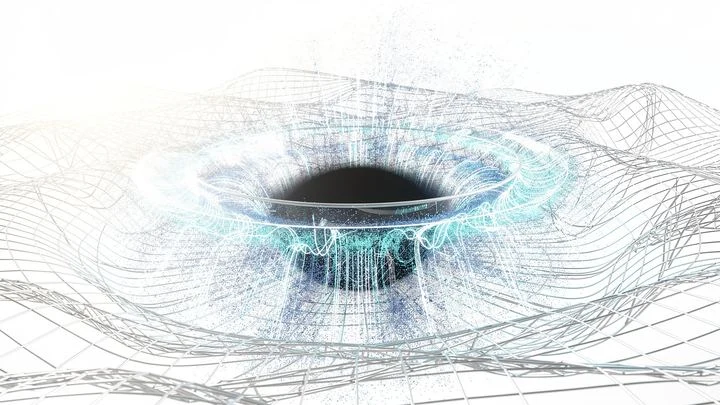
A textbook black hole resembles a perfectly smooth sphere: everything outside it calmly flies off to infinity. However, quantum gravity paints a different picture. Recently, within loop quantum gravity, a solution was found — a 'Kruskal' black hole where spacetime beyond the horizon behaves differently.
Gravitational waves from a tiny body falling into a black hole work like an X-ray image. Only instead of a bone, they illuminate the curved spacetime itself.
Drop a pebble into a pond, and ripples spread across the water. A black hole 'sounds' much the same when matter falls into it or when its spacetime gets a gentle jolt. These fading oscillations are called quasinormal modes, like the tolling of a bell that gradually fades away.
A quantum particle traveling around a closed ring leaves two distinct 'records' along its path. The first is like a fingerprint on a doorknob: it remains unchanged no matter how many times you turn the knob, and it only tells you about the shape and material.
You can zoom into a high-resolution photo for a long time — until suddenly a smooth face dissolves into individual pixels. Something similar, according to a new study, happens to spacetime itself. The authors propose that tiny intervals of length are not pre-existing 'parts' of the universe but results of measurements.
A balloon doesn't deflate all at once: first, dents appear on its surface, which run, merge, and finally the balloon shrivels into a point. Domain walls behave in much the same way — thin partitions that divided space in the first moments after the Big Bang.
A dying star is not just fading away. In its final moments, the core, starved of fuel, collapses into itself at colossal speed. Classical gravity leaves no choice: if the mass is large enough, a black hole is born — a region from which not even light can escape.
A beam of light travels through the void, and its own 'ticking'—an invisible clock embedded in the very fabric of spacetime. Physicists have taken this beam and allowed it to measure itself: the gravitational field on the beam is quantized, and the role of the clock is played by the so-called dressing time — the time that the field 'puts on' like a coat.
The early universe was far from perfect: some regions stretched faster than others, creating folds and warps. But a quantum bounce — the transition from contraction to expansion, driven by the laws of the microworld — fixes everything.
In the first moments after the Big Bang, space expanded at an incredible rate. A tiny quantum ripple, embedded in the uncertainty principle itself, pushed matter apart more strongly than any known force. This ripple is the generalized uncertainty principle, or GUP.