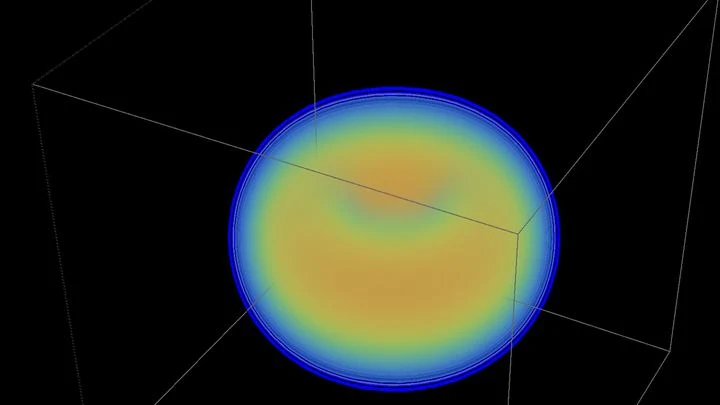
Black hole scalar clouds are long-lived configurations of a scalar field that can exist in the vicinity of a rotating black hole. Unlike ordinary matter that falls into a black hole, these clouds are held in a delicate balance: the black hole's gravity pulls the field inward, while the rotation of the black hole provides a mechanism to extract energy and angular momentum, preventing the field from collapsing. This creates a self-sustaining structure that can persist for very long times, effectively acting as an 'atmosphere' or 'cloud' around the black hole.
History
The concept of scalar clouds around black holes emerged from studies of superradiance in the 1970s, with key theoretical groundwork laid by Press and Teukolsky, and later developed in the context of ultralight bosonic fields. The specific term 'scalar clouds' and their detailed properties were explored extensively in the 2010s.
How it works
The mechanism relies on a phenomenon called superradiance. When a wave or field perturbation scatters off a rotating black hole, it can be amplified, extracting rotational energy from the black hole in the process. If the scalar field has a mass, it can be trapped in the vicinity of the black hole by its gravitational pull, bouncing back and forth. With each bounce, the field is amplified by superradiance, leading to the growth of a cloud. The cloud's growth is eventually limited by nonlinear effects or by the gradual spin-down of the black hole, after which it reaches a stable, long-lived configuration.
In practice
These clouds are studied as potential signatures of ultralight bosonic particles (like axions) and as sources of continuous gravitational waves, which could be detected by observatories like LIGO and LISA.
Fun fact
The existence of a scalar cloud can slow down a black hole's rotation over time, effectively acting as a cosmic brake.
A black hole is a gargantuan cosmic whirlpool that drags in everything nearby. But beyond visible matter, an invisible mist can hover in its vicinity — dark matter. Physicists have studied its behavior. Unlike ordinary matter, the field doesn’t necessarily fall through the horizon.
At the center of many galaxies lurks a black hole, wrapped in an invisible cloud — the halo of dark matter. This is not just a featureless mass: its density changes from the edge to the center, and the degree of this "compression" is called compactness.
The universe sounds with silence. The lion's share of matter — about 85%—remains invisible, manifesting only through gravity. Back when Vera Rubin Vera Rubin showed that galaxies spin as if wrapped in unseen mass.
The universe hasn't always been expanding. In some models, it first contracted, nearly empty and flat, and then, upon reaching a limit, bounced back and started growing, like the world we know. This scenario is called bouncing cosmology.
A black hole with a magnetic field resembles a whirlpool in a river, where water doesn't flow into the vortex but swirls in place. Usually, the hole's rotation picks up waves and amplifies them: this is called superradiance. But add a magnetic field, and everything changes.
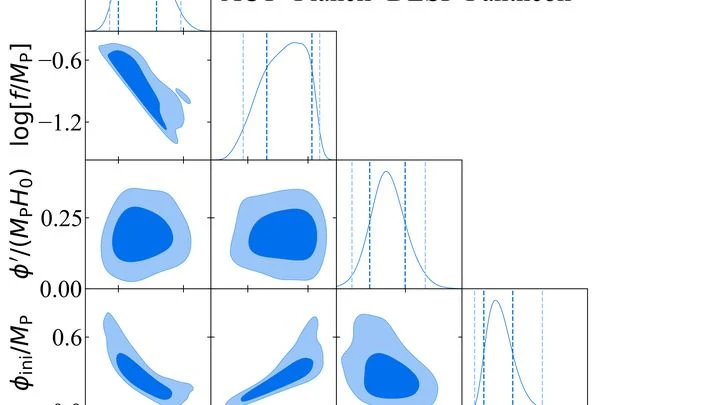
The oldest light in the universe has been traveling toward us for nearly 14 billion years. It was born when the cosmos first became transparent, and since then its plane of oscillation has been rotating ever so slightly. The cause is an invisible ocean permeating all of space: the dark energy field that makes the universe expand faster and faster.
The universe is expanding, and its history features two puzzling episodes that don't fit into a simple picture. The first is a brief period in its youth when everything flew apart faster than expected, as if someone had floored the gas pedal. The second is today's acceleration, as if the same pedal were pressed again, but more gently.
A balloon doesn't deflate all at once: first, dents appear on its surface, which run, merge, and finally the balloon shrivels into a point. Domain walls behave in much the same way — thin partitions that divided space in the first moments after the Big Bang.
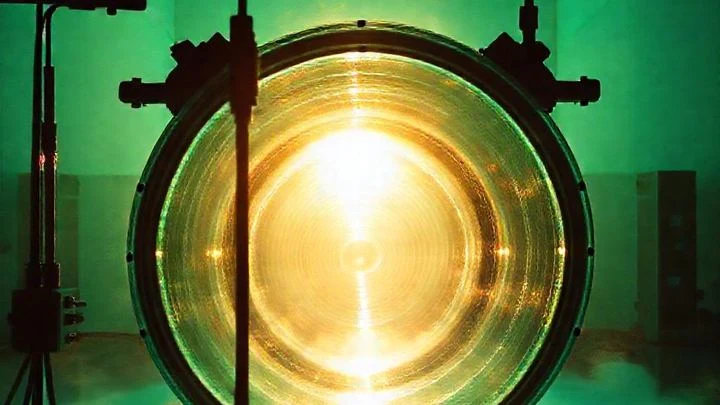
Sound travels through a medium at a certain speed. If the medium moves faster, the sound gets swept along by the flow — like a wood chip pulled into a whirlpool. In superfluid helium — a frictionless liquid — rapid rotation spawns vortex funnels. Inside them, an acoustic black hole forms: a region from which sound cannot return.
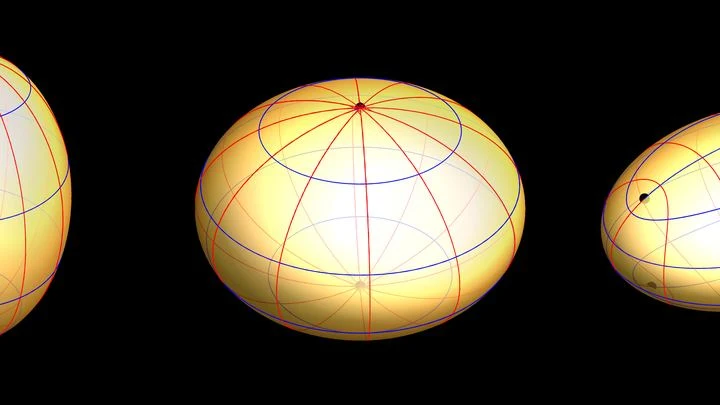
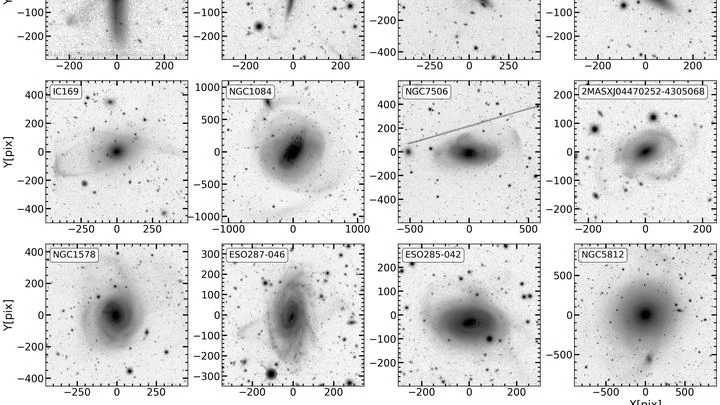
A stellar river winds around the center of a distant galaxy like a glowing ribbon on an invisible frame. That frame is the dark halo: a vast cloud of invisible dark matter whose gravity holds stars and gas in place. If the halo is squashed like a pumpkin or stretched like a melon, the stellar stream will bend differently.
An invisible film, a quantum field, is stretched over a rubber bagel. While the bagel is small, the film stays taut and doesn't sag anywhere: the vacuum remains empty. But once you stretch the bagel to a certain size, a dent spontaneously appears in the film — the field starts to be felt at every point.
This dent is not random.
A spinning black hole acts like a cosmic generator: its rotation pumps energy into an invisible scalar cloud — a prime candidate for dark matter. A scalar field is like temperature: at every point in space it's just a single number, with no arrows or vectors. The cloud grows until it overflows.
Black holes are rarely alone in the cosmos. They are often shrouded in invisible clouds of hypothetical dark matter particles — so light that they feel only gravity, barely interacting with each other or ordinary matter.