A Tiny Black Hole Cools to Absolute Zero express
An ordinary black hole is like a stove that heats up more as its mass shrinks. A tiny hole should glow at unimaginable temperatures and evaporate in an instant. But that scenario ignores quantum corrections — what happens when the very fabric of spacetime begins to tremble.
The authors took the model of a collapsing dust sphere devised by Oppenheimer and Snyder back in 1939 and added quantum effects plus the cosmological constant — the very one responsible for the accelerated expansion of the universe. They ran the calculations for a space with negative curvature (anti-de Sitter, AdS) and got a strange picture: the temperature of a small black hole does not skyrocket but instead tends to zero.
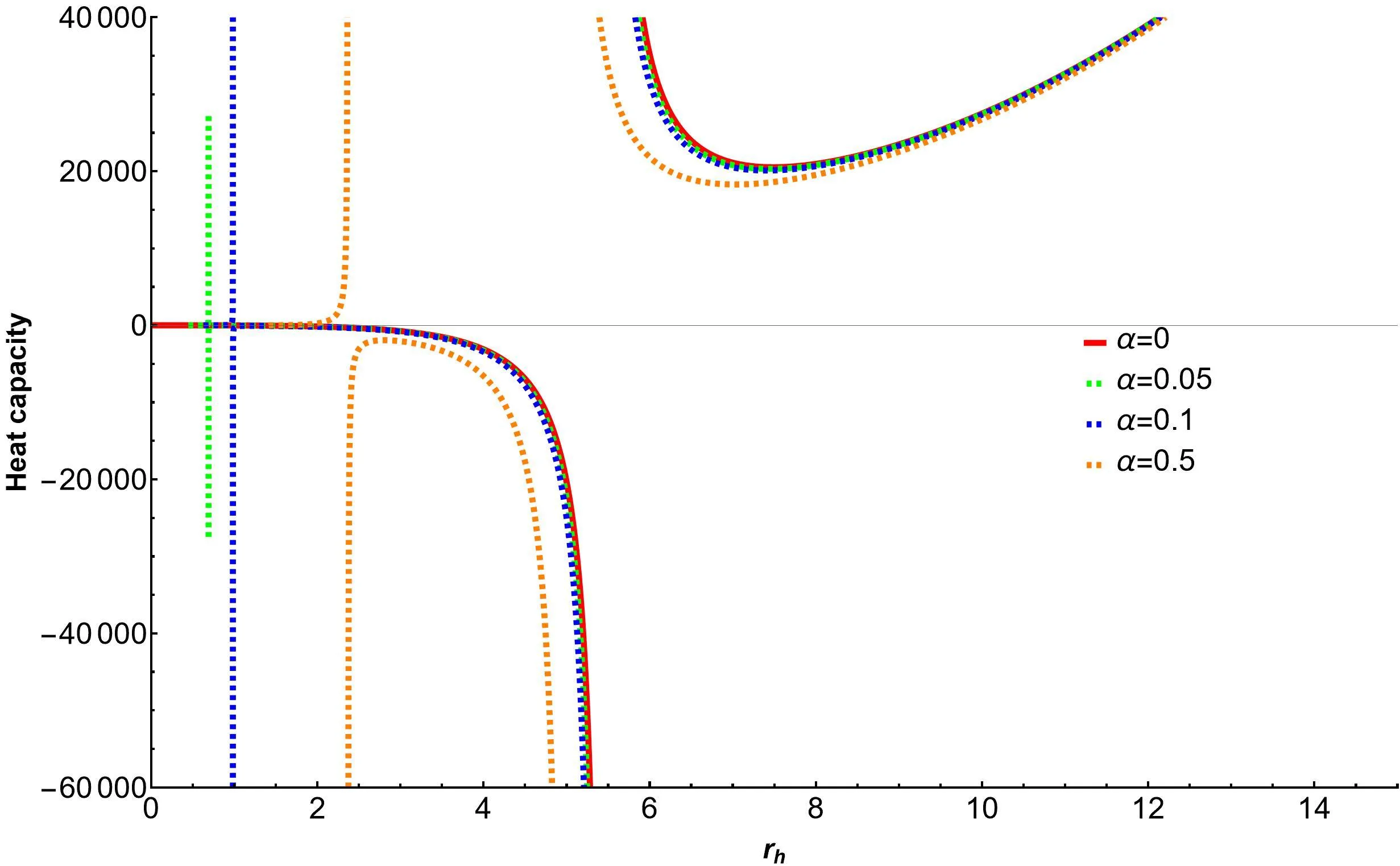
But the most intriguing part is the behavior of heat capacity. For a classical black hole, it is negative: the hole heats up as it loses energy. Here, heat capacity changes sign, passing through zero and then through infinity. This signals a phase transition — much like water turning to steam or freezing into ice. Only here it is not the state of matter that changes but the very nature of the gravitational object. Quantum effects add an extra phase transition that was absent in the classical picture. In the end, the hole does not vanish but remains a cold, stable lump, like a last ember that does not go out but turns into a crystal.
In classical physics, a black hole's temperature is inversely proportional to its mass: a hole with the mass of an asteroid would be hotter than the Sun. But quantum corrections flip this relation at the smallest scales.
In Terry Pratchett's novel "The Pillars of Creation," the world rests on elephants and a turtle — here, a microscopic black hole does not explode but freezes into an eternal cold core, like a sleeping turtle at the heart of space.