The Ocean Conveyor on the Brink express
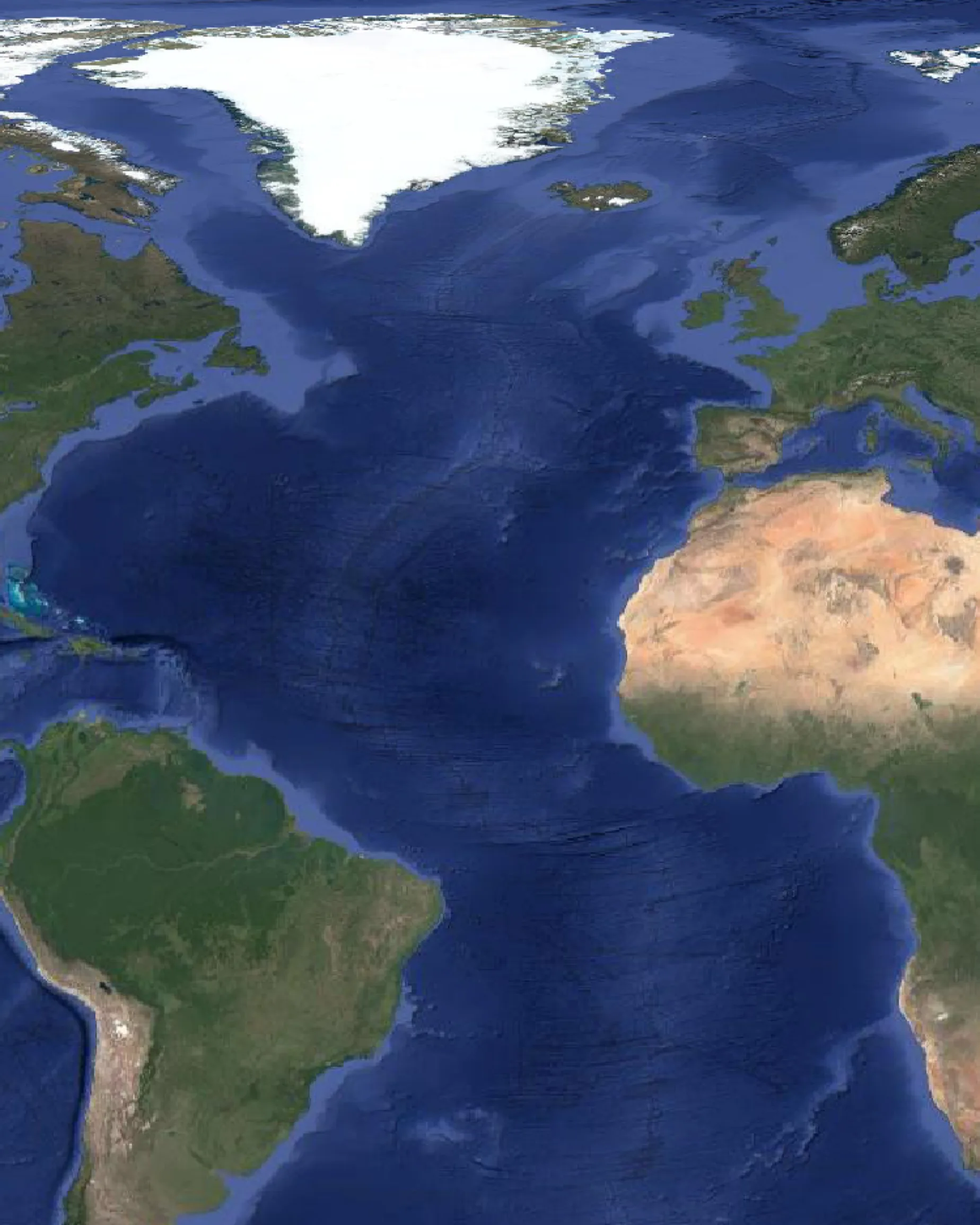
In the Atlantic, a giant invisible conveyor operates: warm surface waters flow north, cool, sink, and return south. This circulation, AMOC, carries heat, making Europe noticeably milder than Canada at the same latitudes. But the conveyor isn't eternal: if diluted by fresh water from melting Greenland ice, the engine stalls. Then Europe would face not warming but abrupt cooling — a climate somersault.
The conveyor has a critical state, like a bicycle that's almost stopped but hasn't fallen yet. In this state, on the edge between stable operation and collapse, the ocean behaves strangely: invisible threads, synchronous temperature fluctuations, stretch between distant points separated by the equator. It's as if two pendulums at opposite ends of a room suddenly swing in sync, though no string connects them.
To detect the approach to the edge, scientists built a climate network: they mapped thousands of points and determined connections by how temperature changes simultaneously. It turned out that in the critical state, far more connections cross the equator than usual. This is like lights flickering in different rooms before a power grid failure — a sign the system is at its limit.
The same pattern, enhanced cross-equatorial connections, appeared in a more detailed Earth model where expansion of the universe carbon footprint led to collapse or recovery of the conveyor. This means climate networks could become a seismograph for the ocean: detecting tremors long before the current stops. Then humanity would have time not just to guess, but to act.
In the movie 'The Day After Tomorrow,' AMOC stops in a few days — in reality, the process would take decades, but the consequences would be just as dramatic.
In Kim Stanley Robinson's novel 'New York 2140,' the shutdown of the Atlantic conveyor is just one of many climate shifts that turn Manhattan into Venice.