phenomenon

intertropical convergence zone

A belt of low pressure near the equator where trade winds converge, causing rising air and heavy precipitation.
13 related articles

Description

The intertropical convergence zone (ITCZ) is a narrow, meandering belt of low atmospheric pressure that circles the Earth near the equator. It forms where the northeast and southeast trade winds—large-scale surface winds blowing from the subtropics toward the equator—meet and converge. Because the converging air is warm and moist, it rises vigorously, cools, and condenses, producing towering clouds and some of the heaviest rainfall on the planet. The ITCZ is not a fixed line; it shifts north and south with the seasons, following the Sun's zenith, and its position largely dictates the wet and dry seasons for tropical regions across Africa, South America, and the Pacific.

History

The concept emerged in the early 20th century as meteorologists mapped global wind and pressure patterns. The term 'intertropical convergence zone' was formalized in the 1940s–1950s, though the underlying phenomenon was recognized earlier through observations of equatorial rainfall and calm winds, sometimes called the 'doldrums' by sailors.

In practice

Forecasting tropical rainfall and tracking monsoon onset rely on monitoring the ITCZ's position, which is critical for agriculture, water management, and disaster preparedness in equatorial nations.

Fun fact

The ITCZ is often visible from space as a near-continuous band of bright clouds, but over the eastern Pacific and Atlantic it can break into distinct clusters, and its average position has been observed to shift by hundreds of kilometers in response to climate variability like El Niño.
Concept graph →

Related articles · 13

Reconnection Layer Thickness: Four Probes versus One
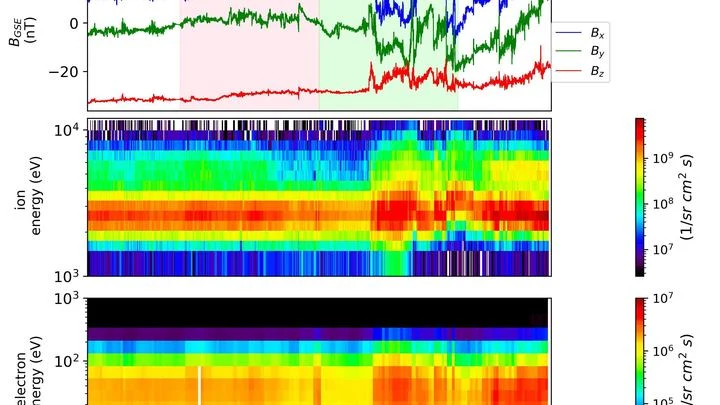
Four witnesses to a single crossing. On November 10, 2017, the four MMS spacecraft flew through an invisible boundary in the solar wind where magnetic field lines reconfigure and release energy.
Exoplanets2026-07-282 minarXiv:2607.25542express
Three Cloud Layers of Jupiter
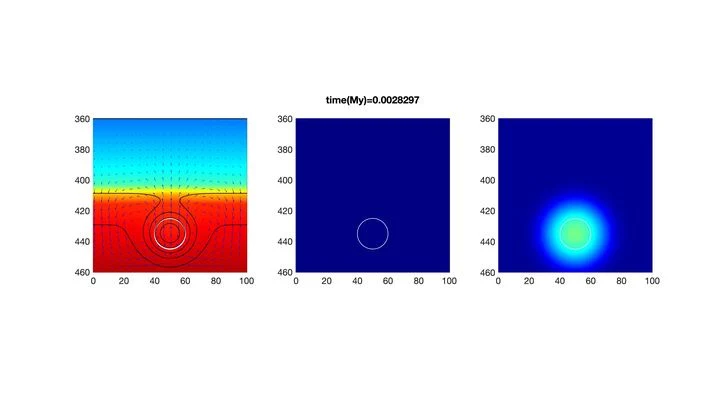
Jupiter's atmosphere resembles a layered cake, where each layer plays its role. Scientists took data from four instruments at once (VLT/MUSE, Cassini/VIMS, IRTF/SpeX, and Juno/JIRAM) and built a model of clouds and ammonia in the planet's equatorial zone, from 0.1 to 10 bar (pressure equivalent to hundreds of kilometers below Earth's…
Are Tropical Cyclones Intensifying? It's Not Just the Atlantic
In 1991, Mount Pinatubo erupted with such force that it blanketed the planet in a thin veil of ash and gases for years. That veil, like a blanket on a hot night, trapped heat and cooled the ocean surface, causing tropical sea surface temperatures to dip. This event marks the start of a detective story about why some oceans are spawning ever more ferocious hurricanes while others remain calm.
The Ocean Conveyor on the Brink
In the Atlantic, a giant invisible conveyor operates: warm surface waters flow north, cool, sink, and return south. This circulation, AMOC, carries heat, making Europe noticeably milder than Canada at the same latitudes. But the conveyor isn't eternal: if diluted by fresh water from melting Greenland ice, the engine stalls.
Stellar2026-02-142 minarXiv:2602.13644express
Four Sentinels of the Solar Wind
October 10, 2024. The Sun hurled a cloud of magnetized plasma toward Earth, and four spacecraft, stationed at a single point between the Sun and Earth, simultaneously recorded how that cloud churned. The distance between the outermost probes was just 80 Earth radii, about half a million kilometers.
Geophysics2026-02-142 minarXiv:2602.13820express
Water in the Mantle: A Hidden Ocean Beneath Our Feet
Deep beneath us, hundreds of kilometers down, lies a layer that can absorb water like a sponge. The minerals there, wadsleyite and ringwoodite, can hold up to 1–2% water by weight within their crystal lattices.
Earth Can Heat Itself Up
Glaciers don't just darken from soot. Their surfaces host tiny algae that, as temperatures rise, bloom and turn the ice dark. Dark ice absorbs more sunlight, melts faster, and further warms the planet. It's like how a black t-shirt in the sun gets hotter than a white one. The second player in overheating is forests.
Exoplanets2026-01-121 minarXiv:2601.07983express
When the Sun Dived into a Cloud
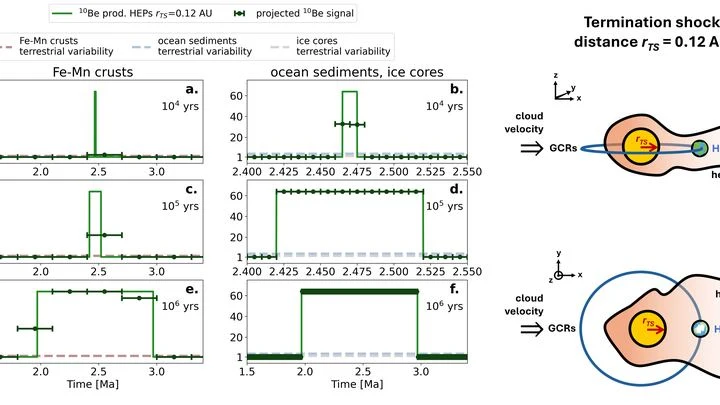
As it travels through the Galaxy, the Solar System occasionally dives into thick interstellar clouds — clumps of tenuous hydrogen and dust.
Tibet's Moist Respite
The Tibetan Plateau is a giant sponge that soaks up rain and snow, then releases water to Asia's rivers. Since 2000, the sponge has been getting wetter. Scientists decided to check: does this moisture make the sponge stronger, or does it soften it? They used a measure of disorder — entropy.
The Climate House of Cards: Where Does the Stability Limit Lie?
Imagine a house of cards where each card supports the others. One wobbles, and the neighbors start to lean. Earth's climate system works similarly: ice sheets, ocean currents, tropical forests, all are connected. If one element crosses a threshold, it can drag the rest down with it.
Climate as a Layered Cake: Continents, Zones, and Seasons in the 20th Century
A baker puts a layered cake in the oven: the dough is the same, the heat is the same, but each layer bakes differently. The thin crust on top is already browning, while the middle is still underdone. Earth's climate is similar: the planet is warming, but different parts of it are warming at different rates and at different times.
Climate as a Conversation: How to Hear Who Is in Charge
A translator who hears only the meaning, not the noise in the hall, can convey a conversation accurately. Climatologists have long sought such a translator for the ocean–atmosphere pair: their interaction resembles a dialogue where voices drown in the roar of extraneous sounds.
How Ripples on Water Steer the Planet's Winds
The planet's winds are not free-flowing currents but rather obedient jets that can be nudged from an unexpected direction. The ocean surface, covered with waves, acts like a tuning knob: change its roughness, and giant air rivers shift by hundreds of kilometers.