A Living Wire Made of Nickel Bricks express
In murky mud, between two electrodes, long chains of bacteria line up: each one as thin as a microscopic cable. Every such filament conducts current over a full centimeter, a true marathon for a microbe. The secret lies in fibers woven right into the cell envelope: electricity runs along them almost without loss, like through a copper wire.
Peering into the fiber with quantum calculations, the researchers saw that it is built from nanoribbons — flat strips just one molecule thick. Each ribbon is assembled, like a child's stacking toy, from identical nickel-organic rings (chemists call them NiBiD blocks). The rings stack in two ways: either directly on top of each other (AA stacking) or offset, like bricks in a wall (AB stacking). The second arrangement turned out to be stronger — extra bonds snap into place between the layers, and each nickel atom holds on with five 'grips' instead of four.
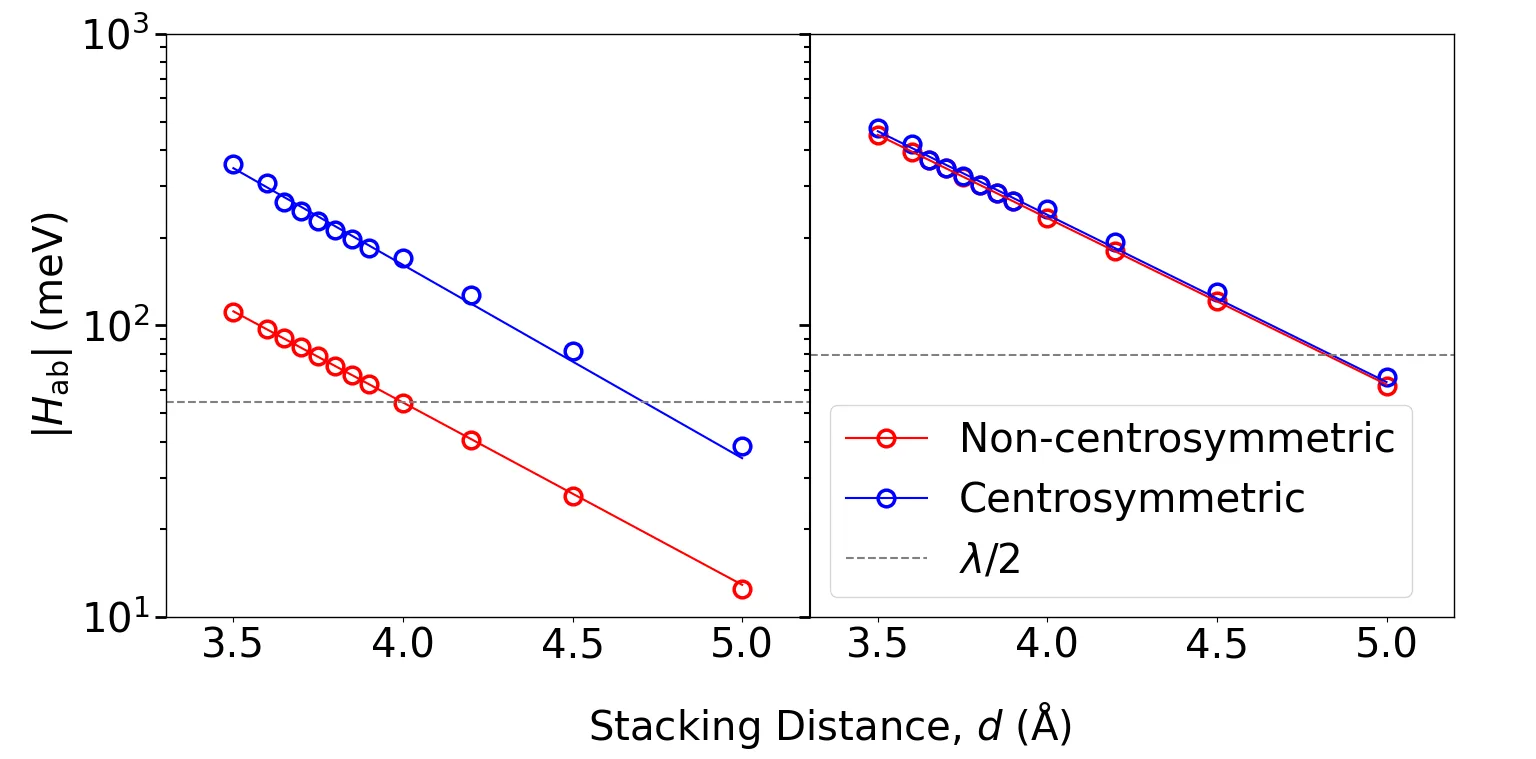
The big surprise is how electrons move. In the most stable stacks, the electron cloud of one ring overlaps so strongly with its neighbor that the charge doesn't stay put but spreads out across the whole ribbon. This isn't hopping from puddle to puddle; it's a smooth flow, almost like in a metal. This very mechanism lets the fiber carry current without overheating and with minimal losses, a boon for future biocompatible conductors.
Original abstract
as written by the authors arXiv:2606.13117
Cable bacteria are multicellular bacteria capable of centimeter-scale conduction through a regular fiber network embedded in their cell envelope. The conductivity of these fibers is extremely high for biological materials, and rivals that of the best synthetic conductive polymers, but the underlying electron transport mechanism remains elusive. Recent microscopic and spectroscopic evidence indicates that each fiber embeds a bundle of intertwined nanoribbons as the conductive conduit. Each nanoribbon consists of a one-dimensional nickel-organic framework, built from stacked nickel bis(1,2-dithiolene) oligomers (NiBiD units) as molecular building blocks. Here we performed DFT calculations of nanoribbon model structures, in order to characterize their electronic properties, examine potential stacking configurations and verify whether these structures can support efficient conductance. Our simulations indicate that nanoribbons are comprised of tightly stacked AA or AB-type packings of NiBiD units. In the most energetically stable structure (AB-type) some Ni centers are predicted to be 5-fold coordinated due to formation of an inter-layer Ni-S coordination bond. In several energetically low-lying structures, the electronic coupling between neighboring molecules exceeds the critical threshold for charge delocalization permitting efficient charge transport beyond small polaron hopping. Our results hence reveal that nanoribbons based on NiBiD units exhibit favorable charge transfer properties that may explain the unusually high conductivities measured in the fibers of cable bacteria.
Cable bacteria are the only known multicellular organisms that move electrons over centimeter distances through their own bodies, not along external pilus wires.