Gravity in Five Dimensions: What the Waves Say express
When a distant galaxy sends us light, it dims with distance, and from that dimming, we can tell how far away it is. Gravitational waves work in much the same way: the farther their source, the weaker the ripple in space that detectors on Earth pick up. But if our world has hidden dimensions, gravity might 'leak' into them, and the waves would fade faster than usual.
The authors took a catalog of 141 mergers of compact objects, black holes and neutron stars, and compared the measured loudness of the waves with distances to galaxies from the GLADE+ catalog. This method is called a 'dark siren': unlike optical flashes, it doesn't require seeing light from the collision. If gravity leaks into a fifth dimension, the waves weaken more than general relativity predicts.
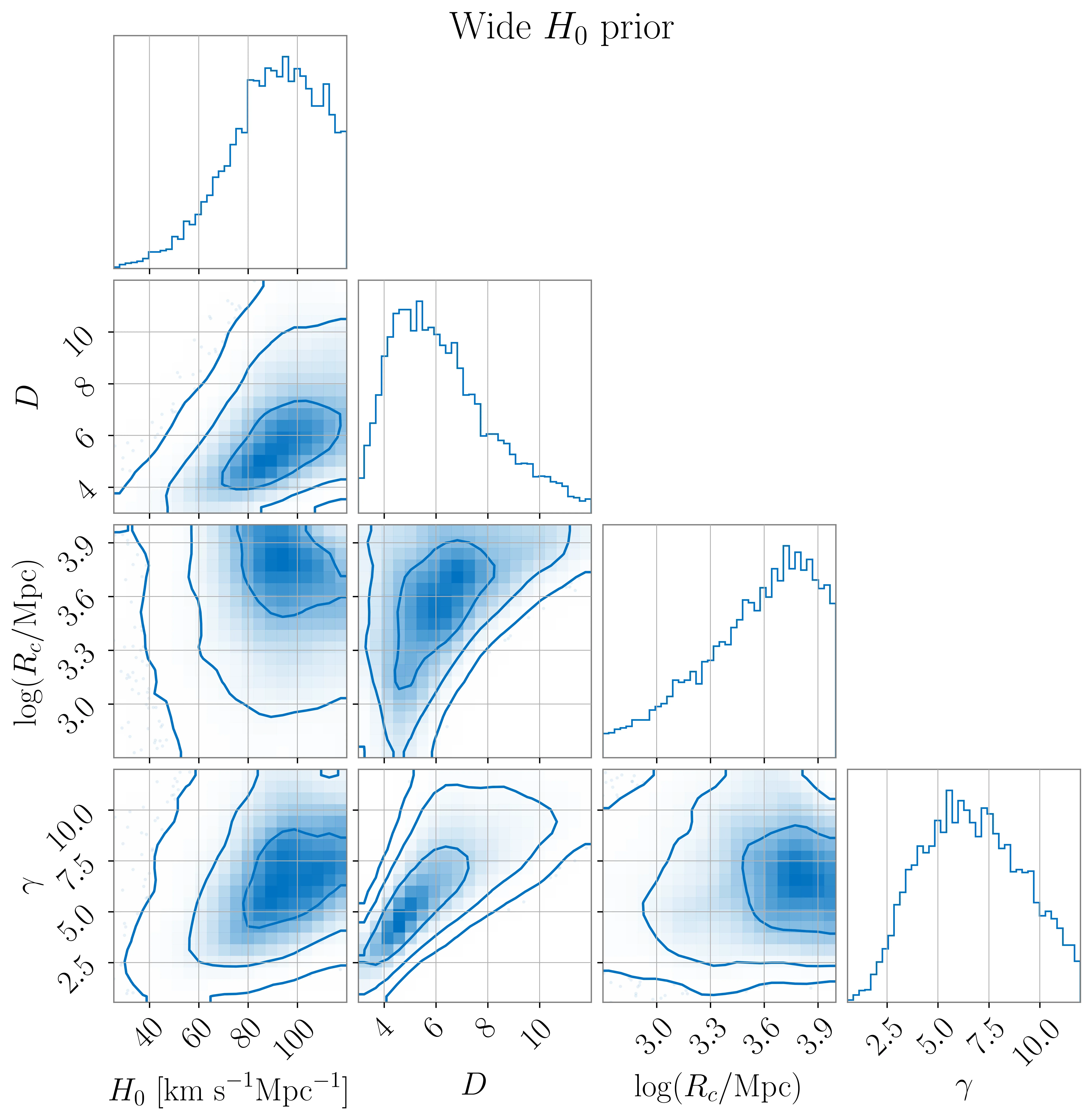
The scientists introduced two parameters: the number of dimensions D and the transition scale $R_c$, at which gravity changes its behavior. The analysis yielded D = 4.38 with a fairly wide uncertainty range — from 3.37 to 6.29. This means the data don't yet contradict the usual four dimensions. The value of $R_c$ remained almost unconstrained: the transition scale could be very large, and current detectors simply don't feel it.
The conclusion is cautious: four-dimensional general relativity has held up again. But the dark siren method is just beginning to gain strength. With each new catalog of observations, sensitivity will grow, and someday we might see that very kink in the wave's fading — a sign that space is more complex than it seems.
Original abstract
as written by the authors arXiv:2606.14549
Higher-dimensional theories of gravity predict that gravitational waves (GWs) can propagate into extra spatial dimensions, leading to modified amplitude damping over cosmological distances. Measurements of GW luminosity distances therefore provide a unique probe of the dimensionality of spacetime. In this work, we constrain higher-dimensional GW propagation using the dark-siren method with the Gravitational-Wave Transient Catalog 4.0 (GWTC-4). We adopt a phenomenological parameterization motivated by braneworld scenarios, in which deviations from General Relativity are characterized by the spacetime dimension number $$D$$ and a crossover scale $$R_c$$ governing the transition between four- and higher-dimensional gravity. We perform a hierarchical Bayesian analysis combining 141 compact binary coalescences from GWTC-4 with line-of-sight galaxy information from the GLADE+ catalog. For a prior $$H_0 \in [65,77]\ {\rm km~s^{-1}Mpc^{-1}}$$ and $$\log(R_c/{\rm Mpc}) \in [2.7,4.0]$$, we obtain $$D = 4.38^{+1.91}_{-1.01}$$ (68\% credible interval). We also find that the inferred posterior distribution of $$R_c$$ accumulates near the upper prior boundary, indicating that the crossover scale remains poorly constrained by current observations. We further show that the inferred constraint on $$D$$ depends sensitively on the assumed prior range of $$R_c$$, which determines the characteristic distance scale at which deviations from General Relativity become significant. Our results provide the first GWTC-4 dark-siren constraints on higher-dimensional GW propagation and demonstrate that current observations remain consistent with four-dimensional General Relativity.
If gravity propagated in five dimensions, the force of attraction would fall off with distance faster, as a cube, not a square. Planets would fly apart, and stars would never gather into galaxies.