An observing run is a scheduled period of data collection by gravitational wave detectors, during which the instruments operate continuously to capture signals from cosmic events. These runs are the primary operational mode of observatories like LIGO and Virgo, typically lasting several months to a year. During an observing run, the detectors are tuned to maximum sensitivity, and data are streamed to analysis pipelines that search for gravitational wave candidates in real time.
History
The first observing run (O1) of Advanced LIGO took place in 2015 and led to the first direct detection of gravitational waves in September 2015. Subsequent runs (O2, O3, O4) have increased sensitivity and detection rates, with Virgo and KAGRA joining the network.
How it works
Observing runs are carefully planned to maximize scientific output. Before a run, detectors undergo calibration and commissioning to reduce noise. During the run, data are recorded with timestamps and auxiliary channels to monitor environmental disturbances. Real-time analysis pipelines, such as GstLAL or PyCBC, filter the data for signals matching predicted waveforms from compact binary mergers. Candidate events trigger alerts to the astronomical community for follow-up observations across the electromagnetic spectrum.
In practice
Observing runs are the backbone of gravitational wave astronomy, enabling the detection of black hole and neutron star mergers, the measurement of the Hubble constant, and tests of general relativity in strong-field regimes.
Fun fact
During the third observing run (O3), which lasted about 11 months, LIGO and Virgo detected 79 candidate gravitational wave events, more than tripling the number of detections from previous runs combined.
Imagine an interpreter distracted by every rustle in the hall, turning a one-hour meeting into two. That's roughly how gravitational wave detectors behaved when analyzing long signals: each turn of the Earth added noise to the calculations, and processing a day-long neutron star merger threatened to stretch into weeks.
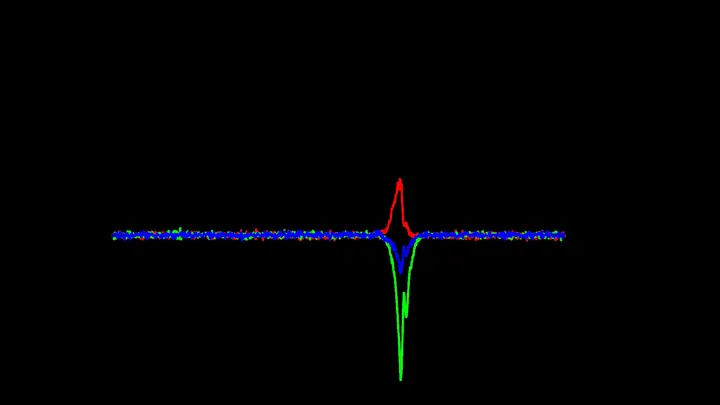
Somewhere in the depths of the Milky Way, radio pulses flare up from time to time — rare, steady, like the ticks of a distant metronome. These long-period radio transients were discovered only recently, and they immediately puzzled astronomers.
A huge bowl of water. Drop a stone into it — ripples spread across the surface. The fabric of spacetime works much the same way: when two massive stars merge, they create ripples — gravitational waves. These waves travel to Earth and are picked up by giant detectors like LIGO and Virgo.
Two tiny weights, each about the mass of a grain of sand, hang in the dark at a temperature colder than deep space. They don't touch, but an invisible thread connects them — gravity. The experiment physicists are now building aims to catch the moment when that thread tugs one weight due to the motion of the other.
In 2034, a rocket leaves a spaceport with an unusual payload: two spheres the size of a large globe, each weighing nearly a ton. No engines, no electronics. Just a mirrored surface of hundreds of corner-cube reflectors — tiny prisms that return light exactly to where it came from. This is the future space tuning fork.
The Sun is not just a blazing ball, but a colossal orchestra, where the strings are solar filaments — giant arches of dense plasma floating in the scorching corona. They tremble, and each oscillation is an encrypted melody of magnetic fields.
In pursuit of gravitational waves, ripples in spacetime left by black holes and neutron stars, detectors like LIGO pump their arms with light of dazzling intensity.
When a distant galaxy sends us light, it dims with distance, and from that dimming, we can tell how far away it is. Gravitational waves work in much the same way: the farther their source, the weaker the ripple in space that detectors on Earth pick up.
LIGO, Virgo, and KAGRA detectors act like giant microphones, listening in on gravitational waves — vibrations of space itself. The new GWTC-5.0 catalog recorded 161 black hole mergers, bringing the total count to 390 events.
Gravitational waves are the very trembling of space, born when black holes or other massive bodies collide. Their main oddity isn't that they pass through us, but that they permanently alter the curvature of spacetime and the distances between everything they touch.
Spacetime is not a passive void but a dynamic membrane capable of elastic deformation. When neutron stars (ultra-dense objects the size of a city, where matter is compressed to nuclear density or black holes) regions with gravity so strong that even light cannot escape their bounds collide, the membrane shudders, generating…
When black holes collide, the very fabric of spacetime trembles. That rumble, gravitational waves, gets picked up by detectors, but decoding the signal used to take hours of computer simulation.
An album with hundreds of family photos holds countless stories. If you look at each picture on its own, you might easily decide that Uncle is a real giant: that day he happened to stand a step higher than everyone else. But flip through the whole album, and it becomes clear — his height is perfectly ordinary; it's just that a step showed up in a couple of frames.
After a supernova explosion, a neutron star neutron star remains: a city-sized ball of unimaginably dense matter, spinning hundreds of times per second. Any tiny bump on its surface would make it wobble like an off-balance spinning top, humming faintly through the fabric of space.
At India's Gauribidanur Radio Observatory, 32 antennas that look like giant TV dishes are listening to the sky. They catch radio waves from pulsars — dead stars that spin at breakneck speed and blink like lighthouses. Previously, signals from these antennas were processed slowly and awkwardly.
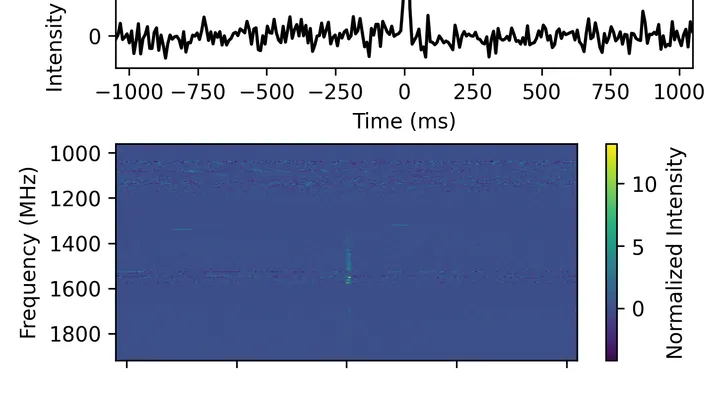
At night, while most people sleep, the giant dish of the Green Bank radio telescope in West Virginia keeps listening to the sky. Over 24,186 hours, that's nearly three years of continuous observation, it caught 50 pulsars and three fast radio bursts.
Two black holes circle each other, and their dance isn't always a smooth waltz. If the holes spin on their own axes, their orbit can start to tumble, like a top that's been pushed and wobbles on its side while still spinning.
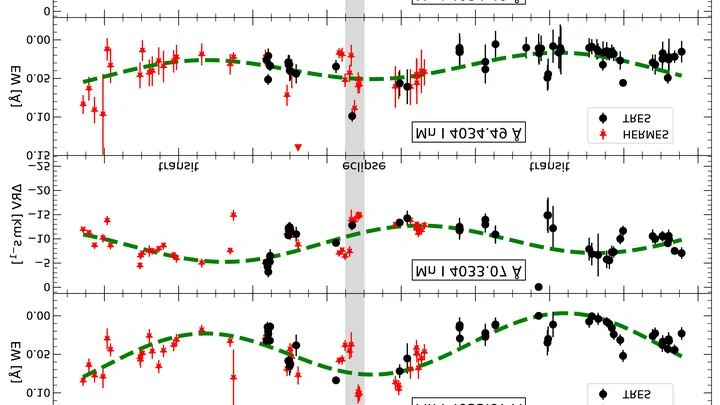
Betelgeuse is a giant star ready to explode as a supernova. But it may not be alone: a small companion star, Sivarkha, circles in a tight orbit. Every 2000 days, it plunges through Betelgeuse’s outer layers, like a boat cutting through water, leaving waves of superheated gas.
Deep in the Siberian taiga, there are a hundred light traps: each about the size of a small table, but together they cover a square kilometer. At night, these traps gaze at the sky, catching faint flashes of light born when cosmic particles slam into the atmosphere. The setup is called TAIGA-HiSCORE, and it usually works as a giant "eye" for such particles.