Modified gravity theories are a family of alternative descriptions of gravity that depart from Einstein's general relativity. They are primarily proposed to explain cosmic acceleration (dark energy) or the dynamics of galaxies and clusters without invoking invisible dark matter. Instead of adding new substances to the universe, these theories modify the laws of gravity themselves, often by adding extra fields, changing the number of dimensions, or altering the Einstein-Hilbert action.
History
The idea of modifying gravity dates back to the early 20th century, but modern interest surged in the late 1990s after the discovery of cosmic acceleration. Notable early proposals include Brans-Dicke theory (1961) and later f(R) theories, which gained prominence in the 2000s as alternatives to the cosmological constant.
How it works
In general relativity, gravity is the curvature of spacetime caused by mass and energy. Modified theories change this relationship. For example, f(R) gravity replaces the Ricci scalar R in the action with a more complex function f(R), introducing new degrees of freedom that can mimic dark energy. Other approaches add a fifth dimension (as in braneworld scenarios) or introduce a massive graviton, altering how gravity behaves at large distances or in strong fields.
In practice
Modified gravity theories are tested using gravitational wave observations, galaxy cluster dynamics, and cosmic microwave background data. They are also used in cosmological simulations to predict observable signatures that distinguish them from dark energy models.
Fun fact
Some modified gravity theories predict that gravitational waves travel at slightly different speeds than light, a prediction that was tightly constrained by the 2017 neutron star merger GW170817.
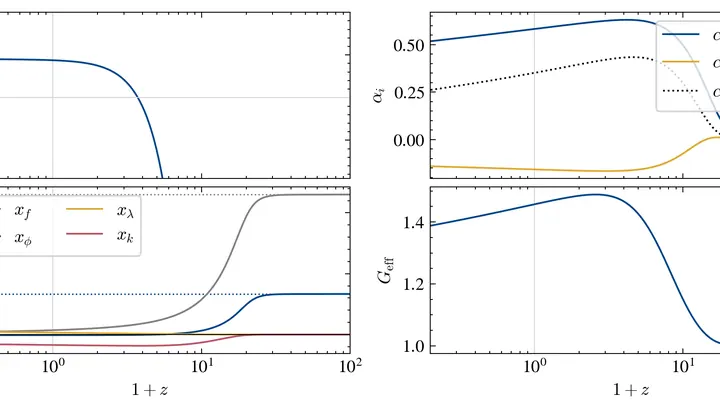
Space is expanding, and that expansion is accelerating. But what if, in the first instants after the Big Bang, gravity behaved differently? The authors of a new study added an invisible field to Einstein's equations that siphons energy from ordinary matter and radiation.
A scale that weighs not a body, but the very space around it. That's how Einstein's equations work in general relativity: they link the curvature of spacetime to what resides within it.
In 2017, detectors picked up a gravitational wave from the collision of two neutron stars. Just 1.7 seconds later, telescopes saw a flash of gamma-ray burst from the same spot. That tiny delay became a treasure for physicists.
Imagine a pot of boiling water. Toss in a handful of pasta, and it quickly overcooks and clumps into a sticky mess. But in a huge restaurant kettle where the pasta floats freely, each piece stays separate.
In the first moments of the universe's life, there was not even a hint of dark energy — the very force that today pushes galaxies apart ever faster. But if you look deeper, down to the Planck scale (billions upon billions of times smaller than an atomic nucleus), spacetime ceases to be smooth.
At the centers of many galaxies lurk black holes — regions with gravity so strong that even light cannot escape. Stars often orbit them, and sometimes one of those stars is a pulsar, a cosmic lighthouse sending out strictly periodic radio pulses. When such a pulsar moves behind a black hole, its signals reach us with a delay.
A large underground tank of liquid xenon waits for a rare event — a nudge from a dark matter particle. Normally, gravity is too weak to notice such a nudge. But if space has hidden dimensions, everything changes: at tiny distances, gravity suddenly strengthens, and the chance of catching an elusive particle grows.
When a distant galaxy sends us light, it dims with distance, and from that dimming, we can tell how far away it is. Gravitational waves work in much the same way: the farther their source, the weaker the ripple in space that detectors on Earth pick up.
An inflating balloon starts out slowly, then suddenly expands faster and faster, as if someone is pumping it up from inside. That's roughly how our universe behaves: galaxies are receding with acceleration. The culprit behind this acceleration is called dark energy.
Baking bread starts with nearly homogeneous dough, in which tiny gas bubbles are already hidden. They grow, and the rate of their growth determines the future structure of the crumb. In cosmology, the role of such bubbles is played by the seeds of galaxies — barely noticeable density enhancements in the hot 'soup' of the early universe.
A black hole is not a frozen sphere. It's more like a soap bubble, whose walls can expand and contract. It even has two layers: the outer horizon, beyond which light cannot return, and the inner one, hidden deeper. When the hole swallows matter or loses energy, both layers shift, like the film of a bubble changing size.
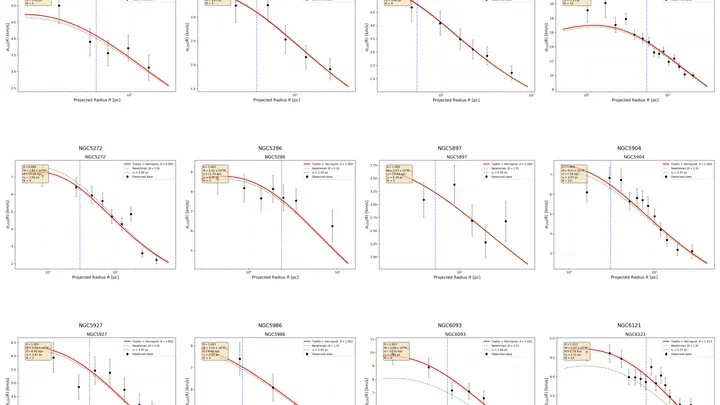
Stars on the outskirts of galaxies rotate unexpectedly fast. According to Newton, the farther from the center, the slower the motion should be, like in a round dance, where the outer dancers move more slowly. But in reality, stellar outskirts race along almost as fast as the core, resembling a giant carousel: on it, the outer horses fly faster so as not to fall behind the inner ones.
In the dark depths of space lurks invisible matter. It doesn't shine, but its pull holds galaxies together. Usually, we assume dark matter obeys the same laws of gravity as tables and chairs. A new study offers a different perspective: dark matter might subtly alter gravity itself.