Gravitational memory makes wormholes more stable express
Wormholes — tunnels through curved spacetime, allowed by general relativity. To be stable, they need repulsive energy — the kind that pushes apart rather than attracts. A source can be the Casimir effect, discovered by Hendrik Casimir: two plates in a vacuum are drawn together as if the space between them pushes them outward.
A gravitational wave passing through a wormhole leaves behind a strain — gravitational memory: a trace that doesn't fade away. Inside the tunnel, this trace adds ordinary energy to the repulsive kind, blending them. Near the throat, the repulsion is stronger, while along the sides the tunnel is held more gently — the wormhole becomes stable.
Recalculating the shape, the authors showed: such a wormhole casts a shadow like a black hole, precisely matching the silhouette of M87* measured by the Event Horizon Telescope. A surprise: if several waves have passed, the imprints stack up, and the shadow may quiver. Perhaps telescopes are already seeing these objects, not yet distinguishing them from black holes.
Original abstract
as written by the authors arXiv:2606.15552
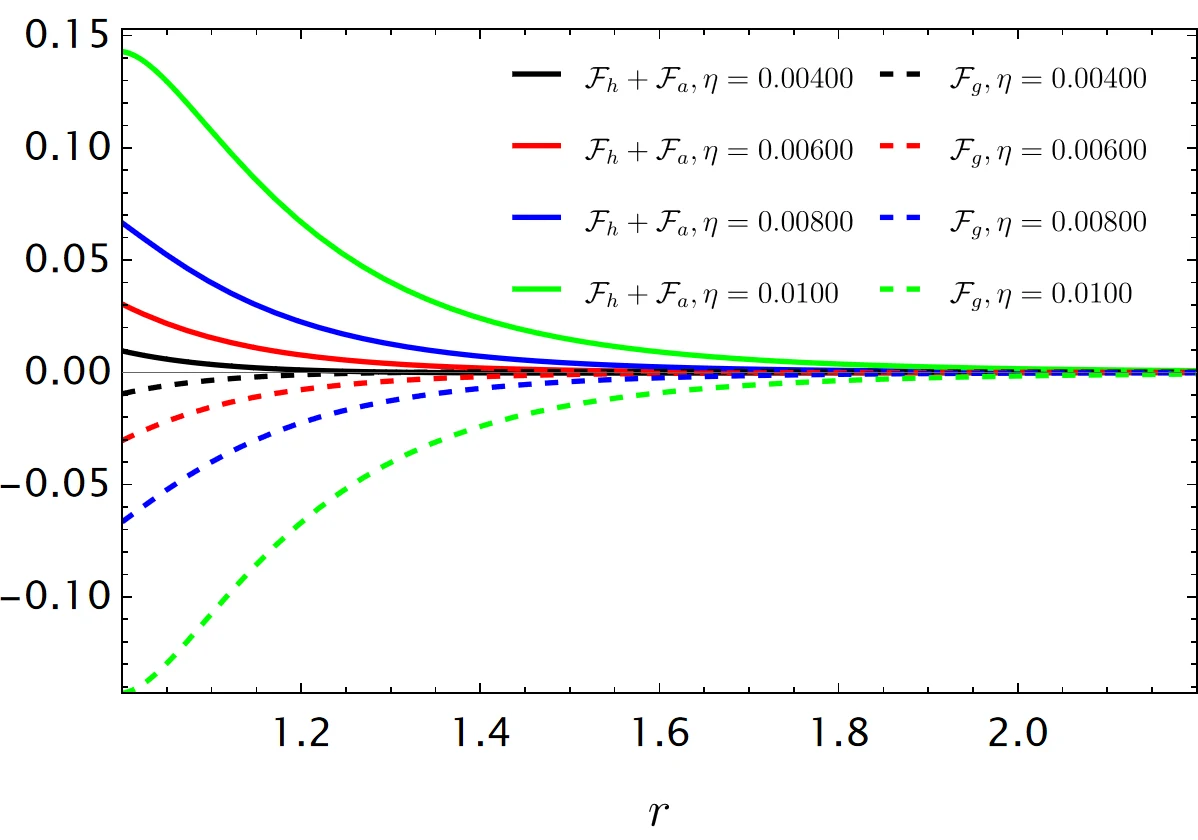
We investigate a class of traversable wormhole geometries supported by an effective Casimir source corrected by gravitational memory. The construction is motivated by the fact that a time-dependent gravitational background can leave a permanent positive shift in the vacuum polarization of a quantum field confined to a Casimir cavity. By promoting the plate separation to an effective radial scale in the Morris-Thorne spacetime, we obtain a density profile composed of the usual negative Casimir contribution, proportional to $$r^{-4}$$, and a positive memory-induced correction, proportional to $$r^{-7}$$. The corresponding shape function is derived directly from the Einstein equations and satisfies the throat condition by construction. We determine the redshift function from a constant barotropic equation of state together with the requirement of regularity at the throat, which fixes the barotropic parameter in terms of the Casimir and memory coefficients. The flare-out condition defines the admissible range of the memory parameter and separates a Casimir-dominated sector from a phantom-like sector, with the transition point associated with a singular limit of the constant-barotropic description. We analyze the curvature scalar, the embedding structure, the energy conditions, and the Tolman-Oppenheimer-Volkoff equilibrium of the anisotropic matter source. The radial null energy condition is necessarily violated at the throat, while the tangential sector depends sensitively on the redshift gradient. We also examine the shadow radius as a phenomenological diagnostic and show that admissible solutions can overlap the EHT range for M87*. The results indicate that gravitational memory can deform Casimir-supported wormholes by softening the ordinary Casimir contribution, modifying the near-throat geometry, and reshaping the internal stress balance required to sustain traversability.
The Casimir effect was predicted by Hendrik Casimir in 1948 over a cup of coffee while discussing the properties of the vacuum.
The wormhole as a portal is familiar from the movie Interstellar, where the scientific basis was laid by Kip Thorne.