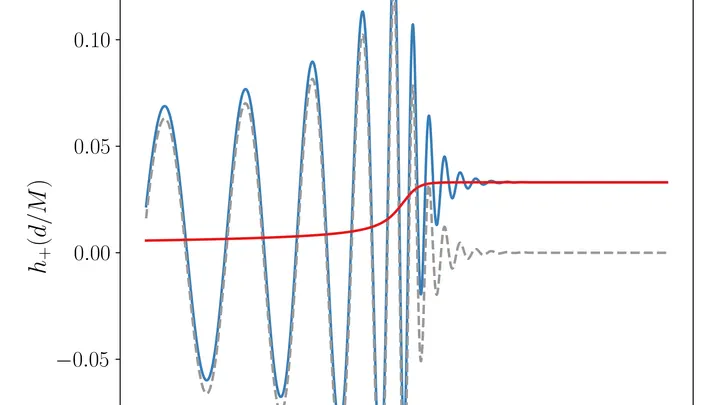
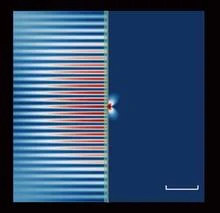
Gravitational memory is a subtle but profound effect of general relativity: when gravitational waves pass through spacetime, they not only cause temporary oscillations but also leave a permanent, residual displacement in the relative positions of test masses. This means that after the wave has passed, the spacetime does not return exactly to its original state—it 'remembers' the event. This effect is sometimes called the 'memory effect' or the 'Christodoulou memory'.
History
The concept was first discussed by Ya. B. Zel'dovich and A. G. Polnarev in 1974, who considered the effect for passing particles. The nonlinear contribution was later rigorously derived by Demetrios Christodoulou in 1991, and the effect is now a standard prediction of general relativity.
How it works
The memory effect arises from the nonlinear nature of gravity. The gravitational waves themselves carry energy, and this energy contributes to the spacetime curvature. When a burst of gravitational waves passes, the energy distribution changes, leading to a permanent change in the metric. For a detector, this manifests as a step-like change in the separation of two test masses, which persists after the oscillatory part of the wave has faded. There are also linear contributions from the motion of the source, but the nonlinear part is particularly interesting because it is a direct consequence of the self-interaction of gravity.
In practice
Detecting gravitational memory would provide a unique test of general relativity's nonlinear structure. It is a target for future gravitational wave observatories, as the effect is small and requires long-duration observations or very sensitive detectors.
Fun fact
The memory effect is so subtle that for a typical binary black hole merger, the permanent displacement it leaves on a detector like LIGO is only about a billionth of a proton's diameter.
A thousand years ago, Vikings took Iceland spar to sea. The translucent crystal split light into two rays. By their brightness, they could find the sun even in fog. Birefringence — the physical term for this phenomenon — now helps hunt for the most elusive force in the cosmos.
When massive bodies accelerate (say, two stars orbiting each other) the space around them doesn't stay calm. It trembles like the surface of a pond after a stone is thrown. These tremors are called gravitational waves. They carry energy away, and the source gradually loses mass.
Wormholes — tunnels through curved spacetime, allowed by general relativity. To be stable, they need repulsive energy — the kind that pushes apart rather than attracts.
Immediately after the Big Bang, space may have vibrated like a string from quantum effects. As these oscillations faded, they would have left a mark on the expansion of galaxies — a memory effect. The search for this echo in telescope data turned up nothing.
Gravitational waves are the very trembling of space, born when black holes or other massive bodies collide. Their main oddity isn't that they pass through us, but that they permanently alter the curvature of spacetime and the distances between everything they touch.
A ball on a slope with two pits usually rolls into the nearest one and comes to rest. But if the slope is slightly deformed and 'remembers' recent nudges, the ball can hang around halfway for a long time — in a narrow spot it doesn't want to leave. That's exactly the trick physicists played with light.
A black hole collision isn't just a burst of gravitational waves; it also leaves a lasting trace: an eternal curvature of spacetime — gravitational memory. Like a boat on water leaves a lingering wake, the cosmos 'remembers' the catastrophe.
Drop a stone into a pond, and ripples spread across the water. As the stone sinks, the waves radiate outward and gradually fade. But if you look at the very fabric of spacetime, it turns out things work a bit differently.
Spacetime resembles a giant crystal. Gravitational waves, born from collisions of black holes, not only make it tremble — they leave indelible defects: edge ones, as if an extra plane of atoms was inserted into the crystal, and screw ones, where the layers twist.
Drop a stone into a pond — the ripples spread and fade away. A black hole, after colliding with another hole or a star, also 'rings', but its oscillations are not simple. Near the hole, 'overtones' sound — secondary waves born from the nonlinearity of spacetime itself.
A superconducting contact is like a narrow bridge between two shores, carrying current without friction. Place such a bridge near a massive star, and it will feel time flowing slower near the star's surface. Clocks on the shores tick at different rates, and the current begins to oscillate differently.
But if the star rotates slowly, the picture gets more complicated.
A handful of sand on a vibrating table is like a crowd on a dance floor that still holds the rhythm of the old song for a second after the DJ has switched to a new one. Scientists made a thin layer of grains bounce on a vertically shaking platform and abruptly changed the shaking intensity.
Fluid flows in the narrow gaps between brain cells. It doesn't stay still: each heartbeat pushes it forward, and breathing adds its own waves. This was seen in images ten years ago, but only now have researchers calculated how this pulsing accelerates molecules.
If you drop ink into a stream, it drifts with the current. But if the stream speeds up and slows down, the ink spreads wider.
A sugar solution can twist light — many have seen this in polarization experiments. Surprisingly, a similar trick appears in the fabric of the cosmos itself.
Time flows slower near the ground than on the roof: this was predicted by Einstein in his theory of relativity. To spot the tiny difference, physicists propose using a pair of photons, linked like voices in a duet.
A single photon passes through two slits and leaves an interference pattern on a screen. Quantum mechanics describes this process with a wave function, but what happens to the particle itself?