Superconductivity Under Voltage: Current and Resistance Together express
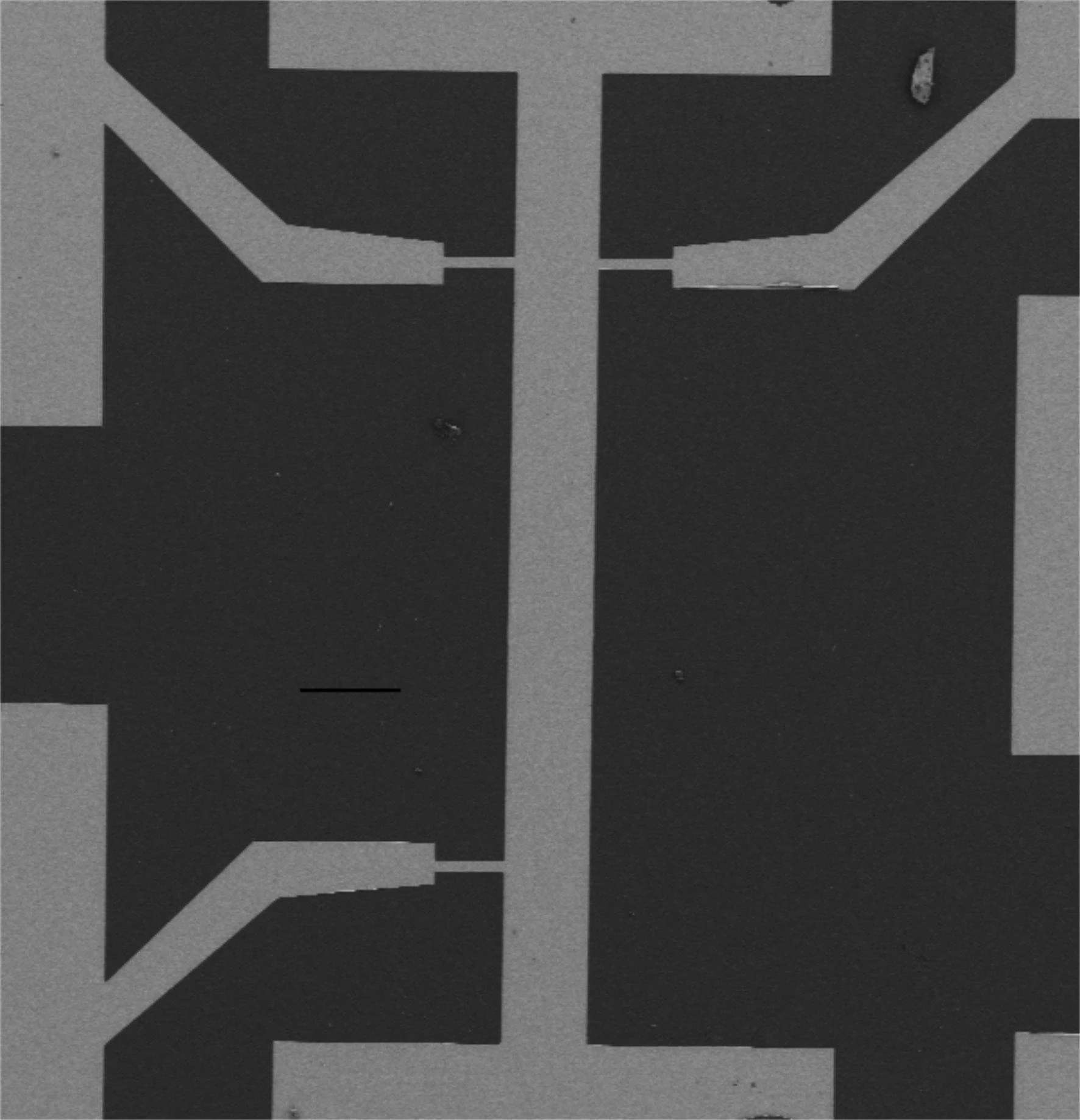
A superconductor is like an ideal highway with no traffic lights: electrons race along without hindrance. But apply a voltage, and the picture changes. In a new experiment, physicists found that an electric field penetrates the superconductor and creates a mixed regime inside.
In this unusual state, part of the current remains superconducting, while part dissipates energy like in a normal metal. All of this happens in a simple three-dimensional sample without microscopic patterns. The effect is caused by oscillations of the order parameter, the quantity that sets the strength of superconductivity, under the influence of the field.
This hybrid regime has become a testing ground for studying quantum fluids far from equilibrium. Previously, such behavior was only achieved in complex structures. Here, nature itself organized the coexistence of order and chaos.
Original abstract
as written by the authors arXiv:2606.18931
The coexistence of superconductivity and finite electric fields may enable access to intriguing forms of electronic states. We demonstrate the emergence of an intermediate state in which electric fields penetrate the system while superconductivity still persists. Our measurements reveal a nonclassical regime characterized by the simultaneous presence of supercurrent and dissipative charge transport. This state, realized in a pristine unpatterned three-dimensional system, arises from electric-field-driven order parameter fluctuations. It provides a platform to explore dissipative states of charged quantum fluids far from equilibrium.
Superconductors expel magnetic fields: this is called the Meissner effect. But an electric field, on the contrary, can partially penetrate inside, as this work showed.