Quantum Capacitance Peers Inside a Topological Qubit express
Two pendulums hang from the same crossbar. A push, and they start swinging, gradually falling into and out of sync. In a topological qubit, Majorana particles, special excitations that can store quantum information, play the role of these pendulums. But how can you tell whether these "pendulums" are well isolated from each other and how clearly their energy levels are separated? Usually, this requires complex manipulations, but the authors of the study found a more direct path.
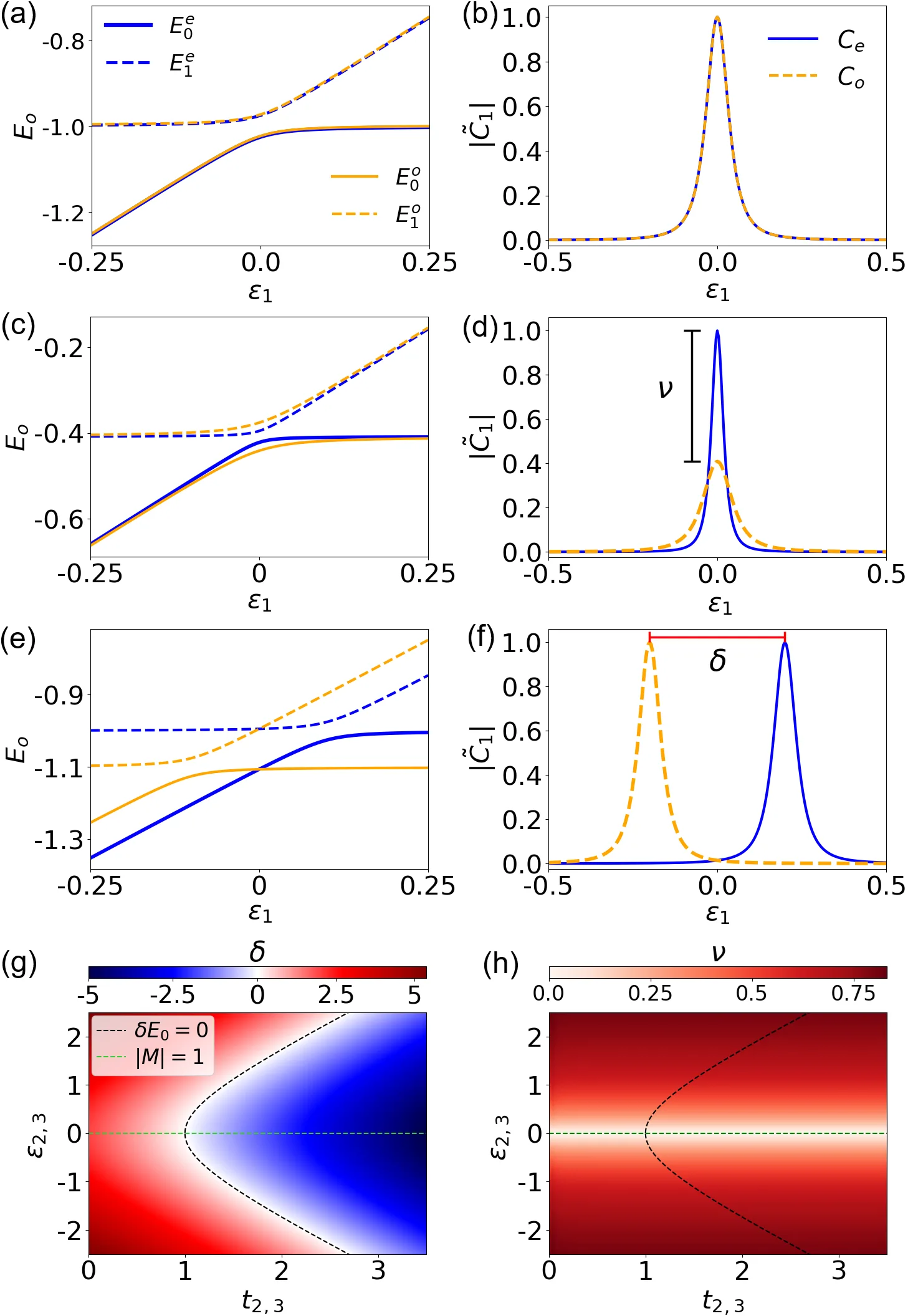
They proposed measuring quantum capacitance — the charge response to a change in voltage. It's like how the tension of a string changes when you slightly turn the tuning peg. An auxiliary quantum dot (a microscopic sensor) is placed next to the qubit, and by measuring the capacitance, you can see two key parameters at once. The first is the ground-state splitting, that is, the energy difference between the two lowest levels of the qubit. The second is the overlap of Majorana particles, which shows how strongly they "feel" each other. Both parameters are extracted from the position and height of peaks on the capacitance graph: one peak corresponds to an even number of particles, the other to an odd number.
This approach not only simplifies diagnostics but also preserves fermion parity: that is, it does not destroy the very quantum state we are trying to measure. The authors confirmed their idea on a microscopic model of Kitaev chains and showed that the method works for a broad class of Majorana-based devices. Now, instead of guessing about qubit quality, you can simply "listen" to its capacitive response, like a tuner listening to the beats of strings to achieve perfect sound.
Original abstract
as written by the authors arXiv:2606.21580
Quantum capacitance (QC) has recently emerged as a promising tool for parity readout in topological qubits based on Majorana bound states (MBSs). Here, we show that this capability can be extended further: by employing an auxiliary quantum dot (QD) as a sensor, we demonstrate that QC measurements simultaneously resolve two fundamental figures of merit of the device, the ground-state energy splitting and the MBS overlap, thus providing direct access to the underlying internal degrees of freedom. Using a low-energy effective model, we provide analytic expressions for these two figures of merit that can be determined from the relative position and magnitude of the QC maxima in the even and odd parity sectors as functions of the auxiliary-QD energy. We further validate these results with a microscopic model of QD-based Kitaev chains and qubits, demonstrating their applicability in a wide range of MBS-based devices. Our results establish QC as a probe of MBS quality and a tool for topological-device optimization that preserves fermion parity.
Majorana particles are named after Ettore Majorana, who predicted them in 1937, but mysteriously disappeared a year later under unclear circumstances.
In the series "The Expanse," an alien protomolecule uses quantum effects reminiscent of Majorana states for instantaneous communication across space.