How a trembling bubble clings to a fold express
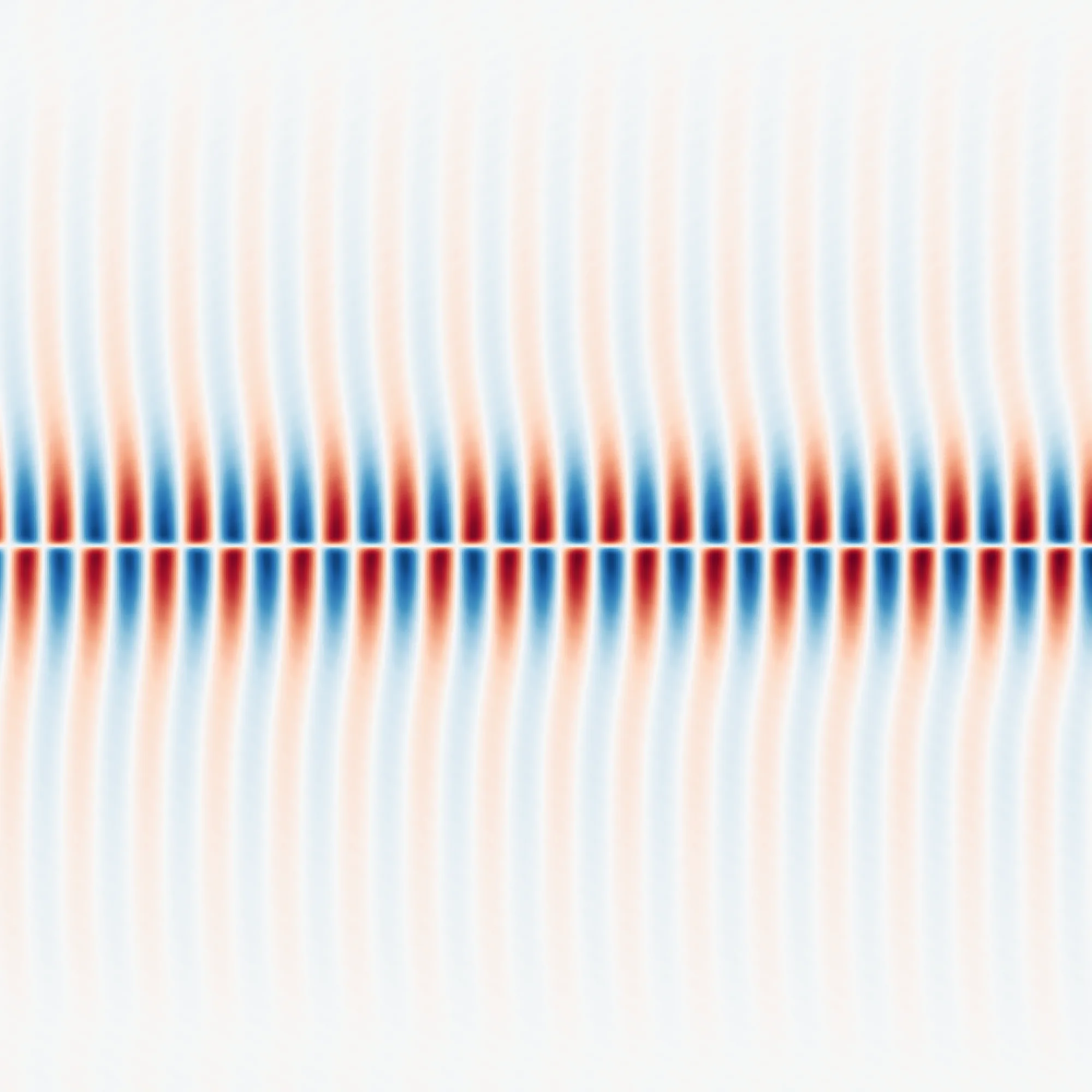
A lone fold runs across a taut sheet — a sharp drop in height that doesn't spread out but moves as a whole. Physicists call such a fold a 'kink'. If you give the sheet a sharp tug in one spot, ripples will travel across it. But in some media, these ripples don't disperse; instead, they gather into a clump and tremble in place for dozens or hundreds of cycles. Such a clump is an oscillon.
For a long time, oscillons were considered independent objects that live on their own in empty space. The authors of the new work looked at them differently: an oscillon is not a separate ball but a special mode of oscillation that is 'trapped' by the medium's nonlinearity. Like sound in a perfectly tuned pipe: at a certain frequency, the sound amplifies and stands still, even though outside the pipe it would fly away.
The main surprise of the work is the discovery of 'wobblerons'. That's what the authors call an oscillon that is bound not to emptiness but to a kink. The kink acts as an anchor: the oscillon trembles next to it without drifting away. Moreover, an oscillon can be born from an anti-bound mode — a state with positive energy that is not confined under ordinary conditions. Nonlinearity again traps it in a cage.
Why does this matter? Oscillons appear in a wide variety of systems: from the early universe, where they could influence the distribution of matter, to vibrations in crystals and cold atomic clouds. Understanding how an oscillon 'sticks' to a field fold helps control such processes and, possibly, search for their traces in experiments.
Oscillons live astonishingly long — sometimes more than ten thousand oscillation periods, even though nothing prevents them from dissipating. Their stability is like juggling: the ball is always falling, but deft hands keep tossing it back up.