Cosmic Scales: How Black Holes Swap Roles express
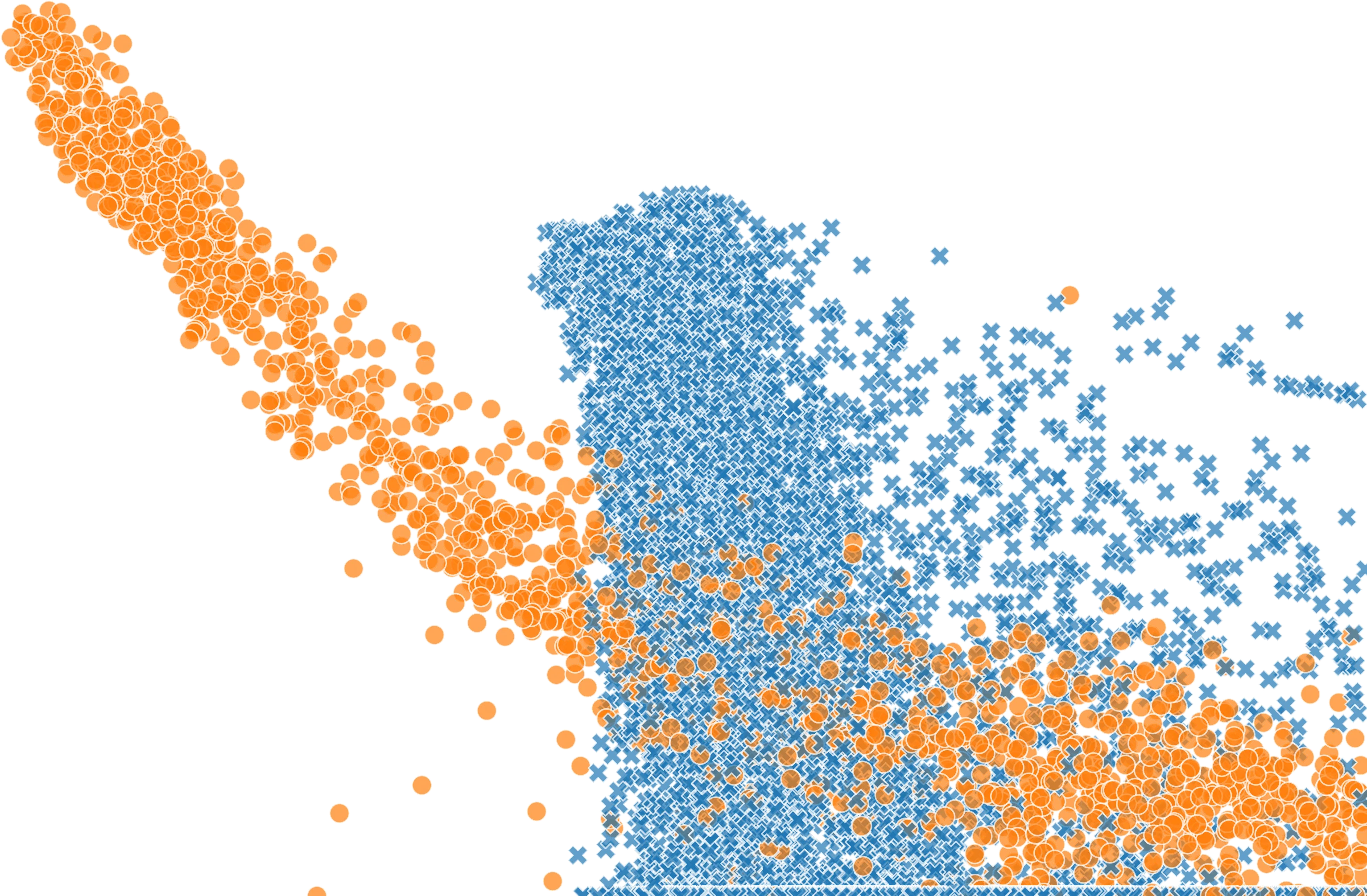
Gravitational-wave detectors picked up a strange burst — the signal GW241011. Two black holes merged, but the pair looked unusual: one hole was about three times lighter than the other, and the system as a whole was spinning rapidly. Such a combination is a rare guest in the catalogs.
Usually, fast spin and a strong mass imbalance are attributed to “hierarchical mergers”: a second-generation black hole, already born in a previous collision, meets an ordinary first-generation hole. But here two difficulties arose. First, the hierarchical scenario rarely yields such a light companion (mass less than a third of the heavy one). Second, after the merger, the newborn hole receives a powerful gravitational kick and often gets ejected from its parent cluster — no one left to merge with. Moreover, the data on GW241011 had already cast doubt on its dynamical origin.
The authors tested an alternative — the “mass-ratio reversal” (MRR) channel in an isolated binary system. The scenario resembles a cosmic role swap: the initially more massive star ends its life first and becomes a black hole. Then it begins to pull matter from its companion star, which has swelled in its late stages. As a result, the roles reverse: the former heavyweight loses mass, while its partner gains weight, turning into a more massive black hole. The outcome is a pair with an inverted mass ratio and high total spin, like GW241011.
The scientists quantitatively assessed under what conditions such a channel works and identified key factors: the rate of mass loss from stars, the efficiency of mass transfer in a close pair, and the strength of stellar winds. It turned out that with certain settings of binary physics, the MRR channel becomes a viable alternative to hierarchical mergers. This is not just an explanation of one event: it is a way to peek into the mechanisms governing the lives of massive binary stars.
Original abstract
as written by the authors arXiv:2606.27852
Recent gravitational-wave (GW) observations have revealed binary black hole (BBH) mergers with both extreme mass ratios and large effective spin parameters ($$\chi_{\rm{eff}}$$). GW241011 is a notable example that shows these properties. Although hierarchical mergers (second-generation + first-generation BHs) can naturally produce high spins, they rarely produce such an extreme mass ratio ($$\sim 0.3$$), and are further limited by gravitational recoil kicks that can eject the second-generation BH from the host environment. Moreover, recent studies have argued against a dynamical origin for GW241011. Here, we investigate the formation of GW241011-like systems through the mass-ratio reversal (MRR) channel in isolated binary evolution. By quantifying the probability of producing such systems across a range of binary-evolution models, we identify the key dependencies on stellar-evolution and binary-interaction physics. Our results demonstrate the conditions under which the MRR channel can provide a viable alternative to hierarchical mergers and place constraints on the physical processes governing binary evolution.
The fastest measured gravitational kick ejected a black hole at about 5000 km/s — enough to travel from Earth to the Moon in a minute and a half.
In Robert Wilson's novel “Spin,” astrophysicists puzzle over anomalous signals from space, and every unusual black hole merger recalls that blend of routine and sudden mystery.