Particles That Never Lose Their Shape ✛ ✎
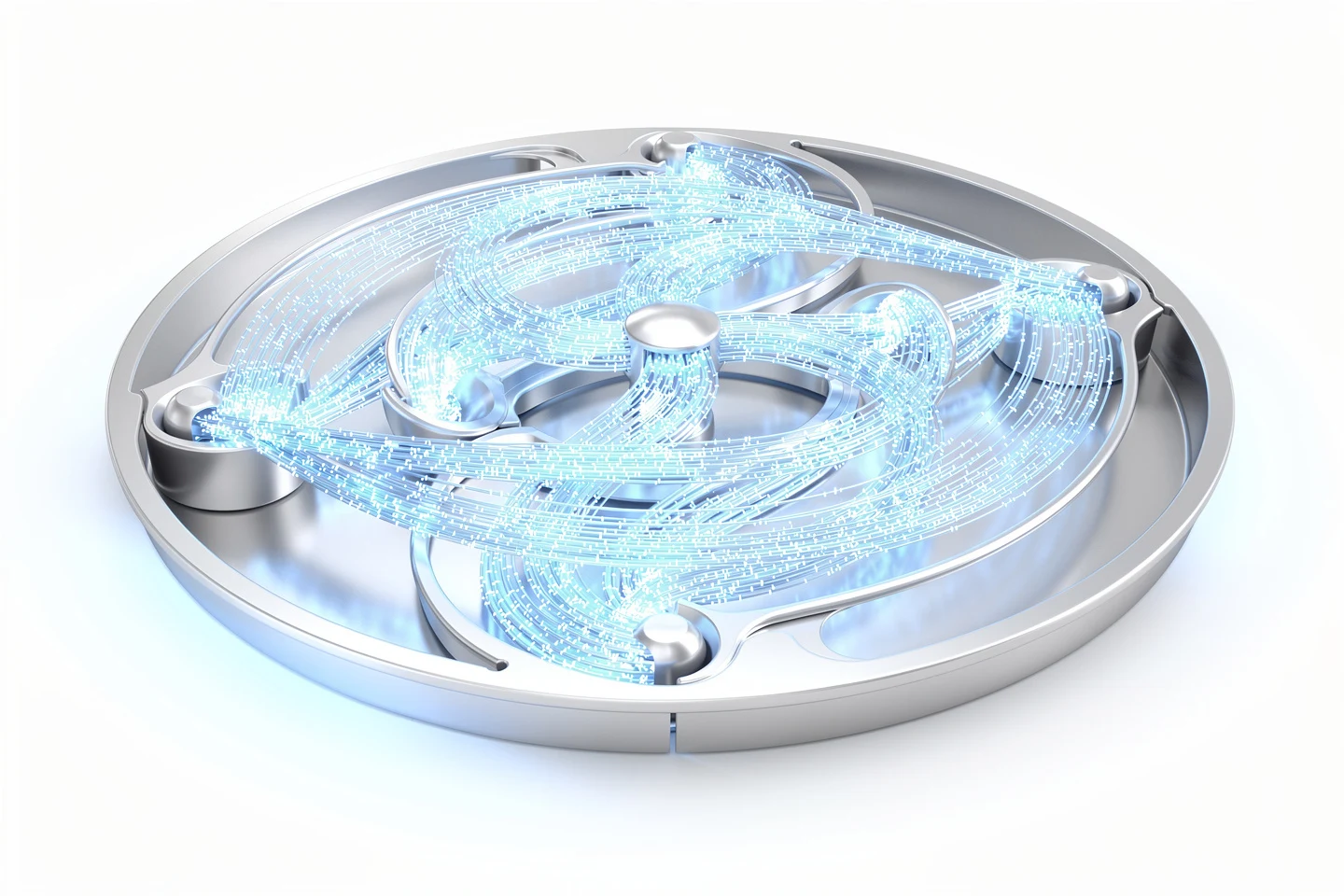
A crowd shuffles in a square. Everyone wants to get closer to the fountain without jostling. After a few minutes, everyone freezes: people have spaced themselves so that it's denser near the fountain and more spacious toward the edges, and no one feels shortchanged. The same principle underlies a method involving smart particles — Machine Learning that helps computers make sense of complex data.
Particles behave like these people. They are drawn to 'hot' spots (regions of high probability) and repel each other. Each particle's motion is a tiny step of optimization (improving position). Together they form a living system, a Dynamical Systems that adapts to the target shape. The rules of motion are written as differential equations (smooth rules of change)—like instructions for a dance.
But how long can this equilibrium last? Imagine the square is vast, and people gradually start shoving more, distorting the pattern. Mathematicians previously proved that a finite number of particles accurately mimic an ideal infinite swarm only for a short time. Then error builds up, like ripples spreading across water. The new study proposes two tricks to keep the shape from drifting.
The first method is a master review. Every so often (at logarithmic intervals, about every few minutes) the crowd checks itself against a master blueprint. Even if the blueprint is intricate, error melts away slowly but surely, like snow under a March sun. This works for any shape but guarantees only logarithmic closeness. The second method is for simple shapes, like a circle stretched into an oval. Then particles only need to remember two numbers: where the center is and how spread out they are. The entire crowd's motion reduces to simple rules, and the error plummets — by a factor of hundreds in the same time. Mathematicians call this probabilistic convergence at a parametric rate.
The finding confirms: finite particle ensembles can be safely used in numerical simulation and Bayesian inference (a method of updating knowledge as data arrives), without fear of deterioration over time. It echoes a broader challenge — how independence emerges from many interactions, a problem known from Markov chains (processes where each step depends only on the previous one). Armed with these rules, engineers can now fine-tune algorithms to run for years without glitches — whether for weather forecasts or medical image analysis.
And the finale: the crowd in the square has long since left, but the shadows of the fountain still fall on the cobblestones. Only now we know: if you organize the movement right, the pattern won't fade even by evening.
This method was originally devised for updating knowledge in statistics, and it was later found to resemble how models like DALL-E draw images from text.