The Particle Orchestra Finds Eternal Harmony: New Guarantees for SVGD ✛ ✎
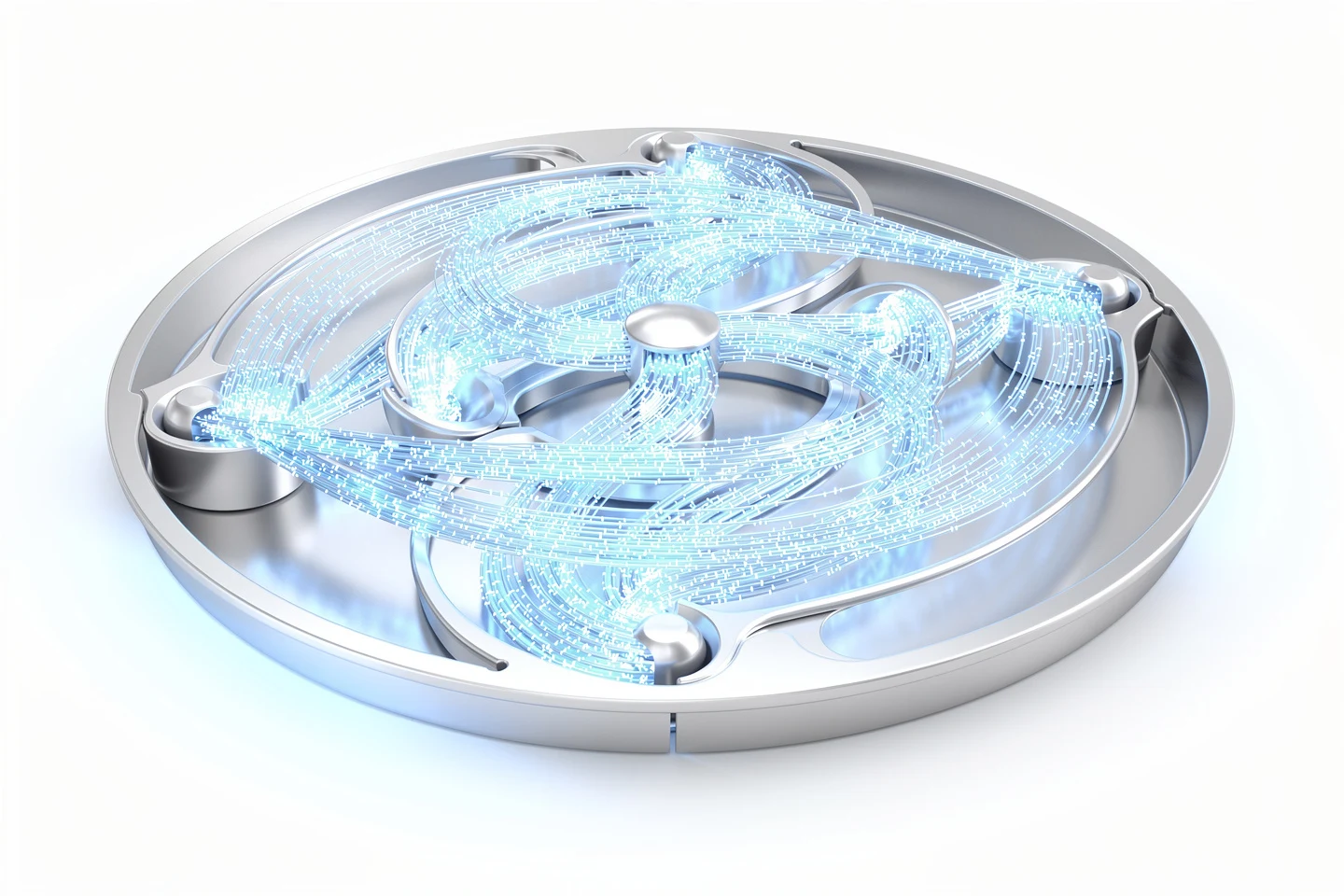
A thousand particles enter a gradient dance. Each feels an attraction to regions of high probability and repulsion from neighbors — so they don't bunch up. This is the SVGD method (steering particles to approximate a complex distribution), an elegant way to draw samples from intricate distributions, for instance, for Bayesian inference. In the ideal case, with infinitely many particles, their flow is described by a partial differential equation of the McKean–Vlasov type — an orchestra playing a score where every violin hears the entire hall. But in practice, the number of particles is finite. Classical estimates of propagation of chaos (the property of independence in the large-numbers limit) guarantee that a finite ensemble resembles the infinite one only for a short time. Then the error grows catastrophically — as if the musicians gradually drifted apart, each at their own tempo.
The researchers proposed two contrasting tricks to keep the orchestra from going off. The first is a cutoff strategy. Initially, while the error is small, the particles compare themselves to a reference finite-time comparison with the mean field (the averaged interaction of an infinite number). Then, after a time on the order of the logarithm of the number of particles, both systems converge to the target measure independently. Thereafter, their closeness is maintained through entropy dissipation: the discrepancy melts like snow under a March sun. The key equation is:
\[ \frac{d}{dt} \mathrm{KL}(\mu_t \| \pi) = - \mathrm{KSD}^2(\mu_t \| \pi) \]
The rate of decrease of relative entropy (a measure of how different distributions are) equals the square of the Stein discrepancy (a special distance measure via the Stein operator). The closer to the target, the slower the melting, but the process never stops.
The second approach revealed an elegant structure for special targets. If the target distribution is obtained by an invertible transformation from a standard Gaussian, and the kernel (the rule of similarity between particles) is chosen accordingly, then the dynamics close on a finite number of observables — the first and second moments. Then the particles and the mean field obey the same system of ordinary differential equations. It’s like an orchestra where all musicians follow the first violinist and automatically fall into harmony.
The results justify the long-term use of finite ensembles: now there’s no need to wonder whether the error might start growing uncontrollably. Moreover, by designing the kernel for a specific target, one can attain not only practical but also theoretical efficiency. A natural extension is the search for other target–kernel pairs that permit the same closure, for example from exponential families. Another direction is relaxing smoothness requirements to cover kernels popular in practice. A crucial next step is to develop numerical methods for automatically constructing finite-dimensional kernels for a given target. This work is directly linked to the fundamental problem of propagation of chaos in non-equilibrium statistical mechanics and to the justification of mean-field methods. The particle orchestra now knows: its music can play forever without losing its harmony.
SVGD was invented for variational inference, but later its deep connection with diffusion models, gaining popularity in image generation, was discovered.