Cosmic Pulse: NICER Catches the 'Heartbeat' of a Black Hole ✛ ✎
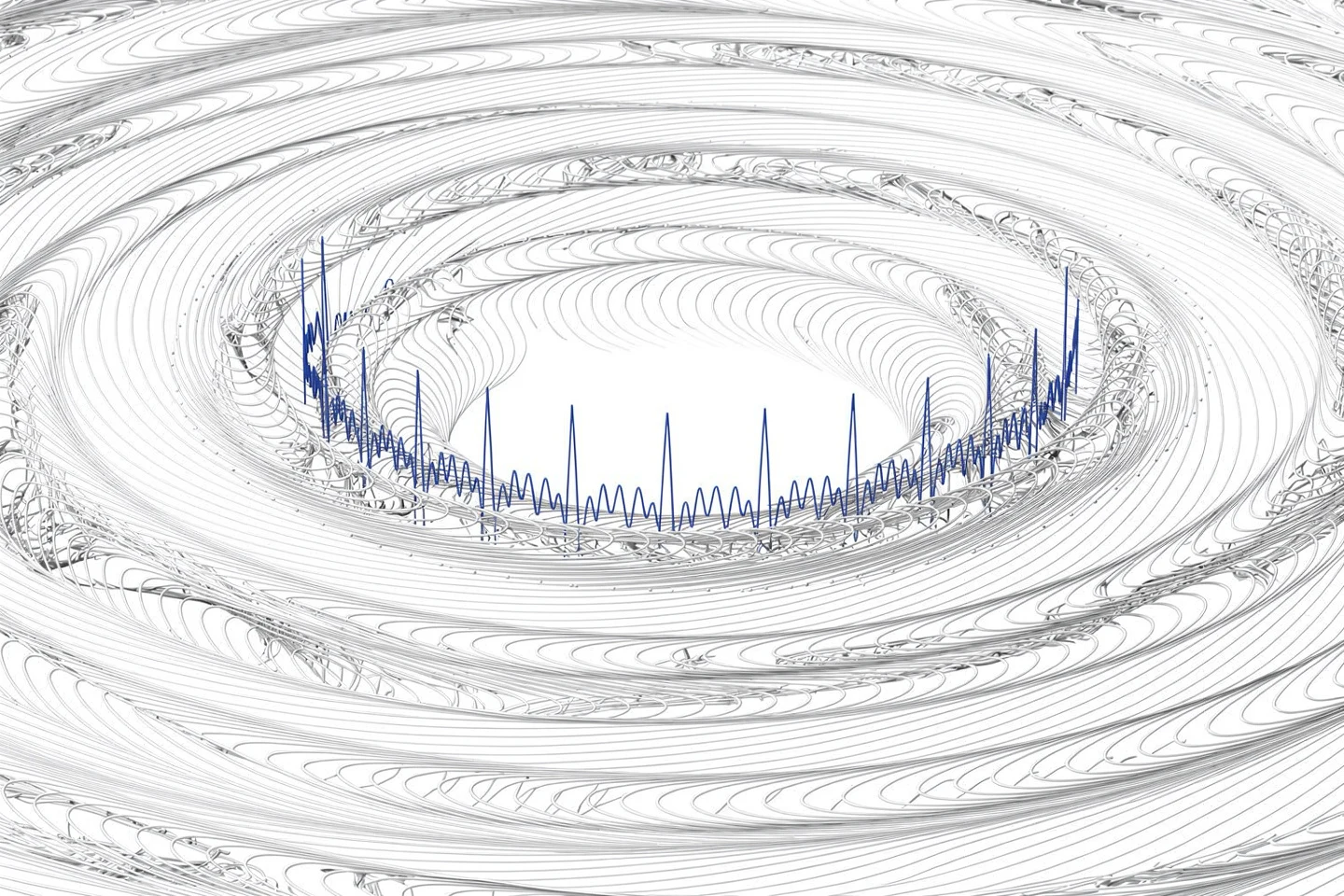
Scientists have long known that black holes aren't entirely black — if a star is nearby, its material (mostly hydrogen) flows onto the hole and spirals like water down a drain. Friction heats it to millions of degrees, producing X-rays. Sometimes this stream intensifies — then we see a flare. In the system 4U 1630−47, such a flare occurred in 2025, observed by the NICER telescope attached to the International Space Station. It was originally built to study neutron stars — super-dense remnants of supernovae that often manifest as pulsars (radio beacons discovered by Jocelyn Bell Burnell).
NICER is an amazing instrument: it takes hundreds of images per second, so it catches the tiniest brightness changes. Scientists noticed the X-ray light flickered: now brighter, now dimmer, and this flicker accelerated as the flare intensified. Such rapid pulsation is called quasi-periodic oscillations. But closer to the peak, a slow rhythm also appeared — one beat every 14 seconds, very weak, changing brightness by only 5%. It's like a faint heartbeat.
After analysis, the researchers realized: when the disk gets hotter and shrinks closer to the black hole, the rapid pulsations occur more often. It's like bubbles in a boiling pot bursting faster when you turn up the heat. And the slow heartbeat is probably the same process, just more subdued. The cause of this rhythmicity is the growth of entropy (disorder) in the turbulent flow. These observations are important: they allow us to peek into a region where time, due to monstrous gravity, slows down (an effect predicted in the solution of Schwarzschild), and matter races at nearly the speed of light. Moreover, such knowledge will be useful in the search for gravitational waves, since their sources are quite similar.
Fun fact: The term 'heartbeat' for such pulsations was coined in 2011 when a similar rhythm was observed in another black hole. And the NICER telescope was initially built to measure the size of neutron stars, but its ability to take very frequent snapshots allowed it to 'hear' the pulse of black holes.
Sci-fi also plays with cosmic rhythms: in the novel 'Solaris,' the planet's ocean pulsates as if alive, and in the movie 'Interstellar,' the black hole's disk fluctuates as if breathing.