Black Hole Cardiogram: NICER Records X-ray Heartbeat ✛ ✎
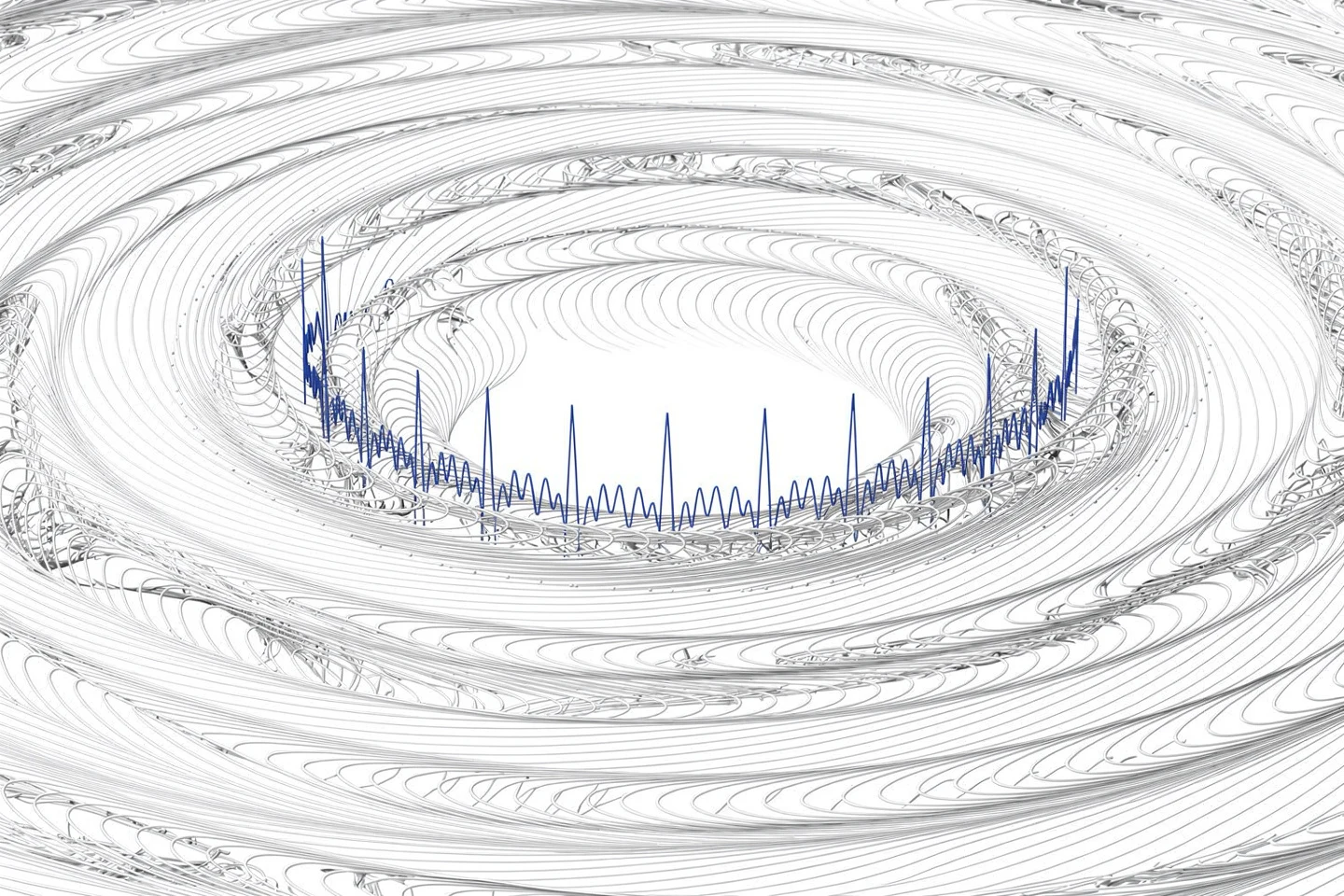
The NICER X-ray telescope has become a precise stethoscope for astrophysicists. In 2025, it was 'listening to' the black hole in the binary system 4U 1630−47—a compact object born from the core collapse of a massive star (the stability limit for white dwarfs was calculated by Subrahmanyan Chandrasekhar). Matter from the companion star, rich in hydrogen, spirals into an accretion disk, heats up to millions of degrees, and emits X-rays, whose fluctuations NICER digitizes with a 300-nanosecond resolution. The rhythm of this pulsating matter is a key to physics in strong fields, where solutions by Karl Schwarzschild for the spacetime metric apply.
During the outburst rise, the telescope caught two types of 'heart tones': fast quasi-periodic oscillations (QPOs) with frequencies from 0.24 to 3.43 Hz, and, closer to the peak, a slow modulation with a period of about 15 seconds (0.07 Hz). To tease out the fine structure of the signal, scientists applied time-resolved spectroscopy: wavelet analysis sorted photons into intervals with and without QPOs, and the Hilbert–Huang transform extracted the phase of the millihertz pulsation. The cardiogram showed that during QPOs, the inner disk does not just tremble: it contracts and heats up. The temperature $T_{in}$ jumped from 0.48 keV to 0.87 keV, while the apparent radius (normalization) dropped several-fold, like a heart muscle contracting to expel radiant energy.
The weak modulation of 2025 turned out to be a quiet copy of the classic 'heartbeat'. Phase-resolved analysis showed that the disk temperature oscillates in phase with the radiation flux (correlation coefficient 0.88), while normalization is in antiphase (−0.73). The coronal region hardly changes. In other words, the disk cyclically swells and collapses, and the instability does not affect the hot cloud above it. This is a picture of entropic or radiation-dominated instability — a well-known mechanism in accretion theory that now has direct observational confirmation. Physics here operates in a regime where relativistic time dilation and near-light speeds of matter create an extreme 'test drive' for equations of state.
Decoding the cosmic cardiogram of 4U 1630−47 is not just cataloging another anomaly. It brings us closer to understanding how matter behaves at the brink of falling into a black hole. Perhaps in the future, by matching QPO frequencies with the black hole's spin, we will be able to extract this fundamental property directly from the rhythm. NICER and its successors (the Athena observatory, the Chinese Einstein Probe telescope, polarimetric missions) will create a multichannel recording of accretion 'sound', encoding the properties of strong-field spacetime. Similar methods apply to neutron stars and even to supermassive black holes in galactic nuclei, linking the microphysics of disks with gravitational-wave events that shake the Universe.
The term 'heartbeat' for accretion oscillations was first used in 2011 for the source GRS 1915+105. The NICER telescope, mounted on the ISS, was designed to precisely measure the sizes of neutron stars, but its sub-millisecond resolution turned out to be ideal for recording fast pulsations from black holes.
The faint pulsation of the black hole evokes the quasi-rhythmic activity of the ocean in Lem's 'Solaris' or the flickering of Gargantua's accretion disk in 'Interstellar'. It is not yet intelligence, but no longer just chaos.