Triplet Pairs: A Quantum Dance Without Steps express
Light hits an organic molecule, and inside, a pair of twin excitations is born. They're called triplet pairs. In single pentacene molecules, such pairs have long been known to share their energy with neighbors: this is the basis of singlet fission, which boosts the efficiency of solar cells. But what happens when molecules line up into long chains, like in polypentacene? Do the pairs move along the chain?
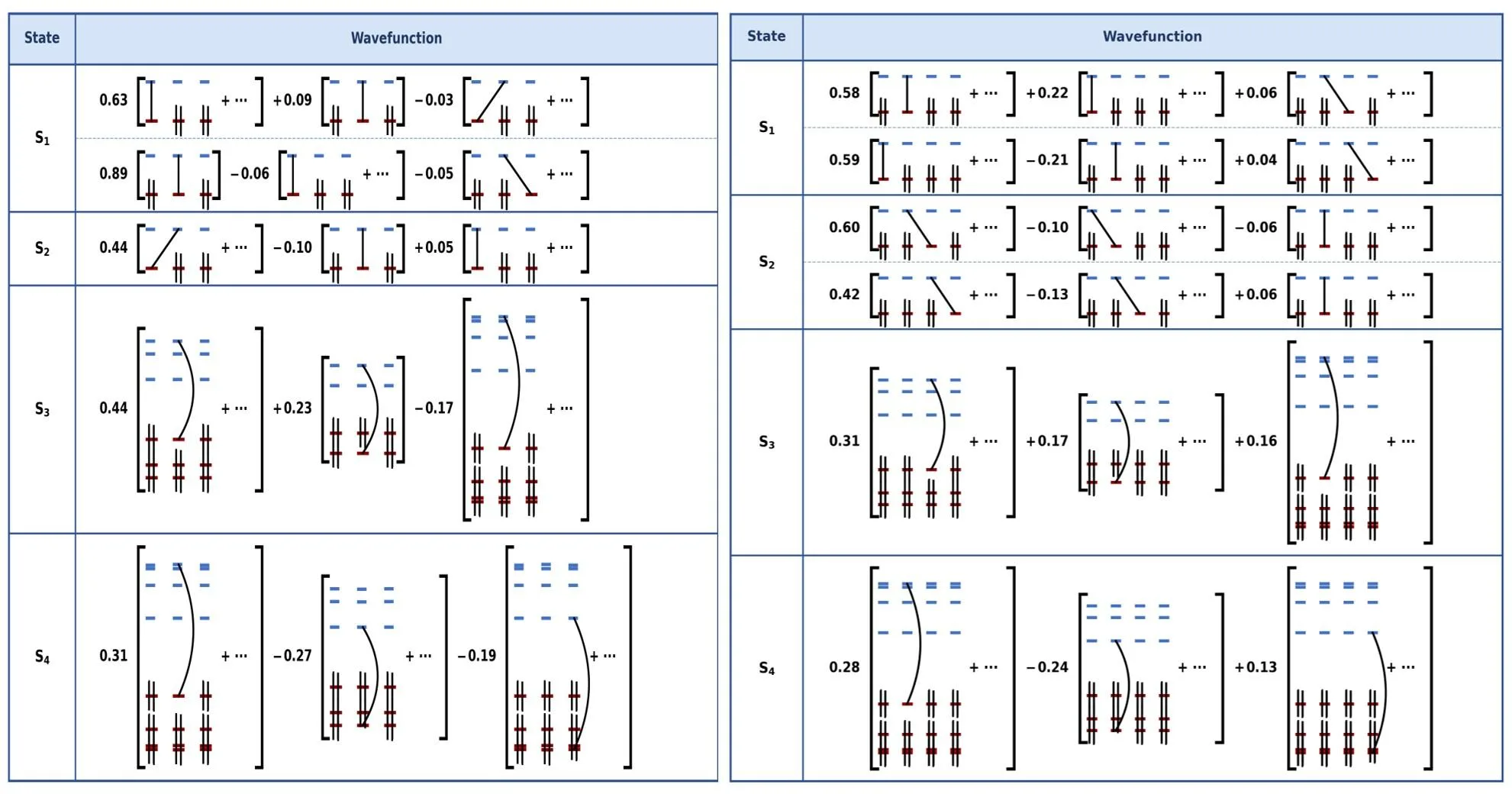
The authors built a quantum model for chains of three and four pentacene units. They used an exact computational method that sorts all possible states of the system into categories: where the excitations are, how they interact, which charges move. The result was unexpected. All states of triplet pairs are squeezed into a narrow energy corridor — almost like standing on a single stair step. And none of them resembles a pair frozen in a specific location.
This is the key to the puzzle. Previously, experimentalists didn't see intramolecular diffusion of triplets in solutions of polypentacene and polytetracene, and were puzzled. Now it's clear: there's no diffusion because the pair doesn't need to move anywhere. It's already everywhere. Its energy is spread across the entire molecule, like the sound of a tuning fork filling a room rather than bouncing from corner to corner.
But if the chains are laid into a film where they touch each other — then energy can jump to a neighboring molecule. This leaves the door open for intermolecular singlet fission — a process that's crucial for organic electronics.
Original abstract
as written by the authors arXiv:2607.03706
We present correlated-electron calculations of optical spin-singlet and triplet-triplet multiexciton states in three- and four-unit pentacene oligomers as microscopic models for polypentacene. The calculations use the Pariser-Parr-Pople Hamiltonian, multiple-reference singles and doubles configuration interaction, and a molecular exciton basis that resolves Frenkel, charge-transfer, and triplet-pair (T1T1) configurations in real space. We find that the complete set of 1(T1T1) eigenstates lies in a narrow, nearly degenerate energy window near the lowest optical exciton and that no eigenstate can be identified with a single localized triplet-pair configuration. Instead, each triplet-pair eigenstate is a quantum superposition of configurations containing all accessible intertriplet separations. This electronic structure explains the perceived absence of intramolecular triplet diffusion in pentacene oligomers, polypentacene, and polytetracene solutions, while leaving open the possibility of intermolecular singlet fission in films with appreciable interchain interactions.
Pentacene is five benzene rings in a row. It's used to make organic transistors, and its derivatives are considered as materials for flexible solar cells.