A quantummodel in chemistry is a theoreticalframework that applies quantum mechanics to describe the behavior of molecules, including their electronic structure, bonding, and reactions. Unlike classical models that treat atoms as point particles with fixed positions, quantum models treat electrons as wavefunctions that determine probability distributions. These models are essential for predicting molecular properties, reaction rates, and spectra with high accuracy, and they form the basis of computational chemistry.
History
The foundations were laid by Erwin Schrödinger and Werner Heisenberg in the 1920s, with the first molecular quantum calculations performed by Walter Heitler and Fritz London in 1927 for the hydrogen molecule. The development of computational methods accelerated in the 1950s–1970s with the advent of digital computers.
How it works
Quantummodels solve the Schrödinger equation for the molecular system, often using approximations like the Born-Oppenheimer approximation (which separates nuclear and electronic motion) and methods such as Hartree-Fock or density functional theory. These approaches calculate the electronic energy as a function of nuclear positions, yielding potential energy surfaces that describe how molecules vibrate, rotate, and react. Modern quantum models also incorporate electron correlation and relativistic effects for heavier elements, and they can be coupled with machine learning to accelerate predictions.
In practice
Quantummodels are used in drug discovery, materials design, and catalysis research to predict how molecules interact and to screen candidate compounds before synthesis.
Fun fact
Modern quantummodels can predict molecular properties so accurately that they sometimes outperform experiments, especially for short-lived intermediates in chemical reactions.
A cartographer receives a sheet with distances between hundreds of unnamed islands. No island is labeled, but the distances repeat, forming triangles and quadrilaterals. From these repetitions, the cartographer reconstructs the map of the archipelago, not knowing which island is which. This is roughly how the new work in molecular spectroscopy works.
A cookbook without a shopping list: that's what a scientist faces when looking at a scheme of chemical reactions. The arrows and formulas on paper look neat, but once you start hunting in the lab for molecules that will actually behave that way, a real quest begins.
The Standard Model is a set of rules for all known particles. But it says nothing about dark matter, which makes up a quarter of the Universe. To find it, you don't need to build city-sized colliders. Radioactive molecules act like sniffer dogs: their incredible 'scent' picks up the faintest traces of unknown forces that slip past giant machines.
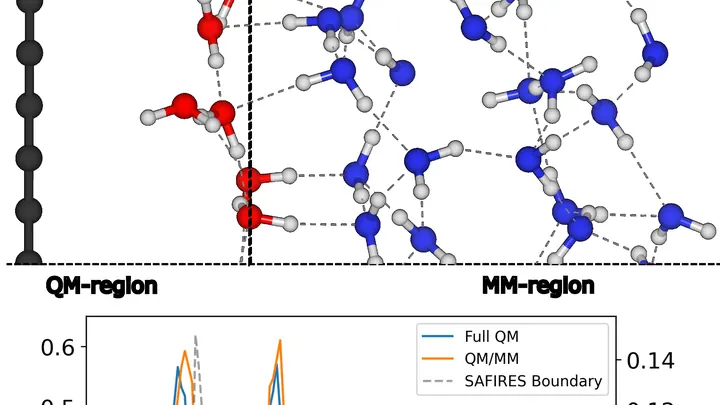
Imagine a huge swimming pool. In one corner, a chemical reaction is underway that needs to be calculated with jeweler-like precision. But the surrounding water is not just decoration: its molecules jostle, attract, and influence the reaction. How do you account for this endless dance of particles without drowning in calculations?
Inside every cell, life is bustling: tiny protein machines tirelessly haul cargo, read genes, and fix errors. But their work is far from perfect: they often 'spin their wheels,' take backward steps, or get stuck in futile cycles. It's like a city traffic jam where cars dart around aimlessly, burning fuel.
The atomic nucleus is not a solid ball but a dense swarm of tiny particles called quarks, glued together by a special glue (the strong force). In light nuclei, such as calcium, this swarm is simply arranged: the numbers of the two quark types, up and down, are almost equal, like the white and black keys in an octave.
Quantum calculations are a recipe with perfect ingredients, but nature-the-chef cooks in her own way. Machine-learned models of atoms memorize the recipe and predict material properties in seconds instead of weeks.
A neural network trained on collisions of protons and electrons transferred its skills to a completely different experiment — catching neutrinos. Like a chef who learned French cuisine and then, without preparation, baked an excellent Uzbek plov.
A seven-metal alloy is like a team where every player is pulling the blanket their own way. Atoms of iron, cobalt, nickel, aluminum, titanium, tantalum, and vanadium can either fall into a strict pattern or scatter into random positions. This determines whether the material will be as strong as steel or as light as aluminum.
A medicinal chemist is like a detective searching for the right compound among millions of suspects. Modern neural networks speed up the search but behave like a witness who says "it's him" and refuses to elaborate. In pharma, such secrecy is dangerous: a spurious correlation could send a toxic compound to the next stage of trials.
A mass spectrometer works like a molecular shredder: it breaks a substance into charged fragments and weighs each one. From this 'fingerprint,' chemists can tell what was in the sample. But if the molecule is new and its fragments don't match anything known, the instrument just shows a set of peaks, and what lies behind them is a mystery.
The authors of the paper proposed a workaround.
In a collider detector, each proton collision leaves a trail of dozens of particles, like the splash from a stone thrown into water. Making sense of that splash and understanding what exactly happened at the moment of impact is a task that humans can no longer handle alone.