Magnetic Flux Quantum Teleportation Without a Magnetic Field ✛ ✦
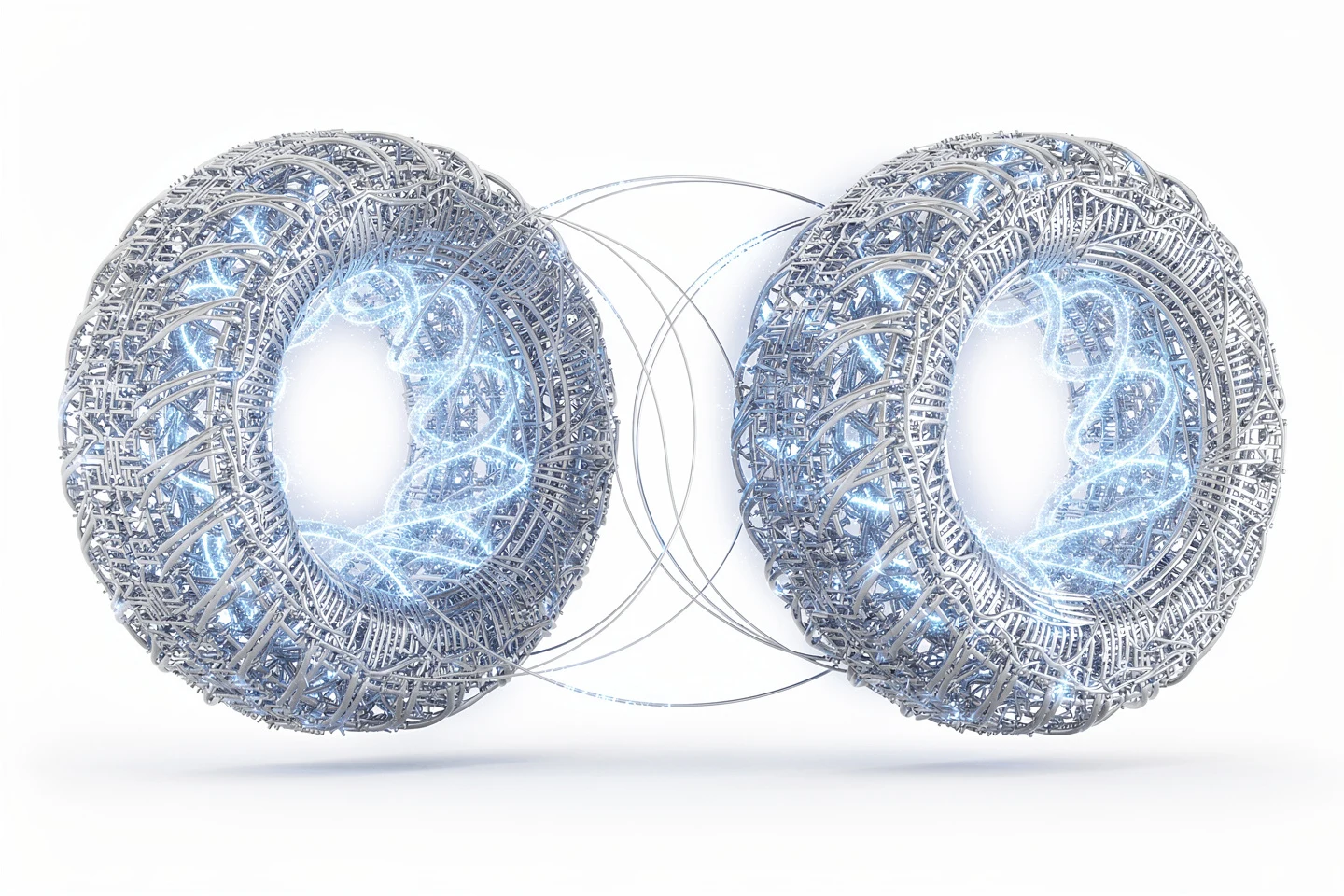
Magnetic fields act at a distance. But David Bohm showed that in the quantum world there is a vector potential — an invisible ledger that influences charges even where there is no field. This Aharonov–Bohm effect allows quantum information transfer without direct contact. John Bardeen proposed using it to shuttle a magnetic flux quantum between two superconducting rings.
In the experiment, the rings are connected by a shared loop where a coherent cloud of electrons forces the total flux to be strictly defined. Quantum superposition lets the flux “leap” from one ring to another, much like rewriting a ledger entry transfers money between safes. The leaps are detected by ultrasensitive interferometers — SQUID-based sensors.
If the leap were faster than light, causality would be broken. But quantum decoherence — the loss of coherence as the system grows — most likely prevents this. Roger Penrose predicted that with increasing mass the wave function collapses on its own. The very mechanism that enables teleportation also sets a limit for quantum computers, but in return it offers ultraprecise sensors.
The magnetic flux quantum is the smallest 'coin' of magnetic field. In a superconducting ring, the current cannot vanish because that would require 'breaking' this coin, and smaller change does not exist. That’s why the ring stores the field forever.