Quantum Waltz: Nonlocal Transfer of Magnetic Flux ✛ ✦
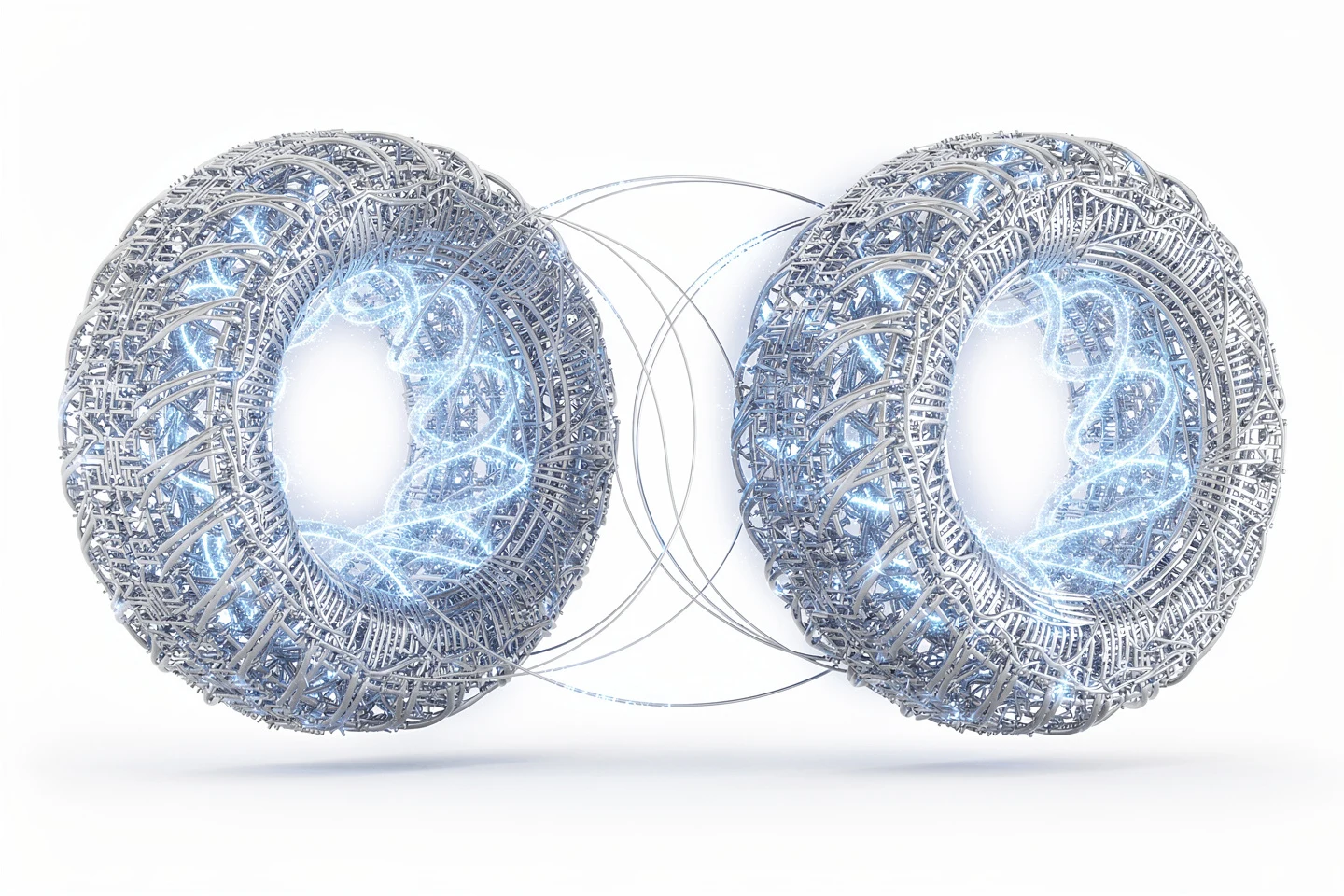
In the quantum world, there is its own dance. Two superconducting toroids, each comfortably holding its quantized magnetic flux, whirl in a synchronous waltz. Between them is a vacuum, not a single field line, yet they mirror each other’s moves without fail. This strange choreography embodies a long-standing dream: to test whether quantum information can be transferred without energy transfer, relying solely on the all-pervading vector potential.
The key to the waltz is a common superconducting loop that threads both rings. Inside it, like a shared vascular system, Cooper pairs condense, forming a Bose–Einstein condensate. Even in the works of John Bardeen, the idea of quantum exchange without real excitations flickered. It is the condensate, remaining unexcited, that imposes a global condition on the total fluxoid. Thus, a bond is born between isolated modes — an echo of the Aharonov–Bohm effect, predicted by David Bohm. This is not induction, but an exchange of quantum numbers — as if two orchestras in different halls play to a single score, without hearing each other.
Simulations show: the toroidal oscillators split into symmetric and antisymmetric normal modes. In the qubit regime, an Ising-type coupling emerges, and populations begin to oscillate — flux fades in one ring and appears in the other. The dancers take turns picking up the melody. But the most intriguing part: the exchange time is inversely proportional to the number of Cooper pairs. For a macroscopic condensate, it could become arbitrarily short, threatening to outpace light and conflict with Faraday’s law of induction. Clearly, constraints come into play — likely, fundamental quantum decoherence.
The experiment offers a rare chance to separate the contributions of vector potential and magnetic field. Success will allow probing the boundary between quantum and classical reality — here, effects of wavefunction collapse, predicted by Roger Penrose, may appear. If the exchange is suppressed at a critical condensate density, that would be direct evidence of a new decoherence channel. And perhaps, hidden here is the resolution to why our macroscopic world is so stubbornly real — and why large quantum systems lose coherence. Such discoveries are critical for quantum computers: understanding the nature of decoherence will suggest how to build robust qubit architectures.
In the future, chains of such toroids, linked by topological constraints, will form a new class of quantum simulators. Interactions in them will be dictated not by fields, but by global conditions — like a dance where partners communicate through glances. Detection using superconducting interferometers (SQUIDs) will provide temporal resolution to track every quantum step. Then — networks with nonlocal connections and distributed information, where a signal needs no wires.
Interestingly, the magnetic flux quantum Φ₀ = h/(2e) can be considered as the smallest 'atom' of magnetism in a superconductor. It serves as the 'step' of the dance in the described experiment.