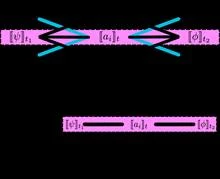
In quantum mechanics, the commutator of two operators A and B is defined as [A, B] = AB - BA. It measures the degree to which the order of operations matters. If the commutator is zero, the operators commute, meaning their physical observables can be measured simultaneously with arbitrary precision. If it is non-zero, the operators do not commute, leading to fundamental uncertainty relations — the most famous being between position and momentum. In the context of a scalar field, the commutator of the field operator at two different spacetime points encodes the causal structure of the theory: if the points are spacelike separated, the commutator vanishes, ensuring that measurements at one point cannot influence the other, preserving relativity.
History
The concept of the commutator in quantum mechanics was introduced by Max Born and Pascual Jordan in 1925, and later formalized by Paul Dirac. The extension to quantum fields was developed in the late 1920s and 1930s by Werner Heisenberg, Wolfgang Pauli, and others.
How it works
For a scalar field φ(x), the commutator [φ(x), φ(y)] is not just a number but an operator. Its expectation value in the vacuum state gives a function that is zero when x and y are spacelike separated, and non-zero when they are timelike or lightlike separated. This property is derived from the field's equations of motion and the canonical commutation relations imposed at equal times. The commutator essentially tells you how a disturbance in the field at one point propagates to another: if the points are causally connected, the commutator is non-zero, reflecting the possibility of influence; if not, it is exactly zero, enforcing locality.
In practice
Commutators are fundamental to quantum field theory, where they are used to derive the Feynman propagator, which describes how particles move and interact. They also underpin the uncertainty principle, which is essential for understanding quantum measurement and the limits of precision in technologies like quantum cryptography.
Fun fact
The vanishing of the commutator for spacelike separations is so important that it is often called the 'microcausality' condition, and it is one of the few rigorous constraints that any relativistic quantum field theory must satisfy.
The interpreter in the meeting room hears the shift in tone before it is spoken aloud. They catch subtle changes in breathing, pauses, and intonations, and already know that in a few minutes the conversation will turn heated.
Imagine a ladder whose rungs are tiny magnets. If neighboring magnets point in opposite directions, the ladder is "calm." But if you make them all point the same way, the whole structure becomes magnetized and "stubborn."
Scientists built such a ladder from germanium atoms — a semiconductor used to make transistors.
Two people agree to meet, but each has their own things to do. One hesitates: what if the other doesn't come? And decides not to go. The other thinks the same. The meeting doesn't happen. That's the simple mechanism the authors dissect: a joint endeavor requires everyone to invest time, but the payoff depends on whether the partner participates.
In the model, each person keeps a to-do list ordered by importance.
A stone thrown at a wall bounces off. In the quantum world, a particle can pass right through, as if the wall were woven from mist. This is quantum tunneling: it lights up stars, works in microchips, and even operates in the cells of our bodies. But most particles have spin — an intrinsic rotation, like a spinning top.
A mountain pass connects two valleys. In one, the protein is folded; in the other, it is unfolded. To get from one to the other, you must cross the saddle — the highest point on the path. In protein science, this point is called the transition state, and the coordinate that shows the distance to it is the committor.
Drop by drop from a faucet, or a steady stream without a single splash. That's roughly what the two regimes of current in a superconducting contact look like. Only here, the role of water is played by Cooper pairs — bound electrons that move without resistance.
In the quantum world, there is its own dance. Two superconducting toroids, each comfortably holding its quantized magnetic flux, whirl in a synchronous waltz. Between them is a vacuum, not a single field line, yet they mirror each other’s moves without fail.
A laser beam in a multi-kilometer tunnel trembles as a gravitational wave passes, but the tremor is barely perceptible, on the scale of fractions of a proton's diameter. To hear this cosmic whisper, physicists squeeze every last bit of performance out of light.
A quantum spin chain is like a string of beads, where each bead is a microscopic magnet pointing up or down. In the XXZ model, these little magnets interact differently along the three axes, and at special parameter values, roots of unity, the system awakens with a hidden memory.
A quantum computer is like an orchestra where each musician, a qubit, must play their part accurately and on time. Usually, musicians are seated in fixed positions and connected by conductors' consoles. But what if we let them move freely across the stage and turn the movement itself into part of the music?
In 1953, mathematician Alexander Grothendieck proved a theorem that became a cornerstone in the theory of tensor products. It states that for ordinary function spaces, two natural norms, the projective and the injective, are equivalent up to a universal constant. In other words, two ways of measuring the 'size' of combinations of vectors give similar results.
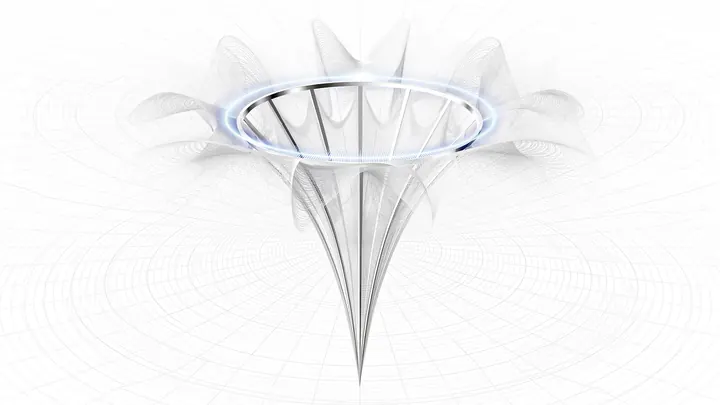
The light cone is a blueprint of causality, laser-cut onto the fabric of the universe. In classical physics, it is as sharp as a scalpel: events inside are linked by invisible threads of influence, while outside lies eternal isolation, sealed by the ultimate speed limit.
On one side of the scale lies all the matter in the Universe; on the other, all the antimatter. According to the laws of physics, at the moment of the Universe's birth, the pans should have been balanced. But we see one pan tipping: around us are stars, planets, people, and almost no antimatter. This imbalance is one of the greatest mysteries.
The quantum world plays a strange game with causality. If in everyday life salt is always added to soup before serving, here the ingredients end up in the bowl at the same time, and the chef doesn't remember the order. Physicists asked: can we measure this 'recipe'? The answer is no.
The quantum world is known for uncertainties: for example, you can't measure a particle's position and its speed at the same time. But new research shows that in a 'fuzzy' spacetime, even probability itself — the measure of chance — loses sharpness. A foggy compass doesn't give an exact direction: its needle wavers.
Two people read the same book, but one turns the page first and then looks at the text, while the other does the opposite. It would seem the result is the same. But in the quantum world, the order of operations changes everything.
This work examines models that output sequences of symbols, like a ticket machine.
Each qubit has its own little ring, freely sliding on the doughnut. All quantum logic boils down to smooth movements: shift, flip, connect. Entanglement, for example, is when two doughnuts stick together, and the rings on them begin to spin synchronously, like figure skaters in pairs skating.
The key insight: the geometry of the surface dictates the rules of the game.
At the Large Hadron Collider, by accelerating particles to nearly light speeds, top quarks are created — the heaviest building blocks of the Standard Model. They live for vanishingly small fractions of a second but manage to exhibit complex quantum connections.
A quantum particle, an inhabitant of the elementary particle world, resembles a coin spinning in the air: neither heads nor tails, but a blend of possibilities. Yet when it lands on the table, the outcome becomes definite. What serves as the table in a measurement?
Inside a living cell, a tiny carbon spinning top whirls — a molecule billionths of a meter across. An ordinary top falls quickly, but this one behaves differently: it can spin in both directions at once, like a quantum coin perpetually frozen mid-fall. This superposition of motions is key to its strange selectivity.
We’re used to time flowing only forward. But quantum laws let it become like a coin showing heads and tails at once.
Take a particle with its own spin — its intrinsic rotation. In a magnetic field, it spins like a top. Send this particle through a device where two opposing magnetic flows fight each other — and it will start moving into the future and the past at the same time.
Two great theories describe reality: one — how massive bodies cause curvature of space, the other — the Standard Model — governs elementary particles. Reconciling them remains elusive, like trying to describe an ocean storm in the language of a diamond lattice.
Time in quantum mechanics is like a shadow on a wall: we see its motion, but we cannot grasp the shadow itself. The Schrödinger equation describes how a system's state changes, but time enters it as an external parameter that nothing measures.
Two muons are born in the decay of an eta meson and fly apart, linked by quantum entanglement. One experimenter, Alice, measures the spin of the negative muon, while another, Bob, records the direction of the positron from the decay of the positive muon. It would seem that the order of events should affect the correlations.
A century ago, quantum mechanics gave the world a neat picture: a particle rotating around a point can only have certain discrete amounts of angular momentum, integer multiples of Planck's constant. This rule seemed as solid as the law of gravity, and it followed from simple algebraic arguments.