Nonlocal Transfer of Quantized Magnetic Flux Between Toroidal Superconductors with No Field in Between ✛ ✦
Context
Progress in the foundations of quantum theory often stalls due to a lack of experiments that distinguish between interpretations. Superconducting circuits, developed for quantum computers, provide a platform for controlling macroscopic quantum phenomena. A key phenomenon—the Aharonov–Bohm effect, predicted by David Bohm—shows that the vector potential is physically meaningful: a charged particle feels the magnetic flux even without entering the field region. This suggests the possibility of quantum superposition and nonlocal flux transfer with no field in the gap. Testing this possibility touches on fundamental questions, including the existence of objective wave function collapse and the limits of quantum decoherence. As with the no-cloning theorem, causality violation here might be prevented by fundamental constraints.
Methods
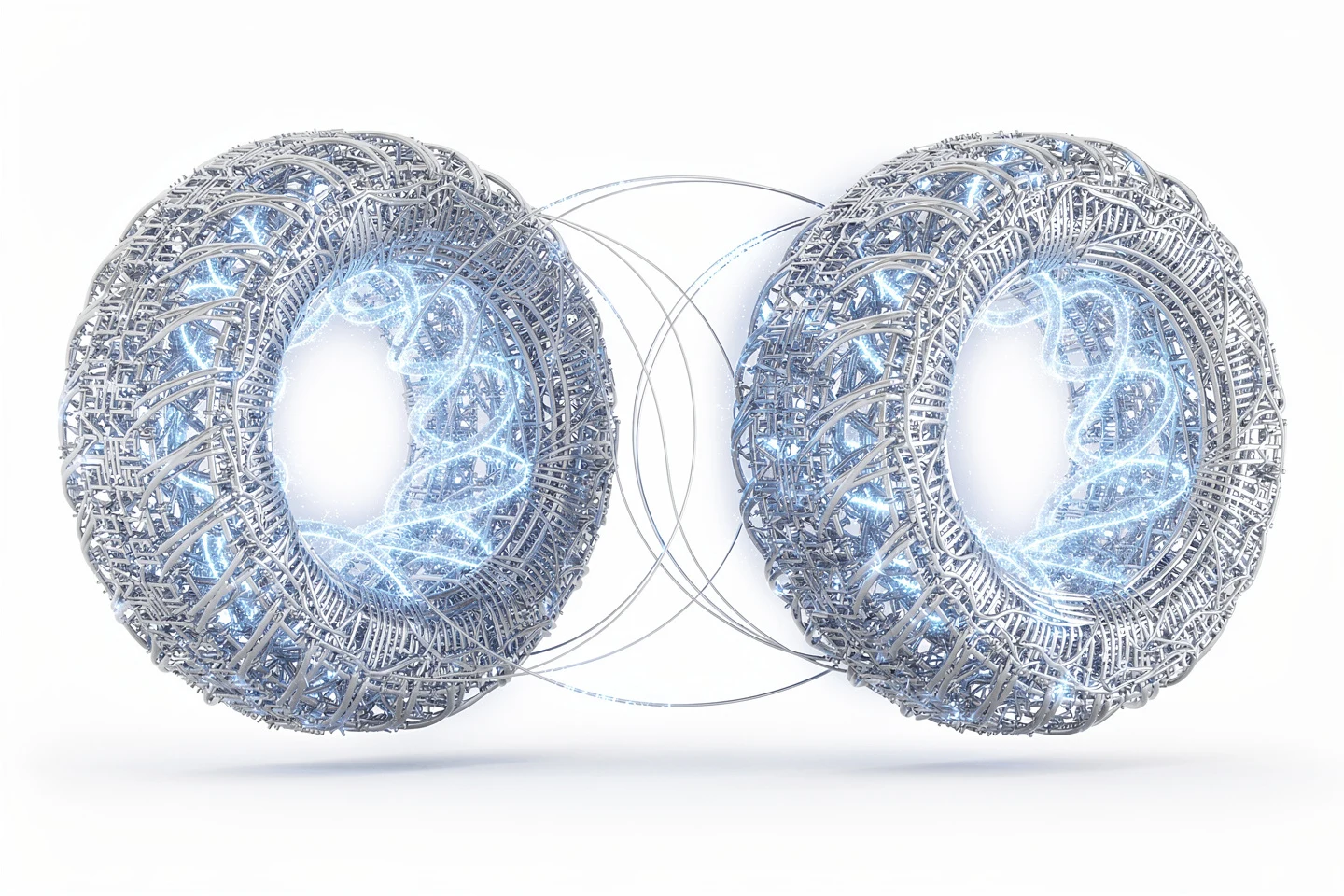
The experiment uses two superconducting toroids, each trapping quantized magnetic flux inside via the Meissner effect. A shared superconducting loop threads through both toroids, inductively coupled to their fluxes. The key element is a Bose–Einstein condensate of Cooper pairs in this loop, which, staying in its ground state, imposes a global condition on the total fluxoid. This leads to an effective interaction between the toroidal flux modes, described as coupling through quantum information exchange without energy transfer from the loop's excitations, first proposed for such systems by John Bardeen. Readout is performed with superconducting quantum interference devices (SQUIDs), enabling quantum measurements with time resolution. Additionally, direct magnetic field probes between the toroids verify the absence of leakage.
Results
Modeling shows that in the harmonic approximation, the toroidal flux oscillators split into two normal modes, whose frequencies depend on the loop inductance and coupling orientation. In the two-level flux qubit regime, an Ising-type interaction emerges, with strength set by the flux matrix elements. The condensate-mediated exchange interaction leads to characteristic population beatings, observed as correlated flux oscillations in the SQUIDs. Calculations reveal that the full flux transfer time is inversely proportional to the number of Cooper pairs in the loop, which in the macroscopic limit conflicts with the speed of light limit: for a sufficiently large number of particles, the exchange could occur faster than a light signal. This signals a paradox that requires accounting for Faraday's law of electromagnetic induction (the curl of the electric field) and the possibility of fundamental coherence loss. Quantum sensing with SQUIDs provides the precision needed to detect individual flux quanta.
Implications
This scheme, for the first time, allows experimental separation of the contributions of the vector potential and the magnetic field to nonlocal effects. A positive result would confirm the possibility of purely field-based nonlocality without energy transfer through space, refining the macroscopic applicability limits of quantum superposition. The experiment will provide a tool to test hypotheses of Roger Penrose on gravitationally induced wave function collapse and other objective reduction models. Observing suppression of the exchange above a critical condensate density would be a direct hint of a new type of density-related quantum decoherence.
Future development
In the future, this architecture can be extended to more toroids, creating a network with nonlocal connections governed by topology. This will open the door to a new class of quantum simulators where interactions are realized not through physical fields but through topological constraints. Advances in quantum sensors based on SQUIDs will boost sensitivity to flux changes down to the single-quantum level. Theoretically, a fully covariant model of collapse, consistent with quantum field theory, needs to be developed.
Impact
The results will impact quantum information theory, superconductor physics, and the development of fault-tolerant quantum computers, establishing possible fundamental scaling limits.
Next steps
Next steps include numerical simulation of the full electrodynamic problem with time dependence and experimental implementation in low-temperature superconducting circuits with high-Q SQUIDs.
Key open problems
The experiment directly connects to unsolved problems of quantum mechanics: the measurement problem, the origin of wave function collapse, and the role of the observer. It also touches on the compatibility of macroscopic coherence with the principles of locality and causality.
The knowledge machine's view
This section is addressed to the author of the paper and their colleagues. Neighbouring works were found by meaning-based search across our archive, not by word overlap. We do not review: we show the field around the work.
What the work does
The study examines nonlocal transfer of quantized magnetic flux between two toroidal superconductors linked by a shared superconducting loop. Simulations reveal splitting into normal modes and an Ising-type exchange interaction, leading to population beats and flux transfer. The authors note a paradox of superluminal exchange in the macroscopic limit.
Where its strength is
A strong point is the concrete superconducting circuit where nonlocal flux transfer emerges from a global fluxoid condition, providing a testable platform for probing quantum nonlocality and the limits of causality.
Where it could go next
- It might be interesting to compare the proposed mechanism with energy teleportation without particle transfer described in a neighboring paper: there, energy is transferred via measurements and classical communication, which could shed light on the nature of exchange in your system.based on: Energy Teleportation Without Particle Transfer arXiv:2506.02054v2
- A nearby paper on a quantum wallet with energy teleportation among five qubits; its approach to analyzing energy flows in many-body systems could be useful for generalizing your model to more toroids.based on: Quantum Wallet: Energy Teleportation Between Five Qubits arXiv:2505.01863v1
- A possible direction is to investigate the role of decoherence and temporal correlations in your system, drawing on the analysis of temporal correlation hierarchies in a qubit, which shows how noise affects quantum oscillations.based on: Death and Rebirth of Quantum Echo: A Hierarchy of Temporal Correlations in a Qubit arXiv:2505.01379v1
Worth trying
- Test whether nonlocal transfer persists when dissipation is added to the shared loop, using methods from the paper on quantum echo.
- Consider the possibility of energy teleportation between the toroids via SQUID measurements, analogous to protocols from the quantum wallet paper.
- Assess the influence of the number of Cooper pairs on the exchange rate and compare with the limits discussed in the energy teleportation paper.
Why this may matter
Such experiments could clarify fundamental constraints on nonlocal quantum interactions and offer new tools for quantum computing and information transfer.
Nearby works in our archive
- Energy Teleportation Without Particle Transfersimilarity 0.63
- Quantum Wallet: Energy Teleportation Between Five Qubitssimilarity 0.63
- Superconductivity Without Heavy Atomssimilarity 0.62
- Entanglement in the Crosshairssimilarity 0.62
- Black hole vortex shifts quantum rhythmsimilarity 0.62
- Quantum Pump: Light from the Voidsimilarity 0.62
- Death and Rebirth of Quantum Echo: A Hierarchy of Temporal Correlations in a Qubitsimilarity 0.61
The closest work in the archive sits at 0.63 by meaning — the usual level for our corpus.
Original abstract
as written by the authors arXiv:2607.05581
We propose a nonlocal flux-transfer experiment in which a quantized magnetic-field excitation confined within one toroidal superconducting structure is coherently transferred to a spatially separated toroid without magnetic-field occupation of the intervening region. The transfer arises from quantized Aharonov-Bohm-type vector potential coupling mediated by a superconducting loop threading the toroids, which, however, remains in the ground state, acting only through a global fluxoid constraint. A direct experimental signature would be the observation of correlated, time-resolved flux exchange between remote toroids in a SQUID readout. We analyze an apparent signaling paradox related to this interaction as a probe of the broader question of whether spatiotemporal quantum coherence is fundamentally bounded. The proposed setup can provide an experimental testbed for addressing foundational questions such as the existence of an objective collapse of a wavefunction or the fundamental limits of macroscopic quantum coherence which is relevant to large scale quantum computers.
Interestingly, in a superconducting ring, magnetic flux is quantized in units of Φ₀ = h/(2e) ≈ 2.07×10⁻¹⁵ Wb. This quantization is what allows us to manipulate single flux quanta, as in the proposed experiment.
Key numbers
- Magnetic flux quantum Φ₀: 2.07×10⁻¹⁵ Wb
- Critical linear condensate density: 8.2×10¹¹ m⁻¹
- Speed of light c: 3.00×10⁸ m/s
- Planck constant ℏ: 1.05×10⁻³⁴ J·s