Water dances: the hidden rhythm of hydrogen bonds express
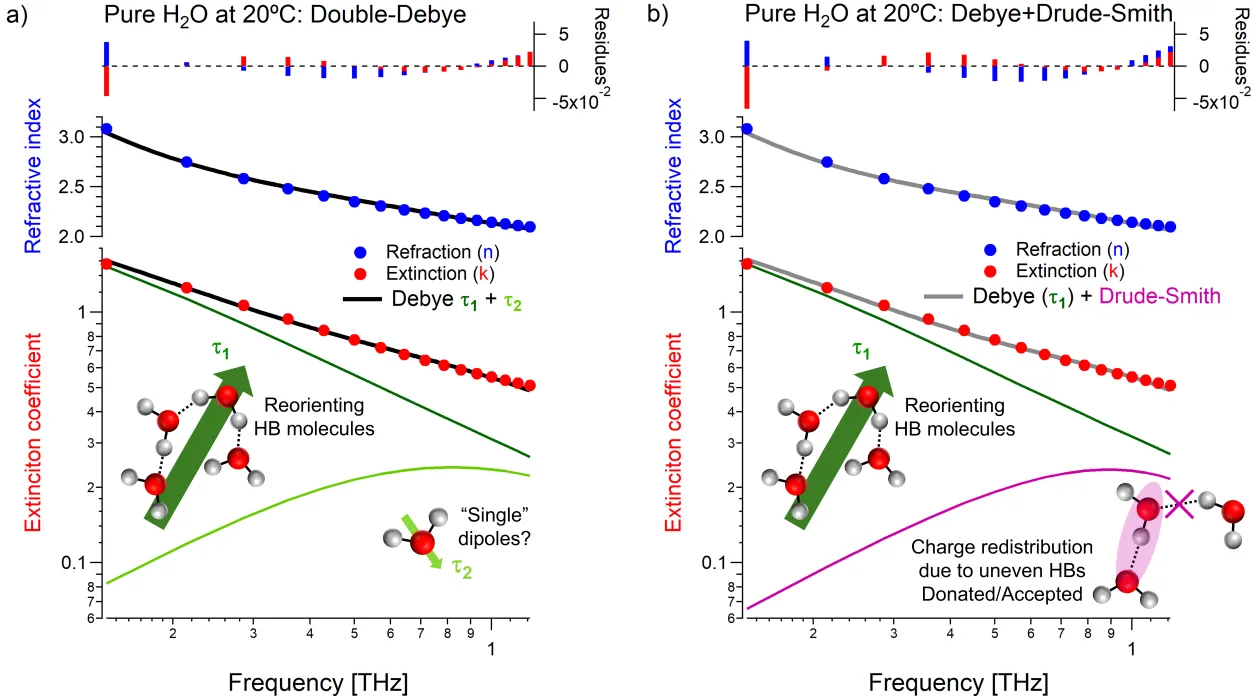
Water is not just a wet substance. On a picosecond scale, it resembles a dance floor where molecules continuously break and form bonds with each other. Usually, this dance is described by one main movement — collective relaxation, as if the whole crowd simultaneously slows down after the music stops. But at very high frequencies, around one terahertz (that's a trillion oscillations per second), a second, faster rhythm emerges.
The authors measured how water absorbs radiation in the range from 0.14 to 1.21 terahertz. The standard description proved insufficient: they had to add a contribution resembling the behavior of electrons in disordered conductors (the so-called Drude–Smith model). This contribution strengthens when heated from 20 to 50 degrees and weakens if ordinary water H₂O is replaced by heavy water D₂O. Computer simulations showed that the culprit is 'rule-breaking' molecules: those where the number of donated and accepted hydrogen bonds doesn't match. As temperature rises, such molecules become more numerous.
But the most interesting part is the nature of this signal. Calculations showed that it arises not only from nuclear motion but also from instantaneous electron redistribution. When the hydrogen network momentarily loses balance, the electron cloud of the molecule shifts, and this generates an additional electrical response. Thus, at terahertz frequencies, water reveals itself as a mix of nuclear dance and electronic echo.
Original abstract
as written by the authors arXiv:2607.06780
The low-frequency dielectric response of liquid water is commonly described by a dominant Debye relaxation together with additional faster contributions whose microscopic origin remains debated. Here we show that the dielectric function of water between 0.14 and 1.21 THz can be represented by a collective Debye relaxation plus a Drude-Smith term constrained to the zero-dc-conductivity limit. The Drude-Smith spectral weight increases upon heating pure H2O from 20 C to 50 C and decreases upon isotopic substitution (D2O at 20 C vs. H2O at 20 C). Molecular dynamics simulations including nuclear quantum effects show correlated changes in the population of water molecules with unequal numbers of donated and accepted hydrogen-bonds. Ab-initio-based spectra calculations further indicate that the ~0.1-1 THz response contains both nuclear-motion and explicit electronic-polarisation/charge-redistribution contributions. We therefore interpret the excess low-frequency THz response as a localised, mixed nuclear-electronic dielectric response correlated with transient donor-acceptor imbalance in the hydrogen-bond network.
The frequency of 1 terahertz lies between microwaves and infrared light. This range was once called the 'terahertz gap'—it was very difficult to study due to the lack of bright sources and sensitive detectors.