Austrian physicists Josef Lense and Hans Thirring in 1918, just three years after the creation of GR, found an exact solution for the weak field of a slowly rotating sphere. They showed that the spacetimemetric acquires additional components that cause test bodies to precess. The gravitational field of a rotating object splits into a static part (like that of a Newtonian sphere) and a 'gravitomagnetic' part, producing forces similar to magnetic ones. Thus the concept of gravitomagnetism was born.
History
Josef Lense and Hans Thirring in 1918 first derived the formula for gyroscope precession in a rotating gravitational field from Einstein's equations. Their work 'Über den Einfluß der Eigenrotation der Zentralkörper auf die Bewegung der Planeten und Monde nach der Einsteinschen Gravitationstheorie' laid the foundations of gravitomagnetism. For a long time, the effect remained unconfirmed due to its extreme smallness for planets. Only in 2004–2011 did the satellite missions Gravity Probe B and LAGEOS/LARES confirm the GR prediction with an accuracy of about 10%.
How it works
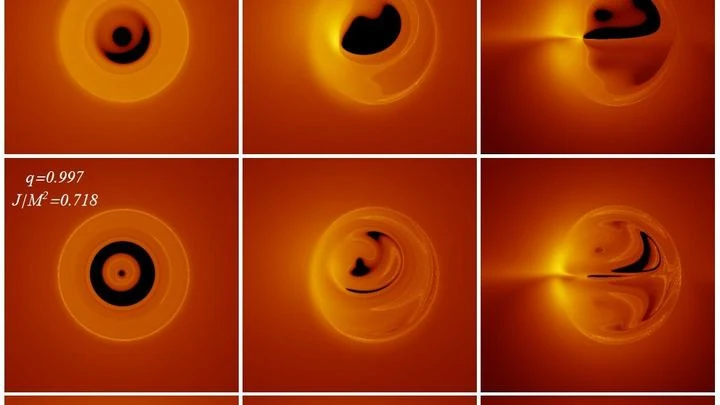
The effect is taken into account in high-precision satellite positioning (e.g., orbit corrections in GPS/GLONASS systems). For compact objects like neutron stars and black holes, frame-dragging can cause observable precession of accretion disks and jets. In strong fields, the weak-field approximation is inapplicable, and numerical solutions of the full Einstein equations are required.
In practice
The Lense–Thirring effect is accounted for in GPS navigation satellites and measured using high-precision gyroscopes like Gravity Probe B to test General Relativity.
Fun fact
The Lense–Thirring effect is so tiny that the gyroscopes of Gravity Probe B had to be the most spherical objects ever made by humans, with deviations from a perfect sphere of only 40 atomic layers.
The mirror races along at nearly forty thousand kilometers per second. Light that strikes it bounces back, but changed, like a ball volleyed by a racket in mid-swing. That's exactly the kind of mirror scientists have built inside an ultra-thin glass thread filled with hydrogen.
First, a powerful laser pulse is sent down the fiber.
When a proton is smashed apart in an accelerator, quarks and gluons fly out. But you never see them free: almost immediately they stick together into new particles, like droplets of mercury merging into spheres.
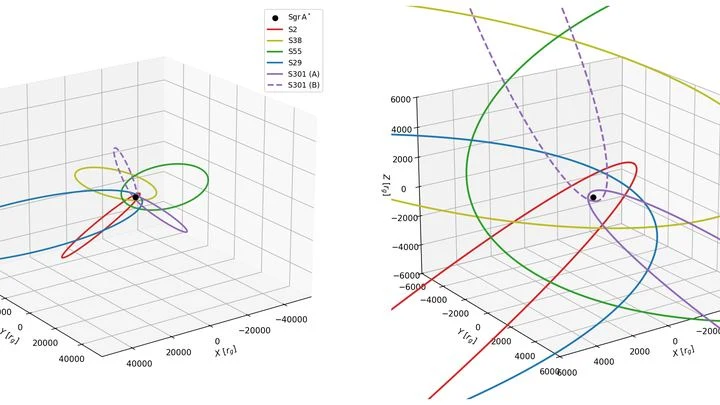
26,000 light-years from Earth, in the heart of the Milky Way, star S301 tears through space at 18,000 kilometers per second. It loops around the supermassive black hole Sgr A* on an elongated orbit. At its closest approach, just 280 gravitational radii separate the star from the black hole — roughly the distance from the Sun to Uranus.
A light ray passing by a massive body gets deflected: this is the effect of gravitational lensing, familiar from images of distant galaxies. The astrophysicists started with a rotating black hole (Kerr spacetime) and added a tiny correction to how light itself propagates.
According to Einstein's general theory of relativity Albert Einstein, a massive rotating body drags the fabric of spacetime along with it, much like a spoon twirled in a jar sets thick honey flowing.
A cosmic ray approaches a black hole almost tangentially. Instead of falling straight in, it lingers on an unstable orbit, like an acrobat balancing on a tightrope over an abyss. After a few loops, the light finally escapes toward a distant observer. Such rays produce multiple images of the same source, known as higher-order images.
The early universe was a restless place. Space trembled with gravitational waves — ripples in the very fabric of reality. In this churning cauldron, dark matter is thought to have been born. But the newborn particles had no mass: it had to come from somewhere.
Usually, the Higgs field is responsible for mass.
Imagine two neutron stars, compressed to the size of a metropolis yet weighing one and a half Suns each. They whirl in an unrestrained gravitational dance, drawing together and flying apart every 4.4 hours. At periastron — the point of closest approach — only a couple of light-seconds separate them, and their speed reaches three and a half million kilometers per hour.
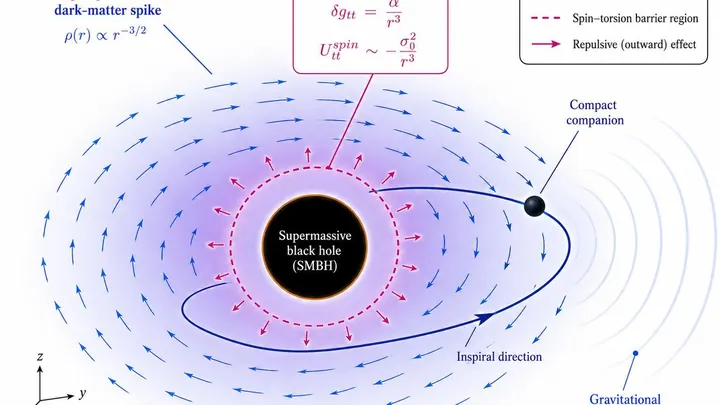
A supermassive black hole drifts through a cloud of dark matter. In the usual picture, this invisible substance just adds mass and barely interacts with ordinary matter. But dark matter particles could have intrinsic rotation — spin.
When a piano falls into an abyss, we think about the abyss. We don't think about the piano's cover. In much the same way, astrophysicists have for decades studied extreme close encounters between small bodies and massive black holes. They focused on the black hole itself and what orbits it. But what the 'bullet'—the small object heading toward doom — is wearing, almost no one asked.
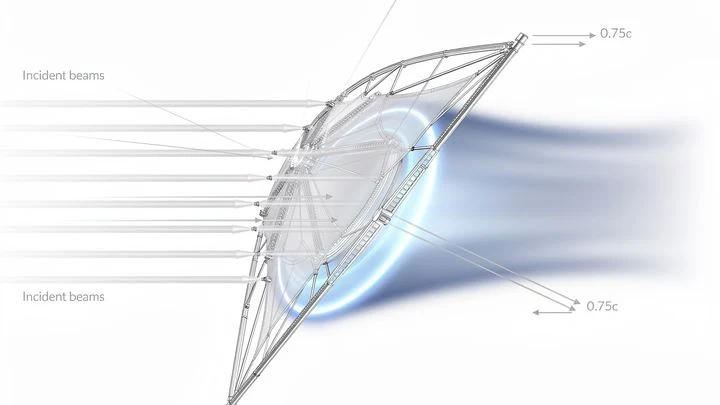
Imagine a three-faced dancer on the crest of a light wave. One face is a catcher, absorbing incoming photons. The second is a perfect mirror, throwing light back. The third is frosted glass, scattering rays in all directions. As long as speed is low, the dance is harmonious. But at near-light speeds, the choreography breaks.
This is like a surfer chasing a wave.
A black hole isn’t a perfectly smooth ball. Einstein’s theory allows invisible 'hair' — clumps of scalar field — to swarm around it, warping spacetime. The shadow — the dark region from which light can’t escape — was predicted by Penrose in the 1960s.
Imagine an air mattress being stretched, with a whirlpool of water spinning on it. As you stretch, the whirlpool tightens: its size relative to the whole surface shrinks.
Two black holes smash head-on at full speed — while a third one circles nearby. In ordinary life, such a crash would produce a burst of gravitational waves (ripples in space, like the ripples from a stone thrown into a pond). But here, part of the ripple passes by the massive neighbor, and changes, like light in a funhouse mirror.
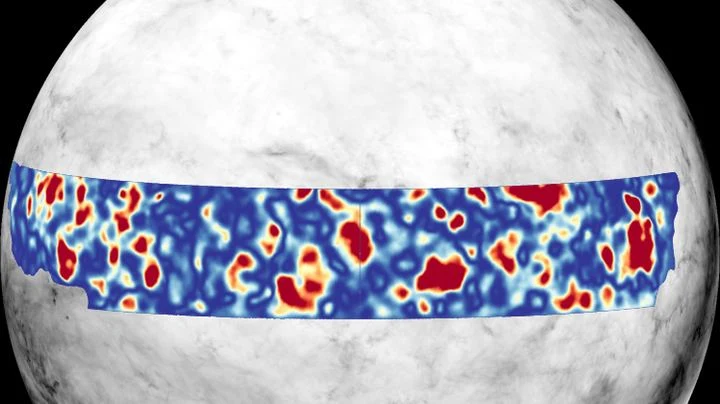
Moving clumps of galaxies and invisible dark matter create wakes in the afterglow of the Big Bang, like boats stirring a pond. This wake, the moving lens effect, is so subtle it shifts the light’s temperature by only a few millionths of a degree: comparable to detecting a candle’s heat from across a continent.
A flashlight beam glides over uneven glass. The glass is massive galaxy clusters, and the flashlight is ancient light born shortly after the big bang. Passing by such clusters, light doesn't just bend around them like water around a rock. Its path shifts slightly sideways, and the amount of shift depends on how the light is 'twisted'—right or left.
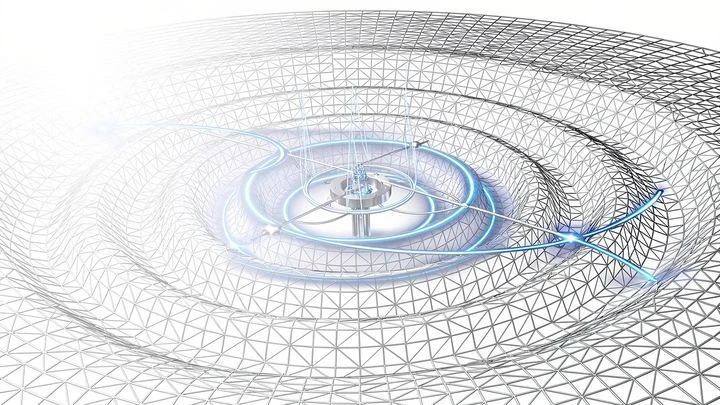
Our Universe behaves like a stretched elastic sheet: massive bodies dent it, creating spacetime curvature — gravity. In brane-world theory, a hidden dimension is added, and this sheet becomes just a surface in a higher-dimensional space. The brane tension determines how much the sheet dents: the weaker the tension, the weaker the gravity.
The Universe speaks two fundamental languages — gravity and light. Under normal conditions, they do not mix: gravitational waves glide through matter without a trace, while photons dance in mirror labyrinths.
Place two identical alarm clocks on a table and set them off at the same time. If one is on a slippery surface and starts to slowly slide, its timing will be thrown off, and within a minute they'll ring out of sync. That's roughly how the new method proposed by astrophysicists for supermassive black holes works.
The fabric of space bends under weight, like a stretched trampoline. Gravitational waves — ripples spreading from cosmic cataclysms, such as merging black holes. If such a ripple encounters a massive galaxy or invisible dark matter, they act like a magnifying glass: bending and amplifying the signal.
A juggler tosses clubs while sitting on a spinning chair. If he starts spinning the clubs all in one direction, the chair will rotate the opposite way — otherwise, the conservation of angular momentum would be violated.
At the center of a vast funnel sucking everything in, a small ball spirals inward. As it orbits, a low hum arises: it's spacetime itself trembling, and we call that trembling gravitational waves. The frequency rises, the pitch climbs, just like the sound of a siren from a passing ambulance.
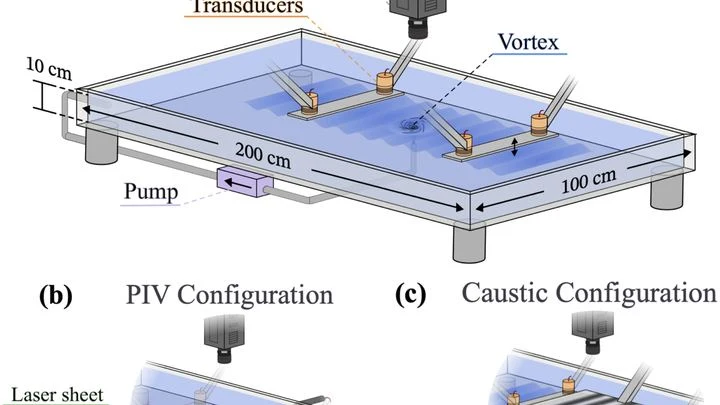
Water going down the drain swirls into a vortex. An everyday sight in the kitchen. But this very vortex turned out to be able to reproduce two effects that physicists usually associate with black holes and the rotation of planets.
The first effect is the shift of a wave as it goes around an obstacle.
According to Einstein's theory, massive objects cause spacetime curvature, like a heavy ball warping a rubber sheet. As they accelerate, they create ripples — gravitational waves, akin to the circles from a stone dropped in a pond.
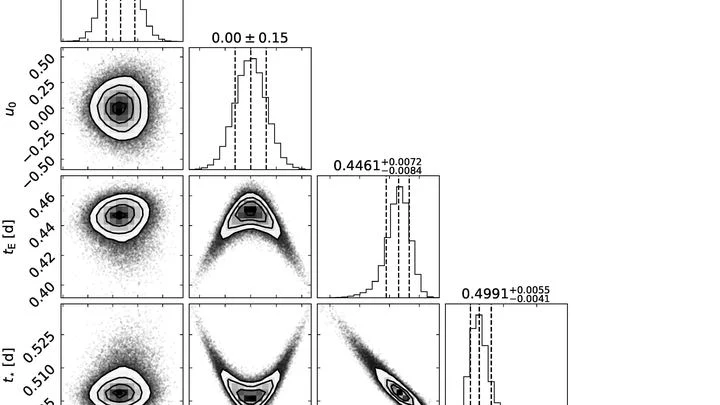
The lone planet KMT-2024-BLG-0816, one of many free-floating planets, was discovered when its gravity acted like a magnifying glass for a few hours. Passing in front of a distant star, the invisible body warped space like a glass marble, and boosted the background light.
In the darkness of interstellar space drift millions of rogue planets — worlds not bound to any star. They are almost impossible to see, but when such a wanderer passes in front of a distant star, its gravity bends the light and momentarily creates a cosmic magnifying glass.
A black hole doesn't just suck in matter — like a giant cosmic whirlpool, it warps the very fabric of reality and bends light rays around itself, focusing them. The effect is even stronger for black holes that spin at nearly the speed of light: their rotation twists space into a tight spiral.
According to Einstein's theory, Earth's rotation drags space-time itself along — like a spoon dragging thick honey. This effect is incredibly weak: about one revolution in billions of years. But it can be caught.
An electron gliding over invisible hills and valleys created by a spin texture: that is the picture behind a new chapter in condensed matter physics. In quantum materials where the direction of localized spins varies smoothly (a spin texture), an electron is no longer just a particle flying through the lattice.