The Dim Glow of Black Holes Won't Save the Universe express
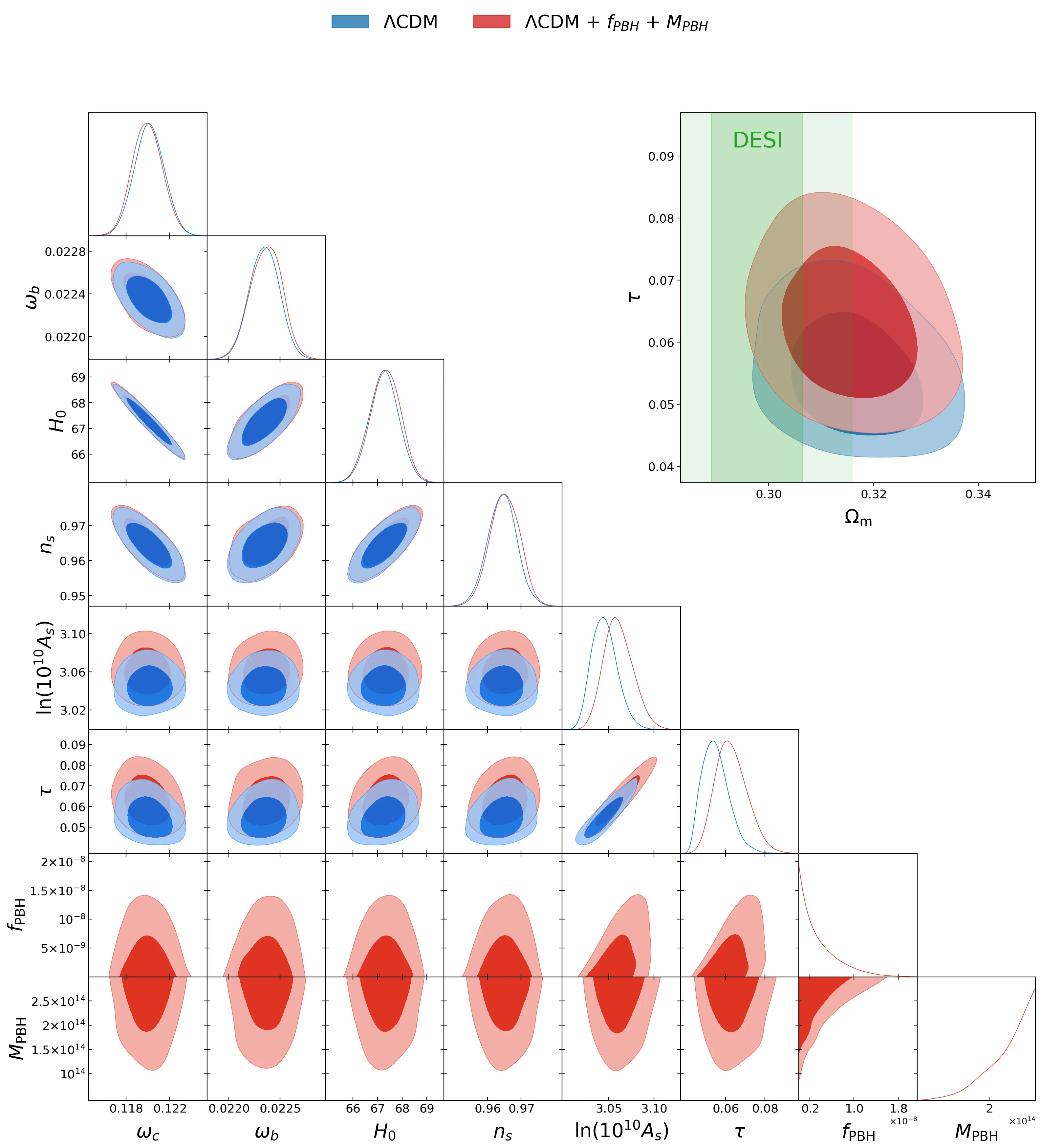
Cosmologists are facing a curious situation: two reliable tools draw slightly different maps of the same universe. One tool is the map of ancient light (the cosmic microwave background), and the other is the map of galaxy distribution. They broadly agree, but in details they diverge. Galaxies show that there's a bit less matter around us than the ancient light predicts. And the ancient light itself looks as if gravity on its way to us bent it a bit more.
A team of scientists tested an idea that could fix this. They proposed that after the universe cooled and became transparent, a temporary fog of free electrons appeared. Such a fog could arise if tiny primordial black holes, those that might have been born in the first moments after the Big Bang, were evaporating in space. As they evaporated, they would heat the surrounding gas, making it opaque to light particles again.
The authors honestly tested this hypothesis against all available data, including the most precise maps of ancient light. They allowed their model to add fog at different stages of cosmic history to find the best match. The result was modest. The extra blurring such black holes could produce was at most 0.008. That's like trying to darken a sunny day by splashing a teaspoon of water into the air. To completely remove the discrepancy between the maps, you'd need a fog density of 0.03—almost four times more.
So the puzzle remains. Nature didn't take the simplest path, and astronomers will have to look for another explanation for why the maps of the past and present don't quite align. Perhaps the answer lies not in new particles but in more subtle details of how we measure the cosmos itself.
Original abstract
as written by the authors arXiv:2608.01919v1
BAO and CMB data are somewhat discrepant when interpreted in the context of $$\Lambda$$cdm, discrepancies that show up as a `matter density deficit' and as a `CMB lensing excess'. One possible resolution is an increased optical depth to scattering off of free electrons in the post-recombination universe, $$\tau$$, a possibility raised by Sailer et al. 2025 and Jhaveri et al. 2025. Since Planck measurements of the low-$$\ell$$ polarization `reionization bump' already constrain $$\tau$$ from standard stellar-driven reionization at $$z<10$$, we investigate additional optical depth sourced by transient or partial reionization at higher redshift from exotic processes. For specificity, we explore the impact of Hawking radiation from a monochromatic spectrum of primordial black holes, retaining the high-$$\ell$$ $$TT/TE/EE$$ data that constrain such histories and varying the reionization redshift jointly. We find that the CMB data do not significantly prefer these additional signals: the boost is at most $$\Delta\tau \simeq 0.008$$, well short of the $$\Delta\tau \simeq 0.03$$ that would completely eliminate the moderate discrepancy. The matter density deficit and the lensing excess are not significantly eased: we explain why, tracing it to compensation from the reionization redshift and the residual PBH signal at $$\ell > 30$$.
Primordial black holes with the mass of a small asteroid (a billion tons) evaporate over a timescale comparable to the age of the Universe. Their final moments should look like a short but extremely bright flash of gamma radiation.
In Terry Goodkind's novel Pillars of Creation, the heroes seek a way to hide from an all-seeing enemy by distorting the surrounding reality — much like dark matter and invisible black holes distort the light from distant galaxies for us.