phenomenon

cosmic microwave background obscuration

Cosmic dust and particles masking the primordial radiation from the universe's early moments.
41 related articles

Description

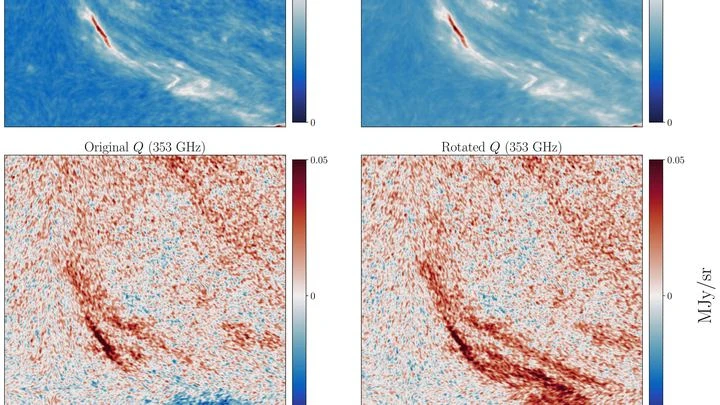
The cosmic microwave background (CMB) is the oldest light in the universe, emitted about 380,000 years after the Big Bang. However, this primordial radiation is not directly observable in all directions: cosmic dust and particles within our galaxy and along the line of sight can absorb, scatter, or polarize the CMB photons, obscuring the pristine signal. This obscuration is a major challenge for cosmologists who seek to measure the CMB's temperature fluctuations and polarization patterns with extreme precision.

History

The CMB was discovered in 1965 by Arno Penzias and Robert Wilson, and the problem of foreground contamination was recognized immediately. The first precise maps from the COBE satellite (1989–1993) had to account for galactic dust, and subsequent missions like WMAP and Planck developed increasingly sophisticated foreground-removal techniques.

How it works

Interstellar dust grains absorb CMB photons and re-emit them at longer wavelengths, creating a foreground that contaminates the signal. Free electrons in ionized gas can scatter CMB photons via Thomson scattering, altering their direction and polarization. Additionally, gravitational lensing by intervening matter distorts the CMB's path, subtly changing the observed pattern. To recover the original signal, astronomers must model and subtract these foregrounds using multi-wavelength observations, since dust emits differently at various frequencies than the CMB itself.

In practice

Foreground subtraction is essential for all CMB experiments, including Planck, the South Pole Telescope, and future missions like CMB-S4, which aim to detect the faint B-mode polarization signature of primordial gravitational waves.

Fun fact

Dust in our own Milky Way galaxy emits a faint glow at microwave frequencies that is hundreds of times brighter than the CMB signal in some regions, making the galactic plane nearly 'blind' to cosmologists studying the early universe.


Concept graph →

Related articles · 41

Cosmology2026-08-052 minarXiv:2608.05296express
Cosmic Light Changes Polarization
Light from the hottest stage of the universe has been traveling toward us for nearly 14 billion years. This is the cosmic microwave background — a faint glow filling the entire sky.
Cosmology2026-08-032 minarXiv:2608.01919express
The Dim Glow of Black Holes Won't Save the Universe
Cosmologists are facing a curious situation: two reliable tools draw slightly different maps of the same universe. One tool is the map of ancient light (the cosmic microwave background), and the other is the map of galaxy distribution. They broadly agree, but in details they diverge.
HEP Phenomenology2026-07-311 minarXiv:2607.29682express
Dark Photons from a Wobbling Field
In the first moments after the Big Bang, the universe expanded at an incredible rate — a phase known as inflation. Even the vacuum was restless back then: quantum jitters shook the fields like wind rustling through a wheat field.
High Energy2026-07-282 minarXiv:2607.25261express
Explosions That Weighed Dark Matter
The universe is like a vast invisible scaffold. We don't see it directly, but we know it's there: galaxies and clusters hold together thanks to it. This scaffold is dark matter. The most popular version says it is "cold," made of heavy, slow-moving particles.
Cosmology2026-07-262 minarXiv:2607.23527
Wind from Cygnus: First Directional Limits from MIMAC
264 kilometres per second — that's how fast the Solar System hurtles through the cloud of dark matter. Its existence was given away by galaxies: they spun too fast to be held by visible mass, and Vera Rubin was first to suspect a hidden scaffolding.
Cosmology2026-07-204 minarXiv:2607.18528
Cosmic Hot Tap: How Primordial Black Holes Rewrite the Speed of the Universe
The universe cooled like a giant bathtub after a hot start. At 400 000 years after the Big Bang, hydrogen was ready to recombine — protons capturing electrons to become neutral atoms. But somewhere in this dark water, a tap kept dripping.
Catching the Neutrino Wind: Why the Faintest Breeze in the Universe Demands the Impossible
In the first seconds after the Big Bang, the Universe left us not only light but also something far more elusive — the relic neutrino background. This echo of creation permeates every cubic centimeter, yet we barely notice it.
The Voice of Light: How Secret Rings Reveal Themselves in the Disk of CI Tau
Two million years away, around the young star CI Tau, a gas-dust disk whirls — a protoplanetary cradle. ALMA observations have already shown rings and gaps in it, but the finest details remained invisible: their width is smaller than the instrument's resolution.
Cosmology2026-07-014 minarXiv:2607.00764
The Universe Isn't Getting Younger: Ancient Stars Rule Out "Early" Solutions
The standard cosmological model ΛCDM, where dark matter and dark energy act as the chief architects of the cosmos, has predicted astronomical data with Swiss-watch precision for decades. Its foundation was laid by three geniuses.
Cosmology2026-06-291 minarXiv:2606.30903express
A Cosmic Compromise: One Number Settles Three Disputes
Cosmology is like an orchestra where different sections suddenly start playing out of sync. Measurements of the universe's expansion rate (the Hubble constant) from the early and late universe give different numbers.
Cosmology2026-06-181 minarXiv:2606.19837express
Where Does the Universe's Matter Go?
The universe is like a vast warehouse where a strict inventory was taken long ago. The cosmic microwave background is an ancient record of everything in stock 380,000 years after the big bang. According to it, the fraction of matter in the cosmic 'budget' (the parameter Omega_m) is known with high precision.
Galaxies2026-06-112 minarXiv:2606.12909express
Dark Matter Clumps into Dense Cores
A giant cloud of invisible matter acts like a funhouse mirror — distorting the light from a distant galaxy. From these distortions, astronomers can weigh the cloud and peer into its depths.
Galaxies2026-06-112 minarXiv:2606.13761express
Dark Cloud Near Black Hole Barely Melts
At the center of the Milky Way, like a matryoshka doll within a matryoshka doll, lies a supermassive black hole, surrounded by a swarm of stars and an invisible shell of dark matter. This shell, or "spike," is expected to be extremely dense right at the horizon.
Cosmology2026-06-101 minarXiv:2606.12521express
Dark Matter Decays and Slows the Universe's Growth
The Universe grows like a metropolis: galaxies skyscrapers are erected on an invisible scaffold of dark matter: its gravity pulling in construction material. Meanwhile, dark energy makes the city itself continuously expand.
HEP Phenomenology2026-06-052 minarXiv:2606.07106express
Invisible Particles Leave Their Mark on Ancient Light
An old photograph taken at the moment of the universe's birth has been carrying its light to us for nearly 14 billion years. This snapshot is the cosmic microwave background, the cooled echo of the Big Bang. It captures the tiny inhomogeneities from which galaxies later grew.
Cosmology2026-05-252 minarXiv:2605.26050express
Dark Matter Decays, the Universe Smooths Out
On the kitchen counter, there's a flour scale and a measuring cup for water. Individually, they're precise, but when you bake bread, the recipe calls for the perfect ratio. Astronomers have a similar dispute about the universe's expansion rate.
Cosmology2026-05-212 minarXiv:2605.22934express
Radio Echo from the Cosmic Dark Ages
The cosmic microwave background is the afterglow of the Big Bang, which we see at millimeter wavelengths. But it also has a long-wavelength tail extending into the radio range.
Cosmology2026-05-192 minarXiv:2605.19375express
A Moon-Sized Shadow in the Milky Way's Halo
A spotlight shines through a dark hall. Between the lamp and the wall, an invisible lens drifts by, and the spot of light briefly brightens and shifts. That is exactly what the DECam telescope, aimed at the Large Magellanic Cloud, a satellite galaxy of our Milky Way, was watching for five consecutive nights.
High Energy2026-05-191 minarXiv:2605.19653express
Invisible Middleweight Black Holes Discovered
Black holes come in lightweights, born from dying stars, and supermassive ones at galactic cores. The missing intermediate link had been hiding. Fast radio bursts, cosmic signals lasting milliseconds but carrying the energy of days of sunlight, helped crack the case. Think of these bursts as cries from the depths of the universe.
Cosmology2026-05-162 minarXiv:2605.16945express
Light Twists in the Universe's Lens
A flashlight beam glides over uneven glass. The glass is massive galaxy clusters, and the flashlight is ancient light born shortly after the big bang. Passing by such clusters, light doesn't just bend around them like water around a rock. Its path shifts slightly sideways, and the amount of shift depends on how the light is 'twisted'—right or left.
Cosmology2026-05-112 minarXiv:2605.11079express
Invisible Seeds of Galaxies
Frozen cake batter is dotted with tiny raisins. If the batter is uniform, all the raisins will puff up evenly, and the cake will be smooth. But if the batter has denser spots (some sweeter, some more bland) the raisins will be distributed unevenly: dense in some places, sparse in others.
Galaxies2026-05-072 minarXiv:2605.06896express
Cosmic Dust Reveals the Anatomy of Magnetic Ripples
A dust storm that has raged for millions of years is not in a desert but between the stars. There, clouds of tenuous gas drift, threaded by magnetic fields. These fields align dust grains like compass needles along field lines. When such dust emits, its light becomes polarized: it oscillates in a single plane, like a rope shaken only up and down.
Galaxies2026-04-292 minarXiv:2604.26439express
Record-Breaking Cloud: How TMC-1 Doubled Our Chemical Inventory
A giant cloud of gas and dust, so cold that its warmth barely flickers, just a few degrees above absolute zero. This is TMC-1 in the constellation Taurus, one of the darkest and densest cradles of molecules in our Galaxy. In recent years, it has become a true treasure trove for astrochemists: the number of substances found there has more than doubled.
Cosmology2026-04-282 minarXiv:2604.26072express
Cosmic Web Alters the Glow of Dark Matter
The universe resembles a giant sponge: bright filaments of galaxies weave around enormous dark voids. Inside these filaments and walls hide clumps of invisible dark matter — halos. When dark matter particles collide and decay, they produce ordinary particles that telescopes can catch.
Galaxies2026-04-101 minarXiv:2604.09347express
Dead Galaxies That Still Breathe
Five galaxies that long ago stopped igniting new stars look like houses with darkened windows. But the ALMA radio telescope and the James Webb Space Telescope peered inside and saw that in these 'sleeping' houses, a fire still smolders.
Exoplanets2026-03-312 minarXiv:2603.29700express
A Cannabis Signature in the Atmosphere of a Distant Planet
Light from a distant star, passing through the atmosphere of planet K2-18b, left unusual "fingerprints" in its spectrum. Astronomers spent 420 hours collecting this light with the James Webb Space Telescope and split it into colors, like a rainbow.
Tiny Detectors Catch the Light of the First Moments
Light that has traveled to us for nearly 14 billion years is like an old photograph whose details emerge with careful processing. The cosmic microwave background (the afterglow of the Big Bang) holds the imprint of the universe's first moments, but its signal is faint and distorted.
Galaxies2026-03-171 minarXiv:2603.16796express
A Magnetic Map Around a Black Hole
Radio waves passing through magnetized gas have their polarization slightly rotated, like a compass needle deflecting near a magnet. This rotation, called the Faraday effect, revealed the invisible environment around the supermassive black hole in galaxy NGC 1275.
Cosmology2026-03-151 minarXiv:2603.14287express
Cosmic Dust: The Ashes of Stars Silencing the Big Bang Echo
Astronomers are trying to capture the radio echo of the Big Bang — a faint glow that fills the entire universe. But the receiver is choking with noise: our Galaxy is packed with glowing interstellar dust, whose emission can easily be mistaken for a signal from the distant past.
HEP Phenomenology2026-03-101 minarXiv:2603.09615express
The Hidden Glow Before the Blast
When a massive star runs out of fuel, its core collapses and a shock wave races outward. But even before the star tears apart, particles that barely interact with ordinary matter may be born in its depths. If they decay into light, that energy leaks into the dense gas around the star. This gas, like a blanket, wraps the star.
Stellar2026-03-081 minarXiv:2603.07481express
Cosmic Clocks: JWST Measures the Age of Clusters
Globular clusters are dense stellar archives, where the youth of the Galaxy is recorded. But reading this chronicle was hindered by imprecise chronometers: age estimates diverged by a billion years.
Galaxies2026-02-252 minarXiv:2602.21502express
A Galaxy Wakes Up Before Our Eyes
Deep in the constellation Ophiuchus lies the galaxy NGC 6447. Until recently, it was quiet and unremarkable, like a house with its windows dark. But over the past 14 years, something has ignited at its center, and now it's visible in infrared light.
Cosmology2026-02-181 minarXiv:2602.16659express
The Universe Without Its Longest Waves
The universe is like an ocean, where waves of different lengths roll onto the shore. The longest waves are the giant fluctuations in the distribution of matter that we see in the cosmic microwave background. Standard theory says such waves should exist on all scales.
Cosmology2026-02-042 minarXiv:2602.04528express
The Dust That Blurs the Birth of the Universe
The cosmic microwave background is a faint glow left over from the Big Bang, like the cooling embers of a campfire. It encodes gravitational waves that may have arisen in the first fractions of a second, when the universe inflated faster than light.
Cosmology2026-02-031 minarXiv:2602.03110express
Gravity Bends Light More Than Expected
Light from distant galaxies passes through clumps of matter, and the gravity of those clumps slightly bends its path, like a lens. By measuring how much the images of distant galaxies are distorted, we can infer the distribution of matter and how gravity affects light.
Galaxies2026-01-262 minarXiv:2601.18269express
Cosmic Traffic Light: Why a Bright Galaxy Fooled Astronomers
Light from a distant lantern reflects off the surrounding fog, and from the delay of the reflection you can infer the distance. If the fog is uneven, the reflection arrives earlier or later, and the distance comes out wrong.
Galaxies2026-01-152 minarXiv:2601.10514express
Fossil Stars Found in Dwarf Galaxy
In the Large Magellanic Cloud, a galaxy that orbits our Milky Way, astronomers have caught five stars that look like fossils from the very distant past. They contain almost no metals, only one-hundredth to one-thousandth of what the Sun has, but they have tens of times more carbon.
Popular Physics2026-01-101 minarXiv:2601.06592express
The Invisible Threads of the Cosmos
The night sky is full of stars, but they are only a small part of everything that exists in the universe. Astronomers have long noticed a strange thing: galaxies rotate so fast that they should fly apart, yet they don't. Something invisible holds them together, like invisible threads linking beads on a spinning wheel. This "something" was named dark matter.
Cosmology2026-01-081 minarXiv:2601.05235express
Dark Energy Controls the Weight of Dark Matter
Dark energy and dark matter are the invisible conductors of the cosmos. Usually considered independent, new research proposes seeing them as dance partners. The lead — dark energy — changes the mass of dark matter particles. Like a dancer who lifts and lowers their partner, dark energy increases or decreases the weight of dark matter.
Cosmology2026-01-031 minarXiv:2601.01034express