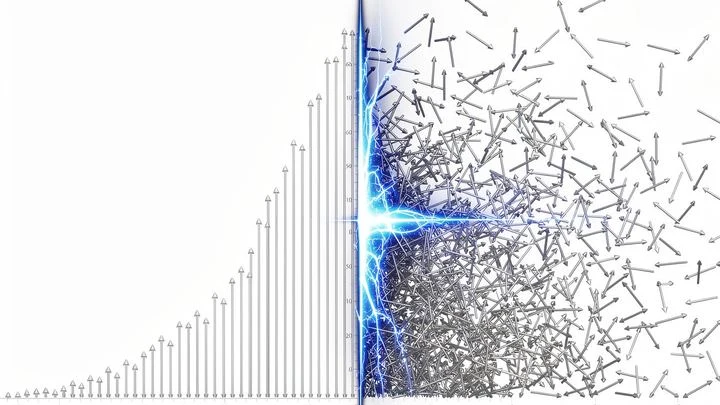
The black hole mass gap refers to a range of masses in which black holes are rarely observed, typically between roughly 3 and 5 solar masses (the upper limit for neutron stars) and about 65 solar masses (the lower limit for black holes formed from certain stellar collapse processes). This gap is not absolute but represents a statistical deficit: astrophysical processes that create black holes tend to produce either lighter ones (from core-collapse supernovae) or heavier ones (from mergers or other channels), leaving a 'forbidden zone' in between. The existence of this gap provides crucial clues about the physics of stellar evolution, supernova explosions, and the behavior of dense matter.
History
The concept of a mass gap was first proposed in the late 1990s based on theoretical models of stellar evolution, but it gained prominence after the first gravitational wave detections by LIGO in 2015, which found black holes both below and above the predicted gap, challenging simple models.
How it works
The gap arises because of two competing effects. On the low-mass side, stars that would produce black holes in the 3–5 solar mass range instead undergo a supernova explosion that leaves behind a neutron star, or the explosion completely disrupts the star, leaving no remnant at all. On the high-mass side, very massive stars lose mass through strong stellar winds before they collapse, so the resulting black hole is typically less than about 65 solar masses. However, black holes can also form through mergers of smaller black holes, which can produce objects in the gap, but these are rarer. The exact boundaries depend on metallicity, rotation, and other stellar properties, making the gap a sensitive probe of stellar astrophysics.
In practice
The mass gap is used to calibrate models of stellar evolution and supernova physics, and it helps astronomers interpret gravitational wave signals by predicting which merger events are likely to involve black holes from different formation channels.
Fun fact
The first gravitational wave event ever detected, GW150914, involved two black holes of about 36 and 29 solar masses, both of which lie in the predicted mass gap, showing that the gap is not empty but just sparsely populated.
You don't hold a ruler right up to an invisible disk; you measure it across the entire universe. Light from a distant quasar, a blazing gas swirling around a supermassive black hole, passes through a lensing galaxy on its way to us.
It's like a sprint record: to break it, you need a perfect run-up. But for sub-millisecond pulsars, the run-up is too short. The fastest known pulsar, PSR J1748-2446ad, spins 716 times per second — faster than a kitchen blender. If it were the size of Earth, a point on its equator would move at about 0.24 times the speed of light. But why doesn't any pulsar spin even faster?
A black hole is like a spinning top that never stops on its own. But if a cloud of ultra-light particles, bosons, forms around it, the picture changes. This "fog" acts like an invisible brake: the particles drain the hole's spin, slowing it down.
Cosmologists are facing a curious situation: two reliable tools draw slightly different maps of the same universe. One tool is the map of ancient light (the cosmic microwave background), and the other is the map of galaxy distribution. They broadly agree, but in details they diverge.
In the dark outskirts of our Galaxy, far from bright star clusters, millions of black holes lurk. They are invisible: they don't shine and don't noticeably accrete matter. Conventional search methods, designed for dense stellar fields, are useless here. A different approach is needed.
Astronomers have proposed using the very fabric of space as a detector.
In the first moments after the Big Bang, the universe was a searing 'soup' of particles. As it cooled, phase transitions occurred — much like water turning to ice. At one such moment, magnetic monopoles of dark matter could have been born: tiny clumps of field with a single magnetic pole.
Layer by layer, artifact by artifact — an archaeologist reconstructs the history of an ancient settlement. Similarly, astrophysicists sifting through 259 records from LIGO–Virgo–KAGRA saw a clear layered structure among merging black holes.
Dark matter remains the inaudible bass line of the cosmic symphony — it emits no light, but its gravitational pull shapes galaxies. Vera Rubin first caught this rhythm in the 1970s by observing the rotation of stars.
The quantum world is often compared to a musical instrument. Each system, whether an atom or a chain of particles, sounds at its own frequencies, which physicists call energy levels. In chaotic systems, like an orchestra without a conductor, these frequencies usually fill the entire available range without gaps.
The mergers of black holes, first predicted by Karl Schwarzschild, are the main source of gravitational waves picked up by LIGO detectors. Over the years, 259 events have accumulated, each one an encrypted birth story of a pair. But is there a hidden system in this data?
Waves sort pebbles on a sandy beach. Small stones lie close together, nearly identical in size. Farther from shore, there's a scatter of larger and more varied ones. And right at the waterline, where the surf is strongest, the biggest and most rounded fragments pile up. Nature sorts black holes by mass in much the same way when they merge in pairs.
In the 1930s, Fritz Zwicky first noticed that galaxies in clusters were moving too fast — something invisible was holding them. Later, Vera Rubin measured the rotation of spiral galaxies, confirming that space is permeated by dark matter.
Among the precious scatterings of the early Universe captured by James Webb, there are objects that resemble ruby beads scattered on black velvet. These are the 'little red dots' (LRDs) — compact sources with steep red spectra, inside which lurk supermassive black holes up to a hundred million solar masses.
If you squeeze a handful of sand, it gets denser, but at some point the grains press against each other: there's no more room to compress. Some theorists think space behaves similarly at ultra-small distances: it has a limit to divisibility, a kind of 'grain.' In this new study, that principle was applied to the birth of black holes in the early universe — the very ones that…
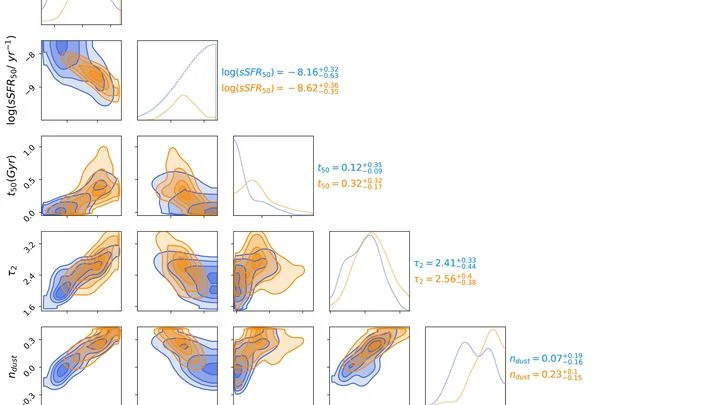
The city has long been asleep: not a single lit window, not a single new house. Only in the very center, in one lone building, someone forgot to turn off a spotlight. That's what a galaxy looks like when stars are no longer born, yet its central black hole still shines.
Two figure skaters glide on the ice. One is light and cautious, barely rotating. The other is massive and fast, spinning with all its might, and in different directions at that. That's roughly the picture painted by gravitational waves from black hole mergers.
The universe hums like an orchestra: its notes are gravitational waves — ripples in spacetime predicted by Albert Einstein. The LIGO observatories, made exquisitely sensitive thanks to Rainer Weiss, strive to catch these whispers.
Our Solar System isn't an island in the void: it's a sensitive web stretched in a dark cosmic corner. Planets circle their orbits like dewdrops on threads, and we are the spider sensing the faintest tremor. That tremor betrays the approach of the catastrophe astronomers call the Big Rip.
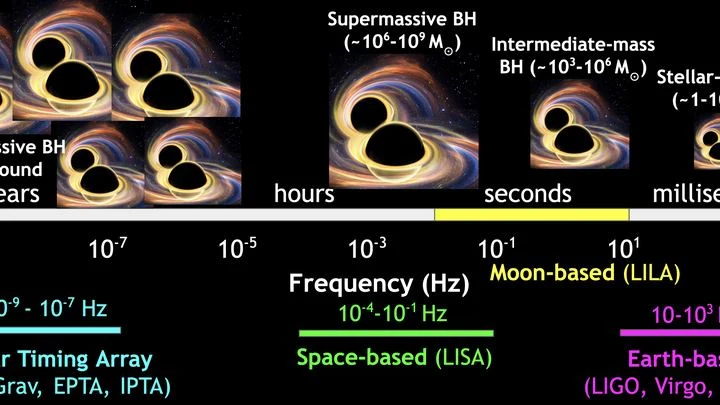
Gravitational waves are ripples in the fabric of space, like circles on water from a thrown stone. On Earth, they are drowned out by traffic, tides, and earthquakes, like a storm beating on a lake, making it impossible to notice faint splashes. The LILA project moves the detector to the Moon, where windless silence reigns.
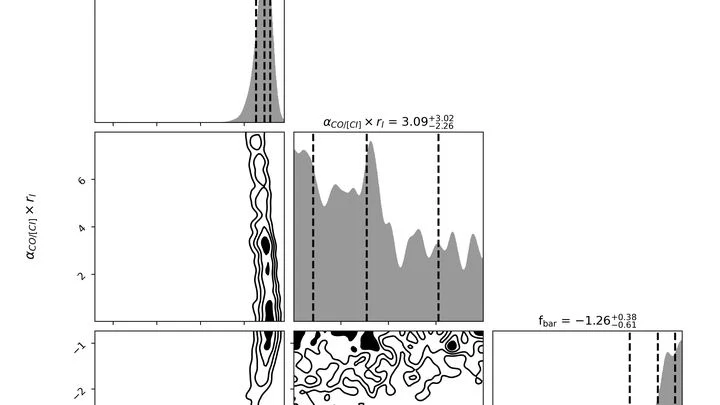
A galaxy is not a static picture but a bubbling cauldron where new stars are constantly born from tenuous gas. To understand how long this boiling will last, astronomers weigh the key ingredient — cold molecular hydrogen. It is invisible itself, but it is betrayed by carbon monoxide (CO), which shines in the radio range.
Astrophysicists have conducted a census of invisible objects that betray their presence only through the trembling of space. They studied the fresh catalog GWTC-4 — a list of dozens of black hole mergers recorded by the gravitational wave detectors LIGO, Virgo, and KAGRA.
Gravitational waves — ripples in spacetime predicted by Einstein — have exposed an abyss: black holes with masses between 60 and 120 solar masses are almost never born.
Stars tens of times heavier than our Sun don't die as thought before. Computer models show that their core often doesn't ignite a supernova, but quickly collapses into a black hole. Imagine a soufflé: the center suddenly sinks, and almost all the batter falls into the funnel, with just a few drops splashing out.
When black holes or neutron stars merge, they disturb the very fabric of spacetime, producing gravitational waves — ripples predicted by Einstein in his general theory of relativity.
In a vast dark hall, someone invisible plucks the strings. The cosmic gas, the tenuous hydrogen that filled the young universe, resembles stretched strings that can resonate at a radio wavelength of 21 centimeters. This is hydrogen whispering about its temperature.
From 2016 to 2018, at the Large Hadron Collider at CERN, protons collided at energies of 13 teraelectronvolts, as if two peas were accelerated to speeds where their impact spawns a whole swarm of new particles.
In the constellation Cetus, 65 million light-years from Earth, three dwarf galaxies nestle: DF2, DF4, and DF9. All have been declared “galaxies without dark matter” — the mysterious invisible substance that usually holds stars together.
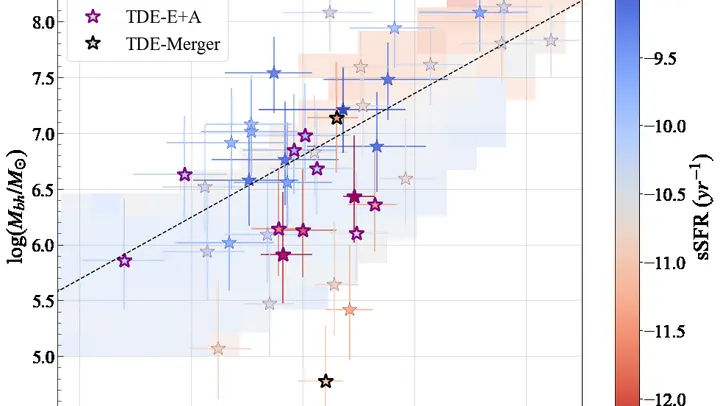
You can't see a black hole until a star wanders too close. Then tidal forces stretch the star like a cook rolling out dough, and some of the material falls into the hole, flaring up as a final goodbye. Such events, called tidal disruptions, are a rare chance to weigh a black hole that would otherwise remain invisible.
Astronomers pointed the James Webb at three galaxies whose light traveled 12 billion years. Early data pointed to incredibly fast growth — like an infant reaching adult height in just a year, clashing with the expansion of the Universe.
The black hole in the binary system Swift J1727.8-1613 flickers in X-rays like a campfire in the wind. But if you look closely at the rhythm of this flickering, you can see distinct 'humps'—bursts at specific frequencies, like drumbeats in the noise of a crowd.
Three distant galaxies spin like giant carousels. Their stars and gas move along spiral arms, and from the speed of this motion you can calculate how much total matter the galaxy contains — visible and invisible.
Astronomers combined two views: radio telescopes revealed cold gas, while the James Webb Space Telescope showed the stars.
Imagine a bridge with its middle ripped out: cars on the other side would be a surprise. That's how astronomers long viewed black holes with masses from 50 to 130 solar masses: the stars that could produce them explode as pair-instability supernovae.