Opacity is a measure of how transparent a medium is to radiation, such as light, X-rays, or radio waves. A material with high opacity blocks most radiation, while a material with low opacity allows it to pass through. This property is fundamental in fields ranging from astrophysics, where it determines how light travels through stellar interiors, to medicine, where it affects the quality of X-ray images. Opacity depends on the wavelength of the radiation and the composition and density of the material.
How it works
Opacity arises from the interaction between radiation and matter. When photons pass through a medium, they can be absorbed by atoms or molecules, exciting electrons to higher energy levels, or they can be scattered, changing direction. The probability of these interactions per unit length is quantified by the opacity. A high opacity means that photons are quickly absorbed or scattered, so the radiation cannot penetrate far into the medium.
In practice
Opacity is used to design protective shielding for radiation, to model the behavior of stars and planetary atmospheres, and to optimize medical imaging techniques.
Fun fact
The opacity of the Sun's interior is so high that a photon takes about 100,000 years to travel from the core to the surface, despite moving at the speed of light.
Light born when a fast electron enters a material is usually assumed to be the same in all directions. But in crystals where optical properties depend on direction, that's not the case. Run your hand over velvet: one way it's smooth and shiny, the other — dark and rough. Similarly, a crystal responds differently to light depending on how it's oriented.
When light hits ordinary plastic, some of it reflects, like a glare on a window. To eliminate this glare, a special coating made of tiny structures is applied to the surface, which cancels out the reflection.
A beam of light enters frosted glass and fades — nothing unusual. But physicists have long known how to make light pass through without losing a single photon. This trick is called electromagnetically induced transparency: two light waves cancel each other at the right point, and absorption disappears. Now a similar feat has been pulled off with atoms.
The universe is like a vast warehouse where a strict inventory was taken long ago. The cosmic microwave background is an ancient record of everything in stock 380,000 years after the big bang. According to it, the fraction of matter in the cosmic 'budget' (the parameter Omega_m) is known with high precision.
In astrophysics, some numbers seem random yet recur with the persistence of a spell. One such number is the ratio of X-ray brightness to H-alpha hydrogen emission in turbulent gas tails. From galactic winds to ‘jellyfish’ slicing through clusters, this ratio steadily holds at around three.
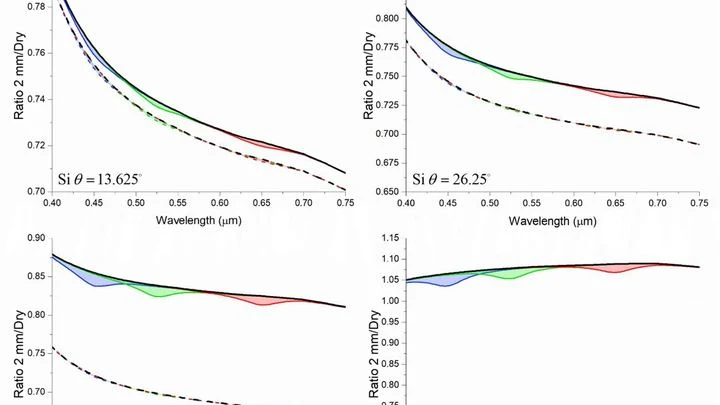
A water droplet on a leaf disappears faster under the sun than heat calculations would predict. A few years ago, a hypothesis emerged: light itself, without heating, could knock water molecules off the surface. This was dubbed the photomolecular effect. If it exists, clouds, climate, and even everyday clothes drying could work differently.
A boiling cauldron: steam rises, water churns, and the temperature varies from point to point. So it is in space: the gas clouds around young stars are not smooth spheres but a seething mixture with vortices and density fluctuations. Astronomers long treated such clouds as homogeneous, but this simplification can skew conclusions.
In Chile's Atacama Desert, at an altitude of nearly five kilometers, stands a radio telescope that catches millimeter waves from the depths of space. These waves carry the heat of distant galaxies, but first they must pass through a window — a thin plate of silicon that separates the cold receiver from the warm outside world.
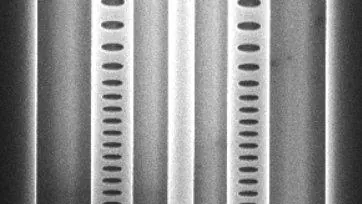
In the world of microchips, where streams of photons, quanta of light, carry information, a fundamental problem arises: light passing through matter inevitably heats it. This heating spawns thermal fluctuations — chaotic, unpredictable jostling of atoms that disrupts precise device operation.