Optical distortion refers to the deviation of light rays from their ideal paths as they pass through a lens or optical system, causing image blurring, geometric warping, or reduced beam quality. It arises from imperfections in lens shape, material inhomogeneities, or diffraction effects. In astronomy and microscopy, distortion limits the resolution and fidelity of images, so correcting it is a central challenge in optical design.
History
The study of optical distortion dates back to the early days of lens making in the 17th century, with systematic treatments by figures like Johannes Kepler and later by Joseph von Fraunhofer in the 19th century, who improved telescope lenses by minimizing aberrations.
How it works
Distortion occurs because different parts of a lens bend light by slightly different amounts, so rays from a single point source do not converge to a perfect point. This can be due to spherical aberration (rays at the edge focus differently than those at the center), chromatic aberration (different colors focus at different distances), or field curvature (the image plane is curved). In adaptive optics, a deformable mirror is used to counteract wavefront errors in real time, while computational methods can post-process images to remove known distortions.
In practice
Correcting optical distortion is vital in high-resolution telescopes, cameralenses, and laser systems, and it is also used in medical imaging to focuslight deep into tissue.
Fun fact
The Hubble Space Telescope's initial images were famously blurry due to a spherical aberration in its primary mirror, which was corrected in 1993 by installing corrective optics.
Light born when a fast electron enters a material is usually assumed to be the same in all directions. But in crystals where optical properties depend on direction, that's not the case. Run your hand over velvet: one way it's smooth and shiny, the other — dark and rough. Similarly, a crystal responds differently to light depending on how it's oriented.
Light in a gravitational-wave detector races through multi-kilometer tunnels, bouncing off mirrors. A perfectly uniform beam resembles a smooth sheet held by its corners. But if one mirror tilts by the width of an atom, the sheet develops wrinkles: 'parasitic' patterns, more complex light spots, awaken in the beam.
Previously, such wrinkles were dismissed as noise.
Cosmologists are facing a curious situation: two reliable tools draw slightly different maps of the same universe. One tool is the map of ancient light (the cosmic microwave background), and the other is the map of galaxy distribution. They broadly agree, but in details they diverge.
A light ray passing by a massive body gets deflected: this is the effect of gravitational lensing, familiar from images of distant galaxies. The astrophysicists started with a rotating black hole (Kerr spacetime) and added a tiny correction to how light itself propagates.
The Universe is a giant concert hall, where instead of walls and balconies, invisible clouds of dark matter float. This architectural ensemble is not static: it refracts and scatters the 'music' rushing through it — gravitational waves from merging black holes.
Two rulers show slightly different lengths for the same table. That's roughly the situation in cosmology with the Hubble constant — the number that tells how fast the universe is expanding.
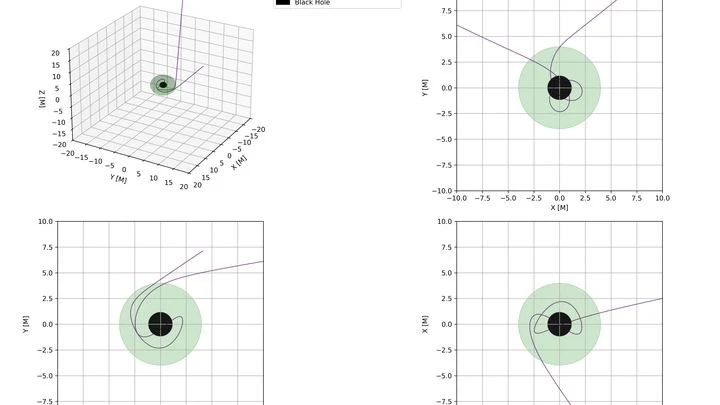
Light passing by a black hole falls into a gravitational trap: its trajectory curves and the particle bounces along a nearly closed orbit, like a pinball.
When light swings past a massive body like a black hole, its path warps — an effect predicted by Einstein. New research has taken into account that near such objects, clouds of hadrons often swirl — the very particles we know from protons and neutrons in atomic nuclei.
The tear film on the eye is an ultrathin layer of fluid that protects the cornea and keeps vision sharp. It’s usually pictured as a perfectly smooth surface, but the real cornea, even a healthy one, is covered in microscopic bumps.
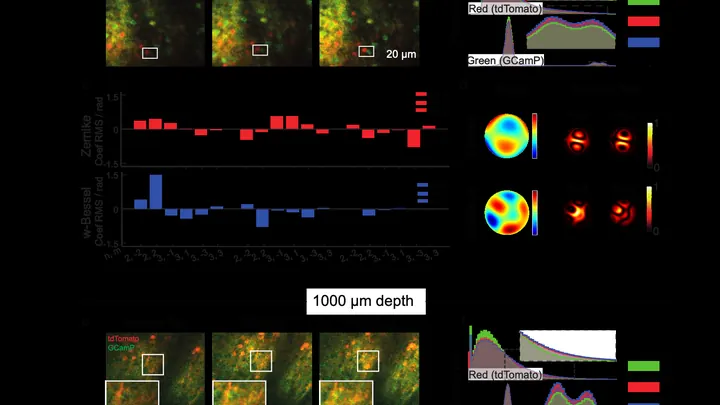
The laser beam in a three-photon microscope works like a flashlight shining through murky water. The deeper you need to illuminate, the more the water scatters light and the dimmer the picture gets.