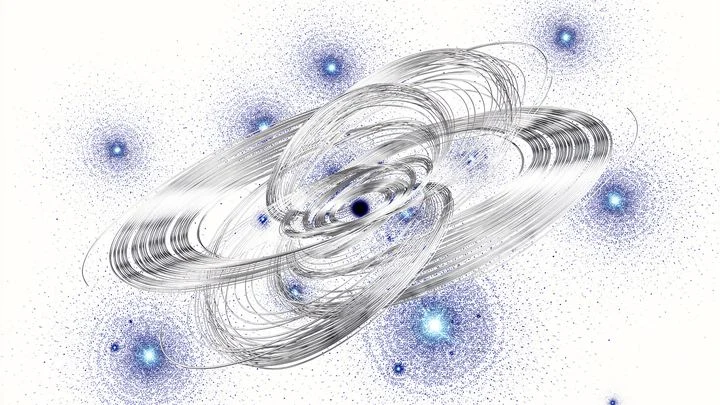
Black holedark matter interaction refers to the various ways dark matter can influence the behavior of black holes, and vice versa. Dark matter, which makes up about 27% of the universe, does not emit light but interacts gravitationally. When a black hole is embedded in a dark matter halo, the dark matter can affect the black hole's spin, mass, and the gravitational waves it emits during mergers. Conversely, black holes can alter the distribution of dark matter around them, creating dense spikes or depletion zones. These interactions provide a unique observational window into dark matter's properties, which remain largely unknown.
History
The study of dark matter's effect on black holes gained momentum in the 2000s–2010s, with the advent of gravitational wave astronomy and improved dark matter models. Earlier work focused on dark matter density profiles around black holes, but the connection to gravitational wave signals is a recent development.
How it works
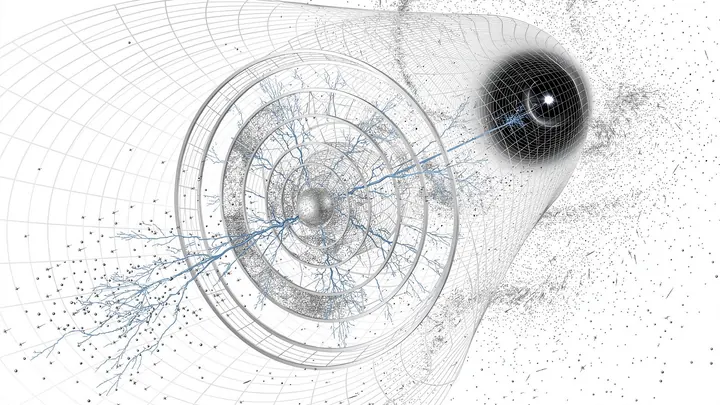
Dark matter particles passing near a black hole can be captured or scattered, transferring energy and angular momentum. This can cause the black hole to spin down or up, depending on the geometry. During black hole mergers, the presence of dark matter can modify the inspiral phase, leaving a distinct imprint on the gravitational wave signal—such as a phase shift or a change in frequency evolution. Additionally, dark matter can form a dense 'spike' around a black hole, which can affect the black hole's shadow and lensing of light.
In practice
By analyzing gravitational wave signals from black hole mergers, scientists can test dark matter models—for example, by looking for the characteristic 'dark matter drag' that would slow the inspiral. This turns LIGO and Virgo into dark matter detectors.
Fun fact
Dark matter can act like a 'cosmic brake' on merging black holes, slightly delaying the final collision and altering the gravitational wave chirp in a way that could be measured.
Cosmologists are facing a curious situation: two reliable tools draw slightly different maps of the same universe. One tool is the map of ancient light (the cosmic microwave background), and the other is the map of galaxy distribution. They broadly agree, but in details they diverge.
The universe cooled like a giant bathtub after a hot start. At 400 000 years after the Big Bang, hydrogen was ready to recombine — protons capturing electrons to become neutral atoms. But somewhere in this dark water, a tap kept dripping.
Light from distant quasars, breaking through billions of years, leaves a pattern of dark absorption lines on the cosmic film — the spectroscopic Lyman-alpha forest. Each line is like a note in a grand score, written by the hydrogen of the intergalactic medium.
Dark matter is invisible to telescopes, but its gravity was revealed half a century ago by Vera Rubin. Since then, physicists have explored dozens of hypotheses, and one of the most elegant is primordial black holes, formed in the first moments after the Big Bang.
At the center of most galaxies lurk supermassive black holes — the overlords of gravity. Since 2019, thanks to interferometry with very long baselines, we’ve glimpsed their shadows: dark silhouettes set against a blazing gas backdrop. But what exactly is painting that shadow?
At the center of the Milky Way, where the supermassive black hole Sagittarius A* reigns supreme (its metric first derived by Karl Schwarzschild), star S4714 makes a dizzying voyage.
At the center of the Milky Way, like a matryoshka doll within a matryoshka doll, lies a supermassive black hole, surrounded by a swarm of stars and an invisible shell of dark matter. This shell, or "spike," is expected to be extremely dense right at the horizon.
On May 14, 2019, LIGO detectors registered a gravitational burst that didn't fit the usual mold. Event GW190521 appeared as a collision of two black holes weighing 85 and 66 solar masses. The resulting hole of 142 solar masses landed right in the "forbidden" range — where stellar collapses leave almost no trace.
Dark matter is the invisible scaffold of the universe. It doesn't shine, but its gravity holds stars in galaxies. In some models, dark matter particles can collide and exchange energy, like molecules in warm air.
Two heavy balls orbit on the surface of a pond. Ripples spread from them: these are gravitational waves. As the balls spiral closer, the waves carry away energy, and the ripples become more frequent.
Recently, astronomers spotted three interstellar comets coming from deep space. One of them, 3I/ATLAS, turned out to be unexpectedly large: its nucleus is several kilometers across.
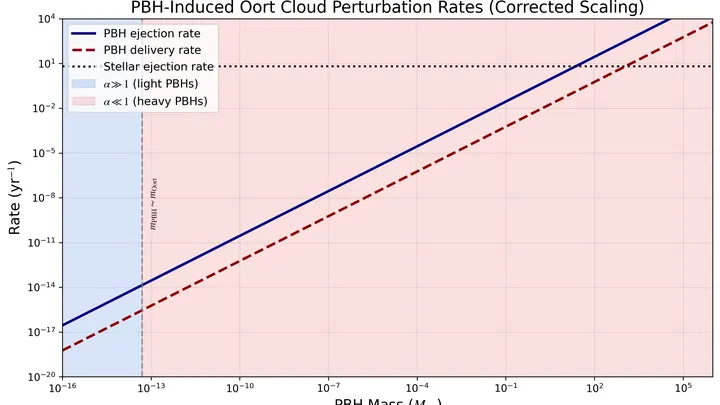
The Oort Cloud is a spherical swarm of trillions of icy bodies at the very edge of the Solar System, about a light-year from the Sun. These objects are almost motionless relative to one another until some gravitational disturbance breaks their calm.
The Big Bang was like a cosmic thunderclap that set the fabric of space vibrating. These vibrations — gravitational waves — still echo through the Universe like a fading rumble from that ancient event. The louder the initial 'bang,' the more primordial black holes should have formed.
The universe is expanding, and the rate of that expansion is a hot topic in cosmology. Nearly a century ago, Edwin Hubble discovered that galaxies are flying apart, but modern measurements of the Hubble constant, which characterizes the expansion rate, give conflicting values.
Two particles cling to each other like climbers on the same rope and fly toward a wall. When they hit, will they bounce off together, or will the rope snap? What does it depend on? Physicists considered the simplest case: everything happens on a single line, the particles attract only when they occupy the same point, and the wall is perfectly rigid.
Dark matter is an invisible substance, five times more abundant in the universe than ordinary matter. Its particles barely touch atoms, but occasionally they can nudge an electron, like a string brushed by the wind.