Plasma on a Leash: How to Design a Particle Trap express
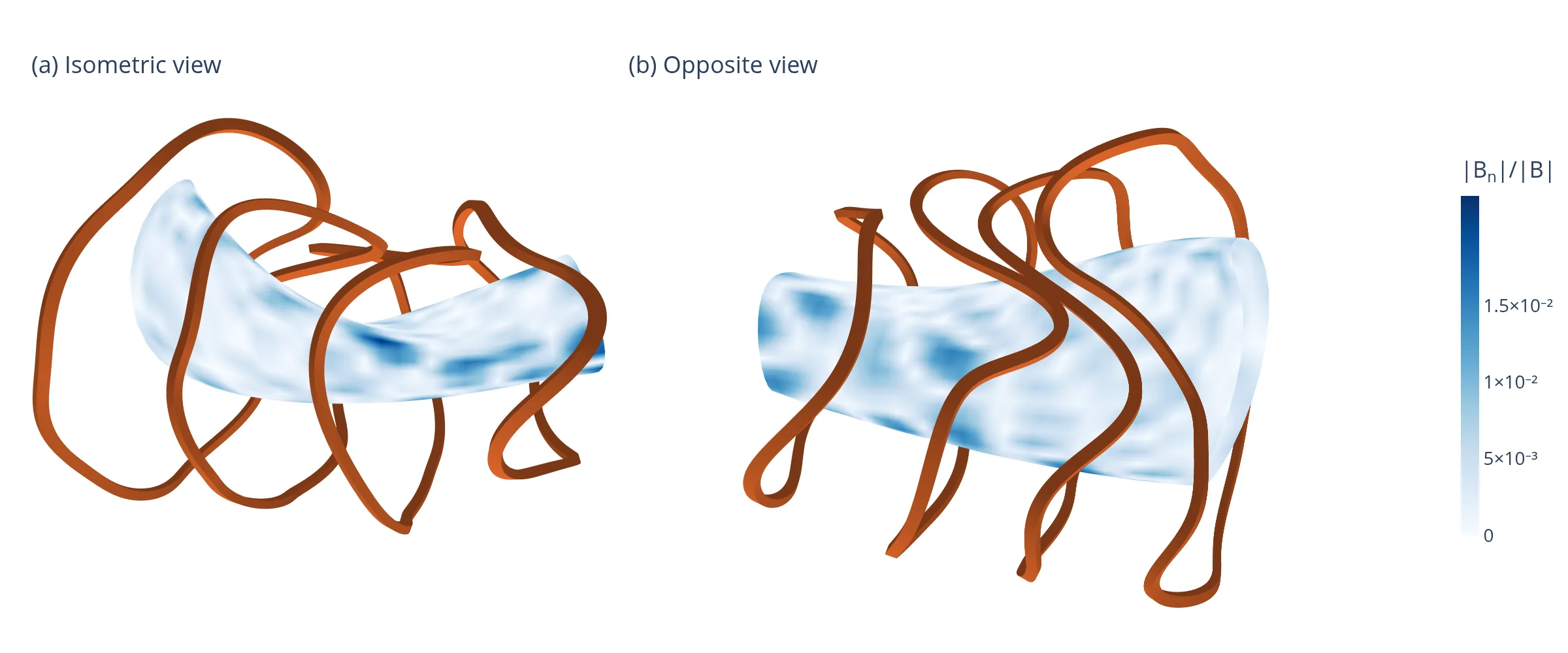
A stellarator fusion reactor resembles an intricately twisted magnetic cocoon. Its job is to confine superheated plasma so that hydrogen nuclei fuse and release energy. But the cocoon's three-dimensional shape creates gaps: some particles escape, especially the fastest ones, which carry most of the heat.
Previously, engineers tried to patch these gaps by looking not at the particles themselves but at indirect signs — the shape of the magnetic field or plasma pressure. This approach was like tuning a musical instrument by the shadow of the strings rather than by the sound. In the new work, physicists for the first time directly calculate the "orbit action"—the key quantity that determines whether a particle stays trapped or escapes. They built a computational framework that iterates over magnetic coil shapes and immediately sees how ion orbits change.
The result is compact stellarator designs where fast ions are confined excellently, plasma remains stable even at high pressure, and coils stay manufacturable. The entire chain, from single-particle physics to the blueprint of the magnetic system, now fits into one calculation. The cocoon no longer tears at every seam.
The word "stellarator" comes from the Latin stella, meaning star. The reactor aims to ignite a man-made star on Earth.
In Liu Cixin's novel "The Three-Body Problem," fusion reactors are mentioned that can operate for centuries without stopping — exactly what a stellarator promises.