Tidal locking is a gravitational phenomenon in which a celestial body, such as a planet or moon, always shows the same face to the object it orbits. This happens because the gravitational pull from the larger body creates a tidal bulge on the smaller one, and over time, the smaller body's rotation slows until its rotational period matches its orbital period. The most familiar example is the Moon, which is tidally locked to Earth, which is why we only ever see one side of it.
History
The concept was first mathematically described by George Darwin (son of Charles Darwin) in the late 19th century, who studied the tidal evolution of the Earth-Moon system.
How it works
The gravity of the central body (like a star) stretches the orbiting body into a slight ellipsoid, creating a tidal bulge. If the orbiting body rotates faster than it orbits, the bulge is carried ahead of the line connecting the two bodies. The central body's gravity then pulls back on this offset bulge, exerting a torque that slows the rotation. Over millions of years, this torque gradually synchronizes the rotation with the orbital motion, locking one hemisphere to face the central body.
In practice
Tidal locking is a key consideration in exoplanet research, as planets in the habitable zone of red dwarfstars are often tidally locked, affecting their climate and potential habitability.
Fun fact
Mercury is not tidally locked to the Sun in a simple 1:1 resonance, but rather in a 3:2 spin-orbit resonance, meaning it rotates three times for every two orbits.
A stone drops into a pond, and ripples spread across the water. In the same way, massive bodies generate gravitational waves, except it's space itself that ripples. So far, these waves have been caught by giant detectors that barely flinch as a wave passes through. But what happens on the microscopic scale, inside a tiny piece of matter?
A stellarator fusion reactor resembles an intricately twisted magnetic cocoon. Its job is to confine superheated plasma so that hydrogen nuclei fuse and release energy. But the cocoon's three-dimensional shape creates gaps: some particles escape, especially the fastest ones, which carry most of the heat.
Two neutron stars whirl in a close dance, each feeling the tidal field of its partner. It's like the Moon raising oceans on Earth, but here it's spacetime itself and the star's matter that deform. Astrophysicists call this tidal deformation — a measure of how much an object 'bends' under the gravitational pull of its companion.
Dwarf galaxies orbiting the Milky Way look as if they’ve survived a gravitational storm. Their stellar bodies are stretched, scattered by tidal tails, and heated from within.
When two neutron stars circle each other, they don't remain rigid spheres. The partner's gravity stretches each star, creating tidal bulges — much like the Moon raises ocean tides on Earth. But unlike water, here it's superdense matter that deforms: a teaspoon of this stuff weighs billions of tons.
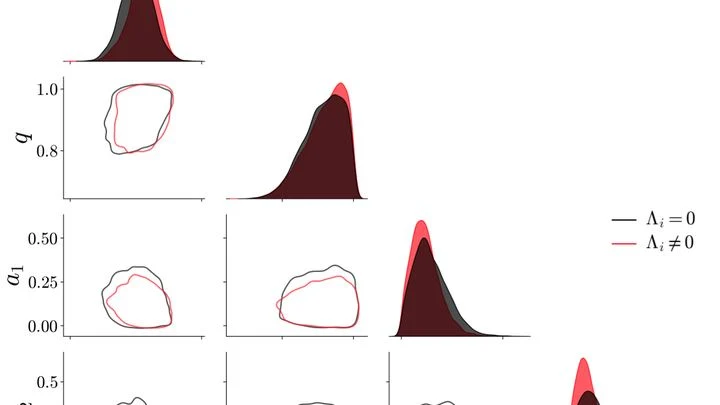
When two superdense stars circle in a tight dance, the space around them shudders. This shudder, gravitational waves, is caught by giant detectors on Earth. But deciphering the signal is tricky: you need to figure out what exactly you're dealing with — a pair of black holes or neutron stars.
When a piano falls into an abyss, we think about the abyss. We don't think about the piano's cover. In much the same way, astrophysicists have for decades studied extreme close encounters between small bodies and massive black holes. They focused on the black hole itself and what orbits it. But what the 'bullet'—the small object heading toward doom — is wearing, almost no one asked.
Two dice lie in different rooms. If they are 'entangled,' a roll of one instantly determines the outcome of the other — even at a distance. In the quantum world, such a link is called steering: one party, by performing measurements on their side, seems to dictate the state of the partner.
Stephen Hawking imagined that the universe was born not from an explosion, but by smoothly emerging from a quantum 'nothing.' In worlds with concave geometry (anti-de Sitter space), such a birth acquires a rim, like the hoop of a drum.
The James Webb Space Telescope is gazing more and more at exoplanets — worlds orbiting alien stars. Some of them are scorching rocky spheres, tidally locked with one side forever facing their star. There, rock melts into oceans of liquid lava. How does this lava move?
A black hole can torment a star for years, rather than rip it apart immediately. Tidal forces are when the hole's gravity stretches the star: the near side is pulled harder than the far side. Usually, getting too close rips the star apart instantly — that's a tidal disruption event.
The Sun is not a calm sphere but a boiling cauldron that follows its own rhythms. Roughly every 11 years, its activity peaks: more dark spots appear on its surface, and streams of charged particles fly into space. But hidden within this grand cycle is a shorter one — about 1.7 years.
A giant planet circles too close to its star. With each orbit, it tugs on the star with its gravity, and waves are born deep inside the star, like ripples from a stone dropped into water. These waves damp the planet's orbit, and it spirals into the star. The star swallows the planet and starts spinning faster.
Stellar rotation is the key clue.
The young star RY Tau is like a finicky spinning top. Around it whirls a flat disk of gas and dust — the leftovers of the cloud from which the star was born. The star pulls some of the disk's matter toward itself like a vacuum cleaner, and flings some back out in a narrow wind cone like a fountain.
When a planet approaches its star to a critical distance, tidal forces, the result of a sharp gradient in gravity between the near and far sides of the celestial body, tear it apart. This process ignites a cosmic funeral pyre: the planet's debris forms a glowing accretion disk around the star.
If two steel balls circle each other, their mutual attraction is powerless to change each other's shape. A water ball, on the contrary, would stretch out like a droplet.
Lunar rocks brought a puzzle: their age is 4.35 billion years, but the Moon itself should have appeared 150 million years earlier. The missing time is hidden in tidal heating. When the Moon hung closer to Earth, Earth's gravity acted like tireless hands: it constantly kneaded and bent the satellite.
The planet's gravity rhythmically squeezes and kneads the moon like dough: from this constant 'kneading', the interior heats up, and oceans of water can persist under the icy crust for ages.
In the Galaxy, there are plenty of rogue planets, thrown out by supernova explosions.