Colloids Learn to Breathe express
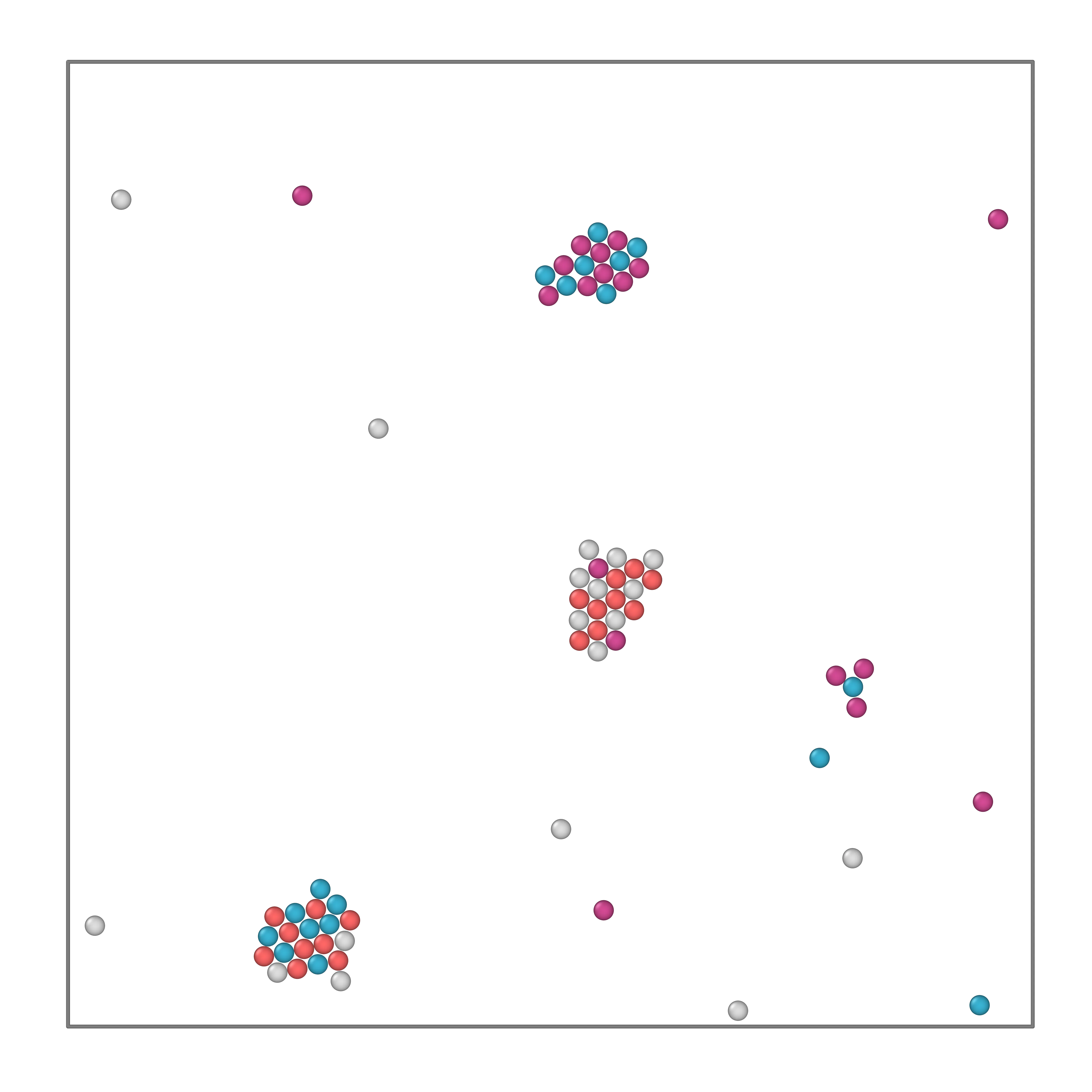
A drop of water on glass trembles and shimmers: it seems to have a life of its own. Similar behavior can now be observed in the world of colloids: tiny particles suspended in a liquid. Researchers simulated particles that emit chemical signals. These signals, like scents in the air, spread around and cause neighbors to either draw closer or move apart.
This mechanism is called paracrine signaling (cell-to-cell communication via chemical messages)—it's how cells in our bodies talk to each other without direct contact. In the model, particles respond to the history of interactions: what happened a moment ago influences the next step. This breaks the usual equilibrium and sets off an internal clock. The system, on its own and without external commands, begins to pulsate: clusters of particles grow and then fall apart.
The authors mapped out different behavioral regimes, from complete stillness to sustained oscillations. Everything depends on three levers: how quickly signals are produced, how quickly they decay, and how far they manage to spread. In one regime, self-sustaining cycles emerge — particles dance endlessly, assembling and disassembling again. This is not just a pretty picture; it's a first step toward programmable materials with living dynamics.
Original abstract
as written by the authors arXiv:2608.03718v1
Developing synthetic materials that exhibit life-like behavior, such as internally driven cycles, remains a central challenge in active matter. Here, we introduce a minimal colloidal model of chemical signaling in which particles produce diffusing signaling molecules that selectively promote or inhibit attractive interactions among neighboring particles. This bio-inspired, paracrine-like signaling mechanism generates context- and history-dependent many-body interactions that break time-reversal symmetry and drive the system far from equilibrium, leading to the spontaneous emergence of autonomous, internally sustained limit cycles in the composition of particle clusters. Using computer simulations, we map the resulting nonequilibrium phase behavior and identify distinct dynamical regimes controlled by the rates of signal production and degradation, together with the diffusion range of the signaling molecules. Among these, we find a robust oscillatory state in which particle clusters autonomously assemble in a cyclic fashion, driven entirely by internal feedback loops. Our results establish paracrine-signaling colloids as a minimal, physically realizable platform for programmable nonequilibrium materials with life-like functionality and provide a general route toward synthetic active matter with self-regulated collective dynamics.
In our blood, platelets use a similar principle: they release chemicals that attract other platelets to quickly plug a wound. But there, the signal works in one direction, toward assembly, while in the scientists' model, particles can both assemble and disperse.
In Stanisław Lem's novel "The Invincible," the heroes encounter a swarm of mechanical "flies" that act as a single organism, following simple rules. Such colloids are a step toward creating artificial life of this kind.