Martian Weather, Earthly Playbook express
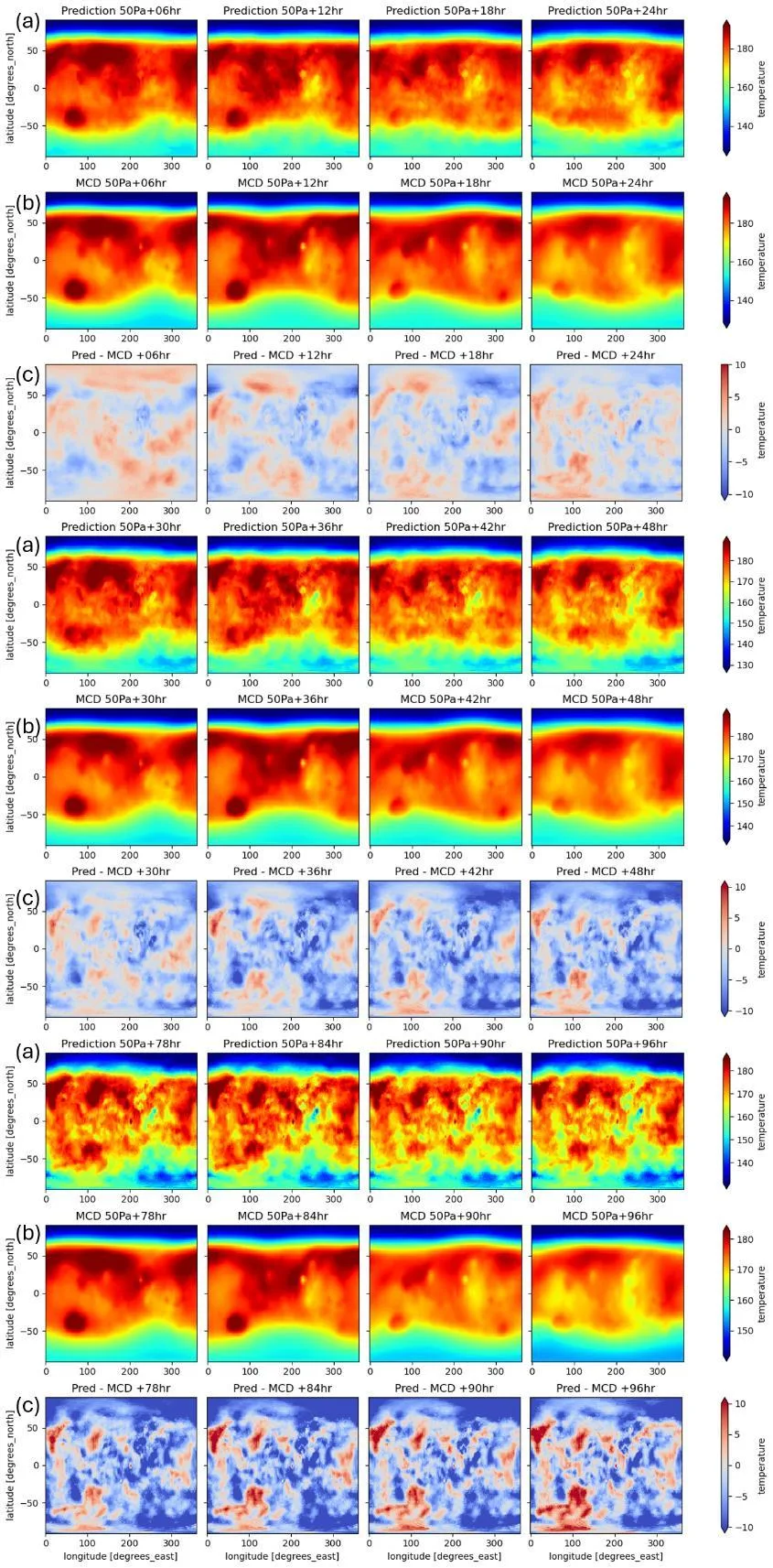
Meteorologists have grown used to trusting neural networks: the GraphCast model predicts Earth's weather days ahead by drawing on global snapshots of the atmosphere. But this 'brain' can be transplanted to another planet — where the air is thin and the Sun warms differently. The authors took GraphCast and fed it data from the Mars Climate Database, a sort of virtual twin of the Red Planet.
The first test, without fine-tuning, surprised them: the model produced a fairly accurate portrait of current weather, simply relying on its Earthly 'habits.' But look a day ahead, and the forecast drifted toward an average climate, losing the daily rhythm. Morning, noon, evening, and night blurred into one endless, averaged picture.
So they retrained the model from scratch. In just ten training cycles, it grasped the essentials: how the daily cycle unfolds, how temperature distributes across altitude layers. After a few dozen epochs, a ten-day forecast matched real Martian dynamics quite well. Quality improved with more data and depended on which season the prediction started from.
This experiment is more than a curiosity. Fast, accurate Martian weather forecasts would help plan rover operations, shield equipment from dust storms, and, eventually, support crewed missions.
Original abstract
as written by the authors arXiv:2608.05054v1
We investigate the transferability of Earth weather foundation models to planetary atmospheres by adapting the GraphCast graph neural weather forecasting model to Mars. While GraphCast achieves state-of-the-art performance for terrestrial forecasting, its applicability to non-Earth environments remains unexplored. Using the Mars Climate Database (MCD), which provides global atmospheric fields across vertical altitude levels (similar to Earth pressure levels), we evaluate zero-shot and fine-tuned GraphCast predictions of Martian temperature and wind fields. Zero-shot forecasts produce a surprisingly accurate depiction of current conditions but fail to reproduce diurnal variability and rapidly decay toward climatological mean states. To address this limitation, we fine-tune GraphCast using MCD variables and top-of-atmosphere solar radiation forcing while holding humidity constant. Fine-tuning enables rapid learning of Martian thermal variability. Within as few as 10 training epochs, the model begins to capture the diurnal cycle and forecasts up to 10 days reproduce seasonal and vertical temperature structure. Prediction quality improves with training sample size and exhibits sensitivity to seasonal initialization. These results demonstrate that Earth-trained AI weather models can be adapted to simulate Martian atmospheric dynamics, providing a pathway toward rapid planetary weather prediction to support mission operations, dust storm risk mitigation, and future human exploration.
Because of the low pressure, even a hurricane-force Martian wind would feel like a gentle breeze: it wouldn't knock you over, but it would kick up clouds of fine dust.
In Andy Weir's 'The Martian,' the astronaut survives by relying on precise weather reports — models like this could have been his electronic meteorologist.