The difference between the sunlight the planet absorbs and the heat it radiates back, measured from satellites (CERES). Positive means the planet is gaining heat.
The imbalance is small—about 0.5 to 1 watt per square meter—but over the whole planet, that adds up to an enormous amount of energy, roughly 20 times the world's total energy consumption. This excess heat does not stay in one place: about 90% of it goes into warming the ocean, with the rest melting ice, warming the atmosphere, and heating the land. Tracking EEI is therefore essential for understanding how fast sea levels will rise, how much heat stress the ocean will experience, and how quickly the atmosphere will warm. It also serves as a check on our understanding of the climate system: if models and observations disagree on EEI, something is missing from the models.
History
The concept of Earth's energy balance dates back to the 19th century, but precise satellite measurement of the imbalance became possible with the CERES instruments, which began flying in 1997 on the TRMM satellite and later on Terra and Aqua. The sustained record from these missions has provided the most accurate estimates of EEI.
How it works
EEI is measured directly from space using radiometers that detect the solar and thermal radiation at the top of the atmosphere. The Clouds and the Earth's Radiant Energy System (CERES) instruments on NASA satellites scan the entire planet, measuring the reflected sunlight and the outgoing infrared radiation. The difference between the absorbed solar radiation and the emitted thermal radiation gives the net energy flux. To get a reliable estimate, these satellite measurements must be carefully calibrated and averaged over months and years, because the imbalance is tiny compared to the huge flows of energy passing through the system.
In practice
EEI is used to monitor the rate of global warming, validate climate models, and estimate the ocean's heat uptake, which is critical for projecting sea-level rise and future climate scenarios.
Fun fact
The excess energy absorbed by Earth each year is equivalent to the energy of about four Hiroshima bombs detonated every second.
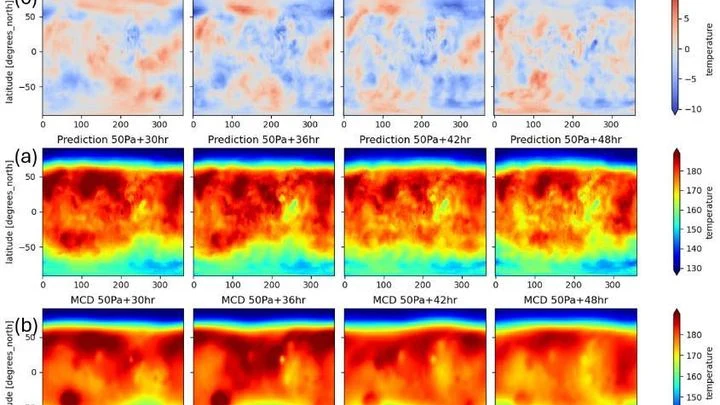
Meteorologists have grown used to trusting neural networks: the GraphCast model predicts Earth's weather days ahead by drawing on global snapshots of the atmosphere. But this 'brain' can be transplanted to another planet — where the air is thin and the Sun warms differently.
For decades, global atmospheric models resembled artists forced to paint planetary storms with coarse brushstrokes: a resolution of 25–100 km forced them to 'guess' convection through approximate schemes, introducing systematic errors in rainfall and climate forecasts.
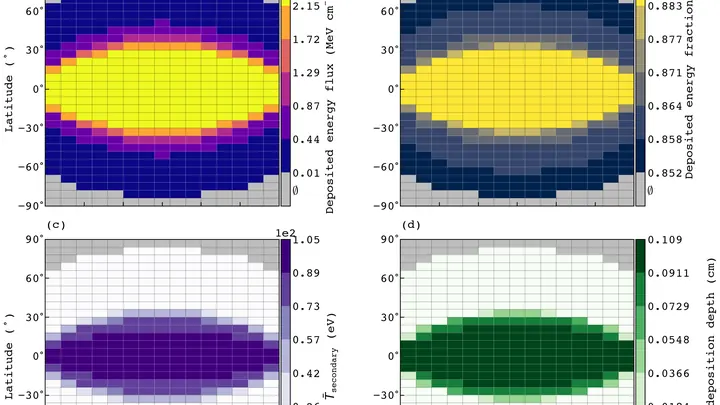
Europa's surface is an icy armor continuously bombarded by charged particles from Jupiter's magnetosphere. Electrons slam into the ice's crystal lattice, lose energy, and kick off chemical reactions. Until now, there was no tool to show how deep such bombardment pierces the ice.
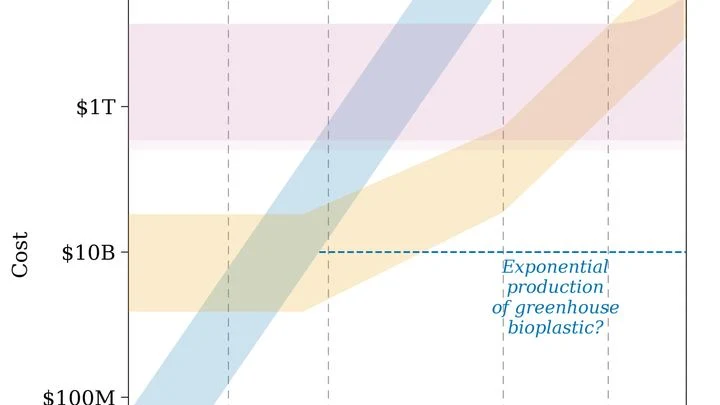
Mars is an icy desert with an average temperature of minus 60. To warm it without biology, scientists propose three approaches with a single idea: create a thick heat-trapping blanket.
First, deploy transparent film-blankets over bases. They let sunlight in but keep heat from escaping, allowing us to harvest water from the soil and grow plants.
Today's Martian surface is a cold, nearly airless home. Many dream of a full renovation: warming the planet, filling it with air from carbon dioxide and nitrogen.
The scorching gas streaming from the Sun is not a continuous flow but rather a soup of charged particles. In this soup, waves constantly boil up: electric fields flare and fade like ripples on water from a tossed stone. One such wave is the ion-ion acoustic wave.
The Sun is slowly brightening, and in hundreds of millions of years its heat would become lethal for Earth. Fortunately, the built-in planetary thermostat — the carbon cycle — when overheating triggers rocks to absorb carbon dioxide faster, cooling the climate.
In the summer of 2023, thermometers around the world registered numbers that even the boldest forecasts had not anticipated. The planet's average temperature rose to 1.48°C above pre-industrial levels, a jump of 0.17°C that broke the previous record as if the climate had suddenly shifted gears.
The orchestra of world weather is playing a tune we didn't expect. The first violin is not carbon dioxide but chlorofluorocarbons—gases that until recently hid in refrigerators and aerosol cans. They trap heat ten thousand times more effectively than CO₂, and for decades they have been quietly warming the planet.
Imagine a house of cards where each card supports the others. One wobbles, and the neighbors start to lean. Earth's climate system works similarly: ice sheets, ocean currents, tropical forests, all are connected. If one element crosses a threshold, it can drag the rest down with it.
Every morning in six American cities, from Chicago to Minneapolis, faucets open at the same time coffee makers switch on. Water and electricity flow through pipes and wires like two connected vessels in the city's body. In the past, utilities monitored these flows separately, as if the organism had no common circulatory system.
From 1955 to 1979, the extent of Antarctic sea ice shrank by 23% in winter and 67% in summer, then partially recovered. This is like a spring that was slowly compressed and then released: the climate of the Southern Hemisphere responded with a delay of several decades.
Picture a map of China with sparse green patches scattered across a yellow desert. Those patches are where the GloSea5 climate model can genuinely look three months ahead, while the desert is everything else, where its forecasts are no better than a coin toss.