The Tidal Fingerprint of Neutron Stars express
The merger of two neutron stars is not just a collision. Even before they touch, they deform each other through tidal forces, and this deformation depends on how 'soft' or 'stiff' the matter inside is. Stiff matter resists more; soft matter changes shape more easily. The difference shows up in the frequency and phase of the gravitational wave that detectors pick up.
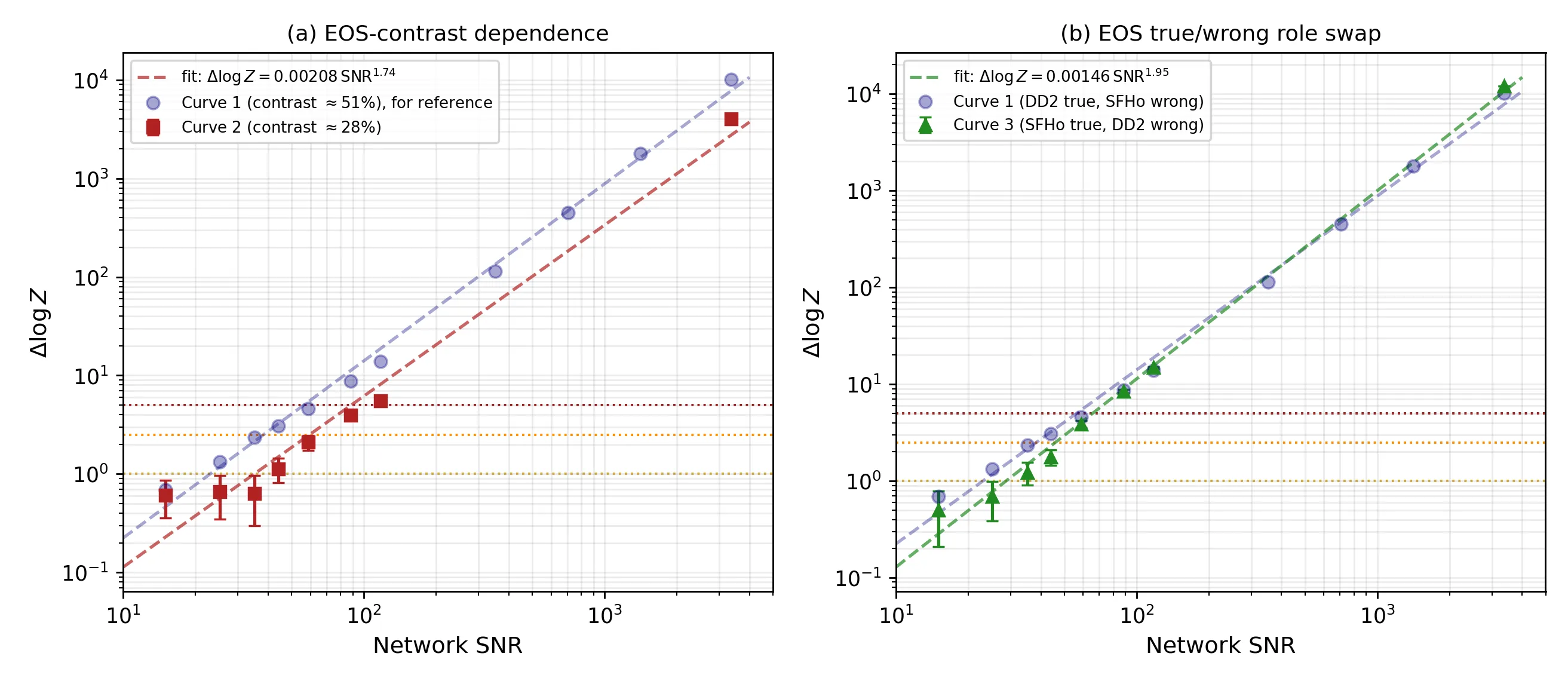
The authors of the study took two different descriptions of neutron-star matter (equations of state) and tested how loud the signal must be for a network of three detectors, gravitational waves from Einstein Telescope and two Cosmic Explorers, to reliably tell which description is correct. They used Bayesian analysis and sifted through hundreds of thousands of signal variants for different stellar masses and different deformability contrasts. The result was surprisingly tidy: the difference in 'convincingness' of the models (the logarithm of the evidence ratio) grows as the signal loudness raised to a power of about 1.8–1.95. The loudness itself is the signal-to-noise ratio (SNR).
This law was derived from a simple consideration: the difference in evidence is proportional to the square of the product of the deformability contrast and the SNR. And when the scientists calibrated the formula on three configurations, it predicted the required loudness for a fourth with an accuracy of 0.3%. This means that even before observations begin, one can estimate how many mergers need to be recorded to settle the question of neutron-star matter.
So the tidal fingerprint becomes a key to the densest matter in the universe. And the louder the gravitational wave, the clearer this fingerprint appears.
Original abstract
as written by the authors arXiv:2608.05794v1
The tidal response of neutron stars during binary inspiral encodes the equation of state (EOS) of dense matter in the gravitational-wave signal. Quantifying the signal-to-noise ratio (SNR) required to distinguish competing EOS models with third-generation detectors is therefore essential. We perform Bayesian nested-sampling parameter estimation on simulated binary neutron star signals observed by an Einstein Telescope plus two Cosmic Explorer detector network and compute the evidence difference between correct- and incorrect-EOS recovery models over a broad range of SNR. Across two tidal-deformability contrasts, a swap of the true and recovery EOS, and two binary mass points, we find a common scaling, $$\Delta\log Z = A\,\mathrm{SNR}^{n}$$ with $$n \simeq 1.74$$--$$1.95$$, where the EOS contrast and binary properties determine only the prefactor $$A$$. This behavior follows from an Occam-factor argument, yielding $$\Delta\log Z \propto (\Delta\tilde{\Lambda}\,\mathrm{SNR})^{2}$$. Calibrating this relation on three configurations predicts, before the run, the SNR required for decisive EOS discrimination in the fourth to within $$0.3\%$$. These results establish a quantitative framework for assessing the EOS-discrimination reach of third-generation gravitational-wave detector networks.
A neutron star the size of a city (about 20 km) weighs as much as one and a half Suns. A teaspoon of its matter on Earth would weigh billions of tons, yet tidal forces can noticeably deform it.
In Robert Forward's novel 'Dragon's Egg', life is described on the surface of a neutron star, where tidal forces are so strong that a mountain one centimeter high is an insurmountable obstacle.