Measuring the Milky Way Through Dusty Stars express
Red giants in the center of the Milky Way resemble distant lighthouses that brighten and dim. Their light pierces through dense dust, but standard distance-measuring methods fail here: the stars are too bright and unstable, and dust distorts the picture.
Astronomers found a workaround. They took stars whose distances were already known from other data and taught a computer model to link that distance to the star's color in infrared light. The model, like a smart calculator, now estimates distance from several 'shades' of infrared glow. The error turned out to be small — about 6% on test data.
With the new tool, astronomers measured distances to more than 36,000 red giants — from 0.5 to 20 thousand light-years. It's as if we suddenly had a detailed ocean depth map where only scattered soundings existed before.
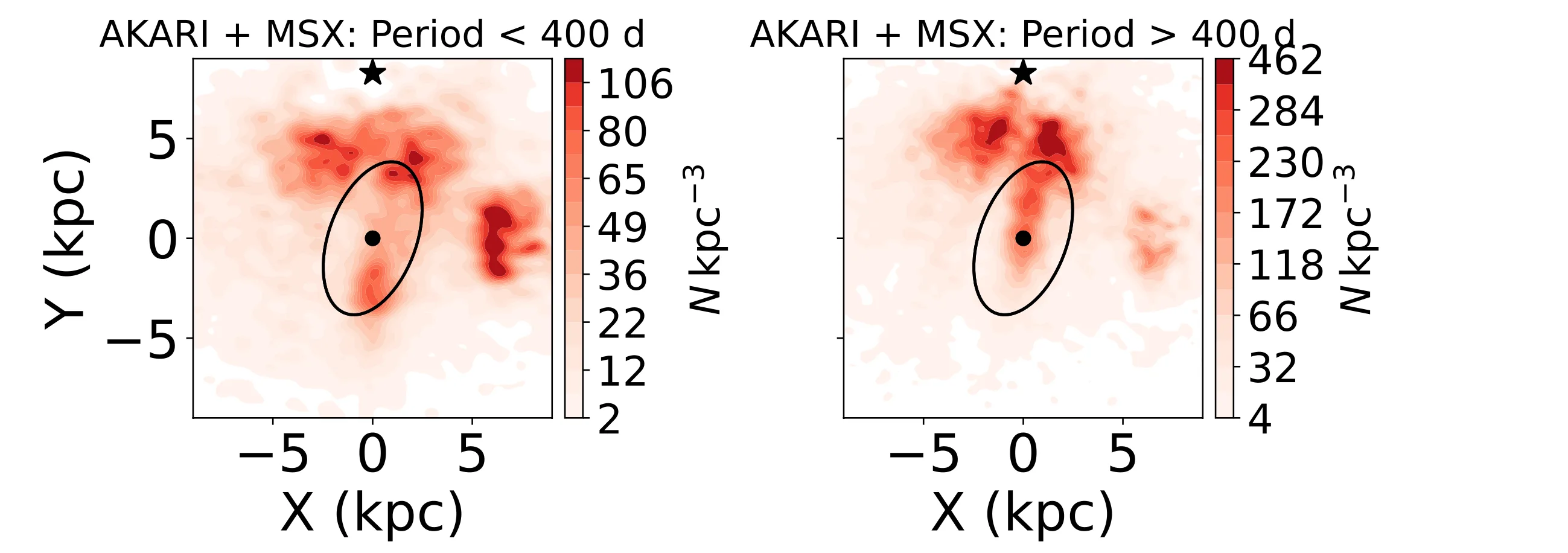
Of particular interest were Mira-type variable stars. Those that pulsate more slowly clustered in the center of the Galaxy, tracing the shape of the elongated bar — our Galaxy's bar. The faster pulsators scattered across the disk. The difference in the 'growth' of these stellar populations hints at how the Milky Way formed.
Original abstract
as written by the authors arXiv:2608.10577v1
The structure and evolution of the Milky Way (MW) can be traced with distance estimates to the evolved stellar populations in the inner galactic region. However, direct astrometric distances remain unavailable or highly uncertain for the majority of these sources due to instrumental limitations, large angular diameters, and complex variability. In this work, we develop a supervised machine-learning model to estimate statistical distances to oxygen-rich asymptotic giant branch (AGB) stars selected from the AKARI mid-infrared survey. We build an XGBoost regression model that maps multi-band IR photometry to distance using a training set of AGB stars with previously derived SED-based distances achieving a mean absolute percentage error (MAPE) of 6% on an independent test set. Distance estimates for over 36,000 AGB sources are obtained within a 36% total error margin, greatly expanding distance coverage (0.5-20 kpc) for dust-obscured AGB populations in the Galactic plane. We find good agreement with reported distances for Galactic Mira variables and independent period-luminosity relations. Utilizing the expanded distance set, we further investigate the spatial distribution of Mira variables in the Galactic bulge and disk. Longer-period Miras preferentially trace the bulge's barred morphology compared to their shorter-period counterparts that populate the disk. We also find roughly constant, but differing, relative scale heights for the bulge and disk, with the bulge vertical dispersion about 30% larger. These findings show that IR photometry-derived statistical distances can recover large-scale Galactic structures and establish long-period Mira variables as efficient tracers of stellar populations in heavily obscured regions of the MW.
The infrared telescope AKARI, whose data astronomers used, was launched by Japan in 2006 and operated in orbit for more than five years, even though its fuel ran out earlier.