A galactic bar is a prominent, elongated structure of stars and interstellar matter that extends from the center of a spiral galaxy, resembling a cosmic 'bar' across the nucleus. Rather than being a simple oval, it is a dynamic, rotating feature that funnels gas inward and redistributes angular momentum, fundamentally shaping the galaxy's evolution. Bars are common — observations suggest that up to two-thirds of spiral galaxies, including the Milky Way, host one.
History
The concept of barred galaxies was first systematically described by Edwin Hubble in his 1926 classification scheme, where he introduced the 'SB' class for barred spirals. The Milky Way's bar was confirmed in the 1990s through infrared observations, though its exact properties remain an active area of research.
How it works
The bar forms from gravitational instabilities in the disk, often triggered by interactions or asymmetries. Once established, it acts as a stellar 'mixer': stars in the bar follow elongated orbits that are not circular, and the bar's gravitational torque transfers angular momentum from the inner to the outer regions, driving gas toward the center and fueling star formation or feeding a central supermassive black hole. The bar also creates resonances — specific orbital radii where stars feel periodic tugs — which can trap stars and even reveal the presence of dark matter clumpsthrough their gravitational influence.
In practice
Bars are used as natural laboratories for studying galactic dynamics, star formation, and the distribution of dark matter, as their resonances can act as detectors for invisible mass.
Fun fact
The Milky Way's bar is estimated to be about 27,000 light-years long, and it rotates as a solid body, with stars inside it moving at the same angular speed.
The night sky looks black, but if you remove the stars and accumulate light for a long time, a faint glow emerges — the summed light of all galaxies born over 13.8 billion years. Astronomers call it the extragalactic background light.
Right after the Big Bang, space cooled unevenly. In some places, folds could have formed — threads of energy as thin as a hair but incredibly dense. Physicists call them cosmic strings. They oscillate, collide, and emit gravitational waves — ripples in the fabric of space itself.
A weather forecaster draws a thick black line across Europe: north of it, frost; south, a thaw. That boundary, the zero isotherm, won't tell you the temperature in Stockholm or Rome, but it honestly marks where winter ends. In recent cosmology, a map has emerged where a similar frontier can be drawn.
Look at an equilateral triangle — the probability simplex for three assets. Each interior point is a portfolio: non-negative shares summing to one. The triangle's center, the barycenter, corresponds to an equal-weight allocation (1/3, 1/3, 1/3). It seems that by moving toward this point, you lower risk and avoid dangerous edges.
When we peer deep into space, we see the past. Edwin Hubble’s law turns redshift into a time machine: light from galaxy UDS 12999 traveled to us for 7.6 billion years — more than half the age of the Universe.
The early Universe is often imagined as a nursery: most galaxies there are amorphous blobs, rowdy and irregular, choking on gas and bursts of star formation.
A river flows toward a whirlpool, but a dam with a notch blocks the way. Most water piles up before the dam, but some, gaining height, leaps over it and falls straight into the funnel. So it is with gas in a galaxy: it streams toward the center but hits a ring of stars and gas, like a dam. Usually, everything stops there, swirling into a dense vortex.
On a playground, a merry-go-round has just been set spinning. In the first moments, kids are still crowding, grabbing the rails, and the overall picture is chaos. But a couple of seconds later, centrifugal force lines them up in a circle, giving the motion a clear shape.
The night sky looks as smooth as the surface of a calm lake. But if you look at gamma-ray bursts (brief, blinding explosions visible across the entire universe) you'll find ripples in that smoothness.
Scientists took a catalog of such bursts and divided the sky into two hemispheres. In the southern one, they found a tiny group: 4–5 bursts huddled together.
Drop two identical pebbles from a mountain peak: one lands a centimeter to the left, and a minute later they end up in different valleys. A galaxy is the same mountain, only with billions of pebbles and a slope that stretches over millions of years. The authors of a new study simulated a disk of 40 million point-like stars and tested how quickly it forgets where it started.
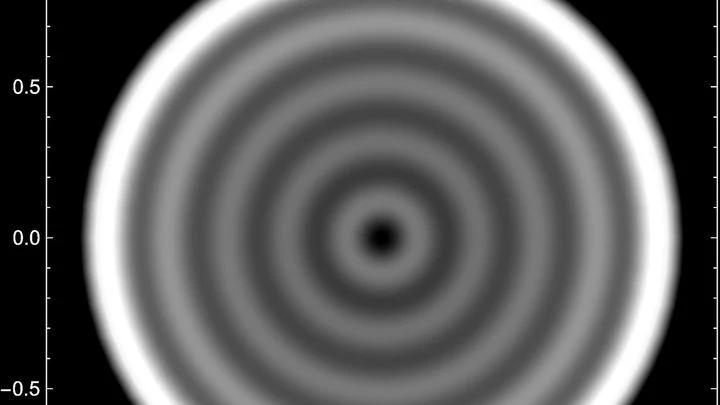
A guitar string only sounds at certain notes, when pressed at the frets. So it is with the gas-dust disk around a young star: it's shot through with standing waves, but only chosen oscillations survive. Where the wave crests, cosmic dust and hydrogen collect, and later exoplanets are born.
Like a river that suddenly disappears underground, the Perseus Arm in the Milky Way breaks off in a region astronomers call the Giraffe Bay. Where the bright band of stars should continue, a dark 'void' is visible.
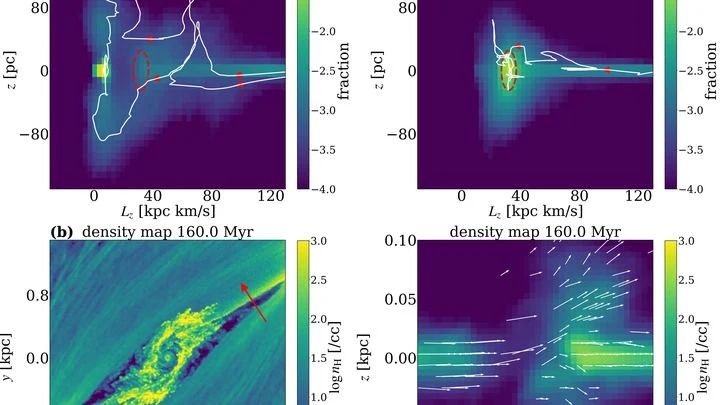
At the heart of the Milky Way spins a stellar bar — an elongated cluster, like a rotating paddle. Its gravity creates a rhythmic field around it, like waves from a speedboat.
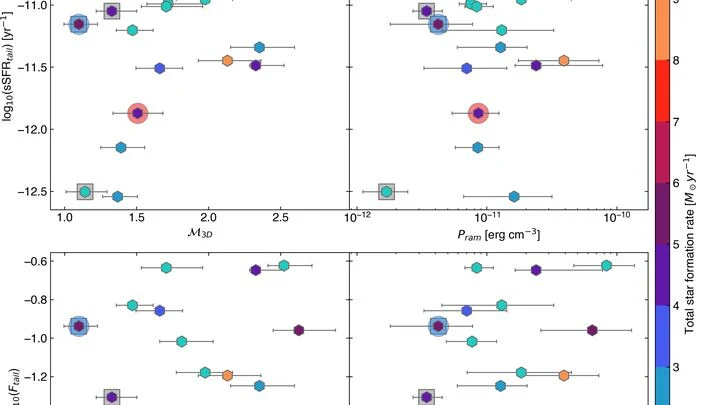
A galaxy plunges into a dense cluster like a runner into a crowd. The oncoming gas, known as the intracluster medium, strips away its own gas, stretching it into a long, glowing tail. Astronomers call these galaxies jellyfish: they have a body and flowing tentacles of stripped material. But only in a few do new stars ignite within those tentacles.
In the star cluster NGC 2158, which is over a billion years old, astronomers have counted how often stars live in pairs. The Hubble telescope stared at the cluster for a long time to catch even the faintest stars: those lighter than one-third of the Sun.
Light from a distant galaxy travels toward us for billions of years, but along the way it can run into a massive galaxy cluster. Its gravity acts like curved glass: it bends the path of rays, so instead of one image, we see several — sometimes arcs, sometimes points.
The night sky looks like a scattering of identical sparks. But hidden among them are true giants — red supergiants. These stars are hundreds of times wider than the Sun and shine so brightly that they can be seen from enormous distances. You'd think there'd be no better beacons for a map of the galaxy.
The galaxy NGC 1560 is a modest island of stars and gas ten million light-years away. Its rotation curve, first measured in 1991, became an icon for those seeking an alternative to dark matter. The plot of rotation speed versus radius shows bends that seem to exactly mirror the bends in the distribution of ordinary matter.