Measuring the Milky Way Through Dusty Stars express
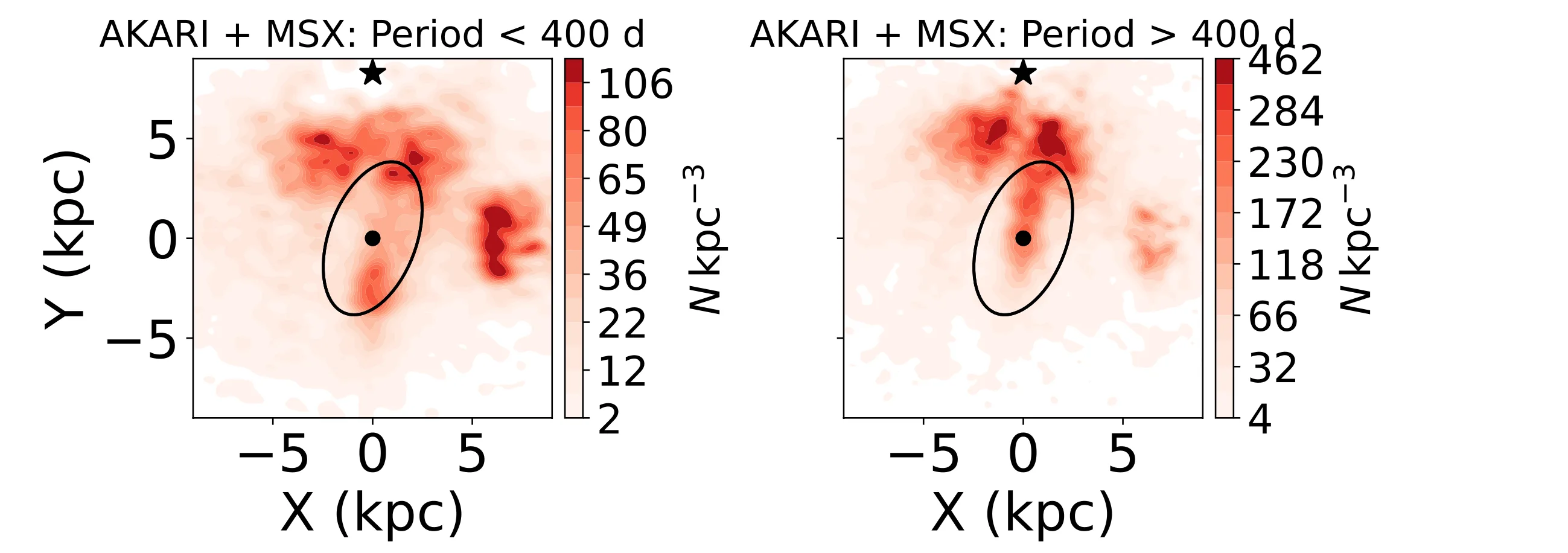
Red giants in the center of the Milky Way resemble distant lighthouses that brighten and dim. Their light pierces through dense dust, but standard distance-measuring methods fail here: the stars are too bright and unstable, and dust distorts the picture.
Astronomers found a workaround. They took stars whose distances were already known from other data and taught a computer model to link that distance to the star's color in infrared light. The model, like a smart calculator, now estimates distance from several 'shades' of infrared glow. The error turned out to be small — about 6% on test data.
With the new tool, astronomers measured distances to more than 36,000 red giants — from 0.5 to 20 thousand light-years. It's as if we suddenly had a detailed ocean depth map where only scattered soundings existed before.
Of particular interest were Mira-type variable stars. Those that pulsate more slowly clustered in the center of the Galaxy, tracing the shape of the elongated bar — our Galaxy's bar. The faster pulsators scattered across the disk. The difference in the 'growth' of these stellar populations hints at how the Milky Way formed.
The infrared telescope AKARI, whose data astronomers used, was launched by Japan in 2006 and operated in orbit for more than five years, even though its fuel ran out earlier.