A Magnetic Shield for Hunting the Electron's Asymmetry express
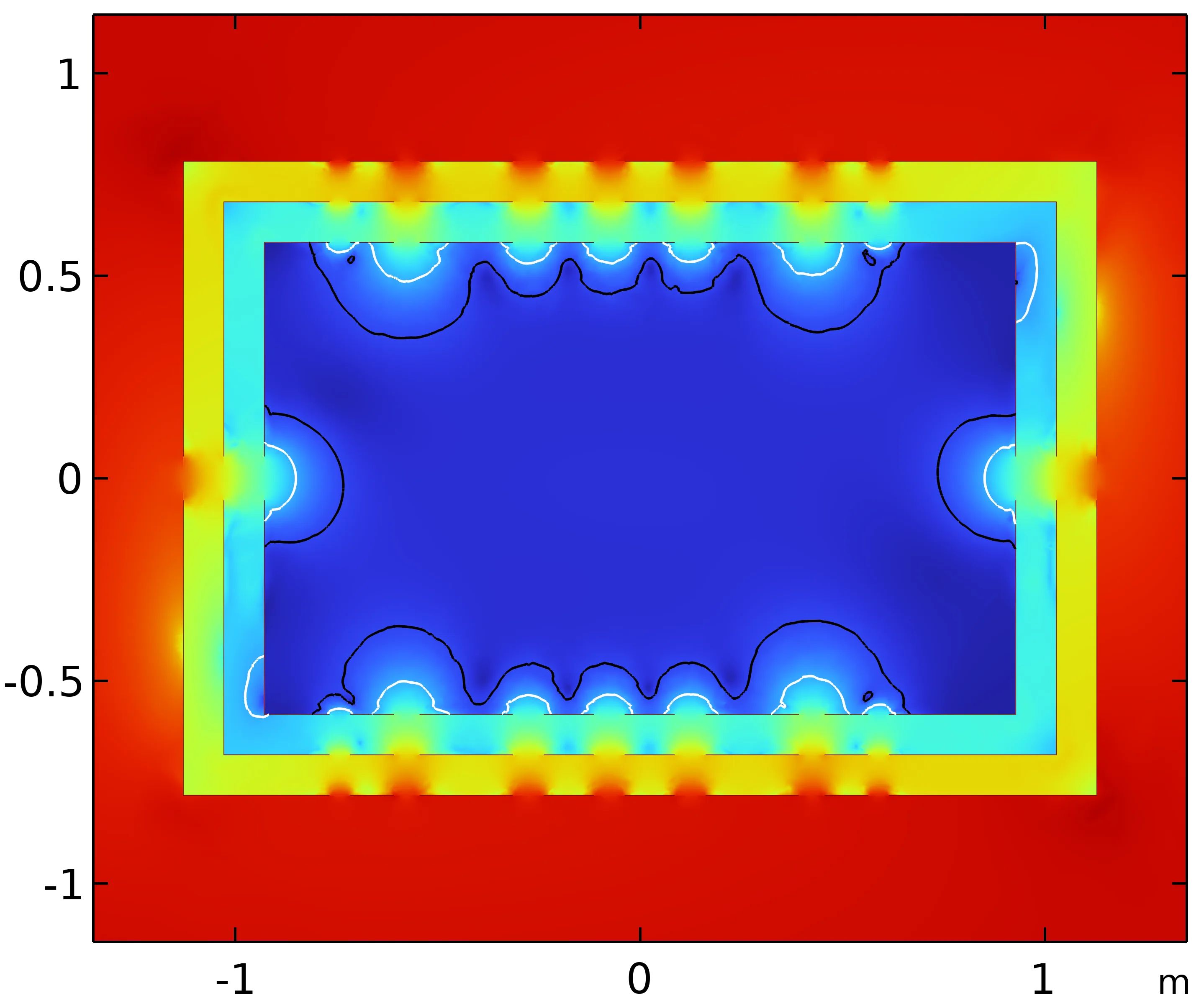
The magnetic field in this setup must be as smooth as glass: the slightest ripple would blur the signal. The engineers built two coils that cancel each other's field externally and packed them in three layers of ferromagnetic plates. Inside, they created a volume of one meter by four centimeters where the field varies by less than one billionth of a tesla, like sea level not fluctuating more than the thickness of a hair.
The mu-metal plates, an alloy that draws magnetic field lines into itself like a sponge soaks up water, are made to be disassembled. The largest weighs 19 kilograms and can be carried easily by two people. The key was not to bend the plates during assembly: a bend leaves stress in the metal, and it starts to "remember" the old field. So the mounts are designed to prevent any warping.
When the field inside the coils is reversed to cancel out errors, the external field barely leaks out. Thanks to this, the shields do not become magnetized and do not need demagnetization after each switch. The residual field stays below one billionth of a tesla for up to 17 hours, even if the field is switched every 30 seconds.
The result: compared to the previous setup, magnetic-field-related errors have been reduced by a factor of about 40. At the same time, the working zone is five times longer, and the number of shield layers is three instead of five. Now we can search for the electron's "warp" with much greater confidence.
Original abstract
as written by the authors arXiv:2608.11439v1
A system of actively-shielded coils and mu-metal shields is devised, constructed and shown to provide the stable and spatially uniform magnetic field needed for the ACME III electron electric dipole moment (eEDM) measurement. Two layers of current-carrying coils, enclosed within three layers of ferromagnetic shields, produce a field that varies by less than 1 nT (10 $$\uG$$) within the 1 m $$\times$$ 4.2 cm $$\times$$ 4.2 cm interior volume in which a beam of ThO molecules are probed as they precess. The demountable shields are constructed from rectangular mu-metal plates. The largest, with a mass of 19 kg and an area of 2.18 m $$\times$$ 0.75 m, is easily carried by two people and just fits within a large available annealing oven. The assembly design facilitates low-stress mounting and handling to suppress changes in the magnetic properties of the mu metal, and also provides modular access to apparatus within the coils for maintenance and upgrades. The nearly static external ambient field is reduced within the shielded precession volume by up to a factor of $$10^5$$. During the magnetic field reversals that ACME uses to suppress systematic uncertainties, the ``actively-shielded'' coil largely cancels out its external fringing field to minimize the magnetization of the mu metal. Even though the shields are only 10 cm outside the coils, shield degaussing after every magnetic field reversal is not required. The non-reversing residual field stays below 1 nT for up to 17 hours when the field is reversed every 30 seconds, for example. The measured performance, compared to the previous generation ACME II apparatus, suggests that the magnetic-field-related systematic uncertainties for ACME III will be smaller by an estimated factor of 40 despite a five times longer precession volume and the use of three magnetic shielding layers rather than five.
Mu-metal is so sensitive to deformation that even a light tap with a hammer can ruin its magnetic properties, so the plates are transported in special containers and never dropped.