The volt per metre (V/m) is the SI unit of electric field strength. It describes how strongly an electric field pushes on a charged particle: one volt per metre means a potential difference of one volt exists across a distance of one metre. This unit ties together voltage (energy per charge) and distance, making it the natural measure of field intensity in circuits, capacitors, and electromagnetic waves.
History
The unit derives from the volt, named after Alessandro Volta in the 19th century, and the metre, standardized during the French Revolution. The explicit use of V/m as a field unit became standard with the development of electromagnetic theory in the late 1800s.
How it works
An electric field E is defined as the force per unit charge, but it also equals the negative gradient of electric potential: E = -dV/dx. So if you place two parallel plates one metre apart and apply one volt between them, the field between them is 1 V/m. The unit is equivalent to newtons per coulomb (N/C), since a volt is a joule per coulomb and a joule is a newton-metre.
In practice
Used to specify electric field strengths in high-voltage engineering, to set safety limits for electromagnetic exposure, and to characterize the fields in particle accelerators and capacitors.
Fun fact
The electric field of a typical lightning bolt is about 10,000 V/m — enough to ionize air and create a conductive path.
Systems:SIElectric field strength equal to one volt of potential difference per metre of distance.
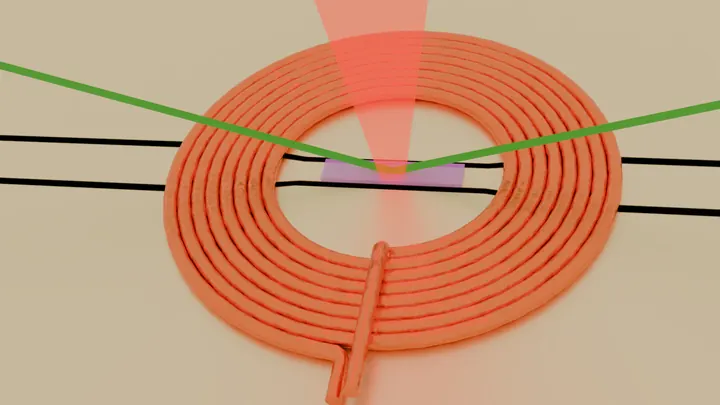
Inside an MRI magnet, current flows through a closed superconducting loop, like water circling in a bucket after you give it a spin, it just keeps going on its own. To change that current, you heat the loop with a small heater: it stops being superconducting, becomes an ordinary resistor, and then an external source can 'top up' or 'draw off' current.
An electron beam is a stream of tiny particles carrying an electric charge. When such a beam hits a material, it doesn't just heat it or knock out atoms: it also gives the surface a slight push, like a jet of water pushing against your palm.
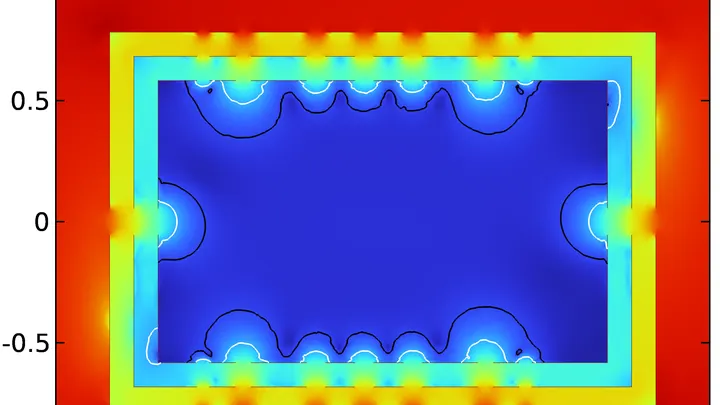
The magnetic field in this setup must be as smooth as glass: the slightest ripple would blur the signal. The engineers built two coils that cancel each other's field externally and packed them in three layers of ferromagnetic plates.
Radio astronomy began with the mysterious noise caught by the antenna of Karl Jansky and the rhythmic pulses that Jocelyn Bell Burnell playfully called 'little green men'.
Imagine a balance scale with identical weights, yet one pan always tips lower. In the world of elementary particles, this imbalance is called CP violation: particles and their mirror twins (antiparticles) behave slightly differently.
A power transistor made of silicon carbide operates under voltages thousands of times higher than what comes out of a wall outlet. If the field inside it becomes uneven, the device burns out. Previously, this field was invisible: it is too strong for ordinary sensors, and the device must remain under voltage.
In a regular battery, the electrolyte is liquid, and charged particles (ions) move freely. In the solid-state version, they squeeze through atomic 'corridors', like pedestrians in narrow passages. For a battery to work quickly, you need a material with high ionic conductivity.
You are counting sand grains falling in an hourglass, but each time the wind adds or removes a few. In the most sensitive cameras, the task is similar: you need to figure out how many "sand grains" (electrons) the sensor itself added, and how many came from light. This inherent sensor noise is called readout noise, and it hinders seeing weak signals — for example, the light of a distant star.
A tiny defect in a diamond crystal works like a sensitive antenna. When a magnetic field oscillates nearby, this defect, a nitrogen vacancy, responds by glowing. Previously, to hear the signal, you had to accumulate many repeated measurements, like listening to a whisper with your ear pressed against a door. Now a single short "look" suffices.
The neutron is a particle with no charge but with internal structure. Like a ball that looks smooth on the outside but has a complex filling inside. Scientists have long wanted to understand how electric and magnetic forces are distributed inside the neutron. To do this, you need to "feel" it — collide it with its antiparticle and see what happens.
Two taut strings plucked at the same time sound different if they are connected by a rubber band. Energy starts to flow from one to the other, and the pitch of the combined sound shifts slightly. Two nanomechanical bridges, microscopic beams etched into a crystal, behave much the same way.
Measured dipole moment of tantalum-181: 3.39 × 10⁻³² e·cm — like spotting a one-atom shift across the entire Solar System. An ordinary atomic nucleus is perfectly balanced, like a spinning top. In tantalum, that balance is broken: the positive and negative charges are slightly offset from each other.