A dipole is the simplest configuration of a magnetic field, consisting of two opposite poles—north and south—separated by a distance. It serves as the fundamental building block for understanding more complex magnetic phenomena, from bar magnets to planetary magnetospheres. In physics, the dipole approximation is often used to describe the field at large distances from any localized current distribution, making it a universal tool in electromagnetism.
History
The concept of magnetic dipoles dates back to the 13th century with Petrus Peregrinus's experiments on lodestones, but the mathematical description was formalized by William Gilbert in his 1600 work 'De Magnete.'
How it works
The dipole field arises from a separation of magnetic charges (or, more accurately, from a loop of electric current). The field lines emerge from the north pole, curve through space, and re-enter at the south pole, with the strength decreasing as the cube of the distance. In quantum systems, dipoles can also refer to electric charge separation, which plays a role in molecular interactions and light-matter coupling.
In practice
Dipole antennas are ubiquitous in radio and telecommunications, and magnetic dipoles are central to MRI machines and data storage technologies.
Fun fact
The Earth's magnetic field is approximately a dipole, but its poles wander and have reversed many times in geological history.
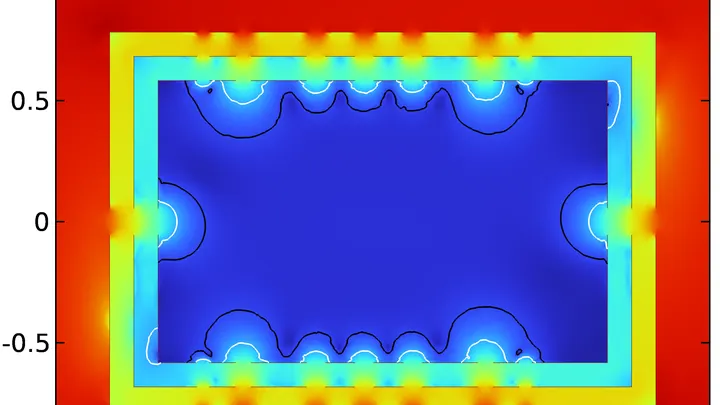
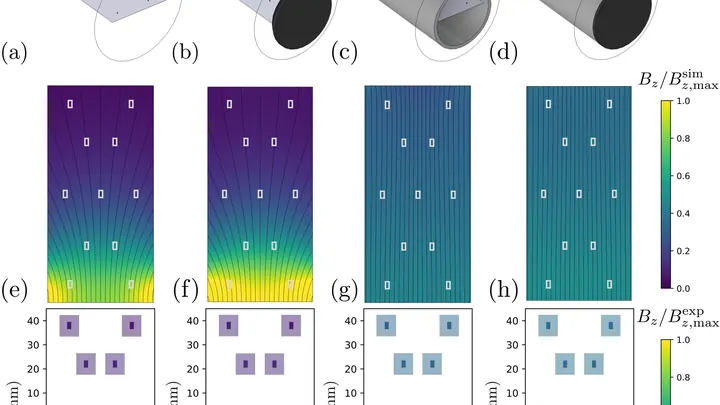
The magnetic field in this setup must be as smooth as glass: the slightest ripple would blur the signal. The engineers built two coils that cancel each other's field externally and packed them in three layers of ferromagnetic plates.
A black hole is not a vacuum cleaner. By itself, it doesn't pull everything in more strongly than an ordinary star of the same mass. But if there's a magnetic field nearby and charged particles flying around, an interesting game begins.
Ordinary electric current heats up wires — anyone who has touched a phone charger knows that. But there's another kind of current: instead of electrons rushing in a crowd in one direction, they spin in sync, like figure skaters in a pairs routine. This coordinated rotation is called a spin current, and it produces almost no heat.
When designing smartphone antennas, engineers need a reference — something like a tuning fork for adjusting musical instruments. As Maxwell showed, radio waves and light are of the same nature, and the new antenna module uses 5G millimeter waves traveling at the speed of light.
A sunspot cools, and above it a dark filament, a prominence, hangs for weeks. Inside it, like a compressed spring, hides the magnetic field. It can be laid out in neat arches, or it can be twisted into a tight rope.
Red giants are swollen, aging stars. Deep inside, an ocean of plasma churns: heat forces its way from the core to the surface, generating waves like a mighty surf. The star's magnetic field acts like an invisible seabed – it steers these waves, changing their height and speed.
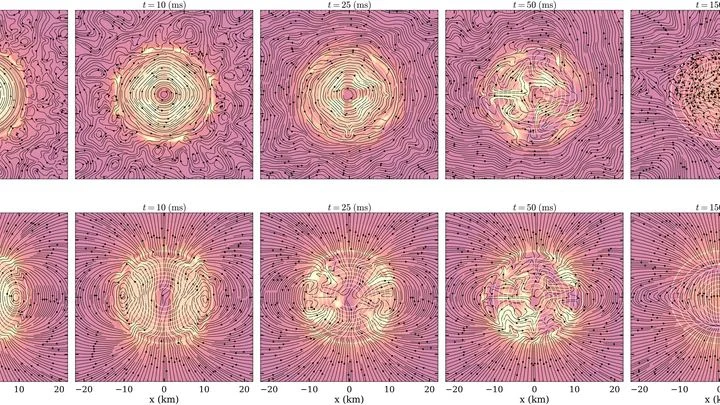
A neutron star is a sphere the size of a city but with the mass of an entire Sun. Its magnetic field can tear atoms apart from thousands of kilometers away. Yet until now, it was a mystery how this field is arranged inside: whether it is twisted into tight ropes or more like neat lines radiating from the poles.
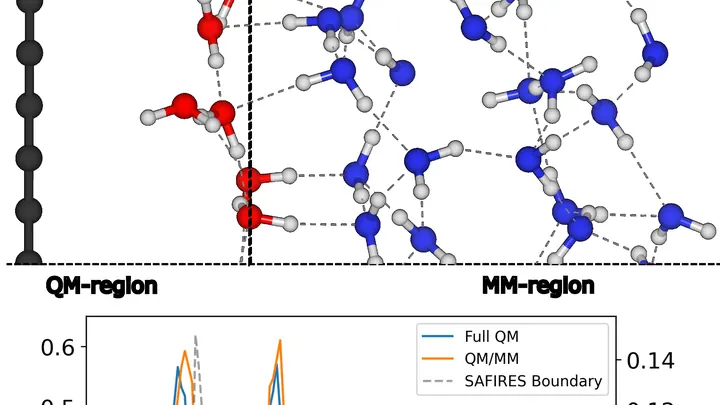
Imagine a huge swimming pool. In one corner, a chemical reaction is underway that needs to be calculated with jeweler-like precision. But the surrounding water is not just decoration: its molecules jostle, attract, and influence the reaction. How do you account for this endless dance of particles without drowning in calculations?
A pair of figure skaters spins while holding hands. If their path is a perfect circle, each push from a partner is predictable. But stretch that path into an oval, and the effort becomes uneven: a jerk as they come together, a lull as they pull apart. Something similar happens with two black holes in the final minutes before they merge.
In a large gas cloud where stars are born, the magnetic field lines are roughly aligned in one direction, like the fibers in a piece of felt. But look inside, into the dense clumps that will eventually become stars, and the picture changes: there the lines are twisted every which way, like a ball of yarn after a kitten has played with it.
If you look at a map of distant galaxies, it is not perfectly uniform: on one side of the sky there are slightly more, on the other — slightly fewer. This lopsidedness has been noticed in several sky surveys, and it does not look like a random fluke. Usually, it is explained by the fact that our Galaxy itself is flying somewhere, making distant objects appear shifted.
A white dwarf is what remains of a star like the Sun after it sheds its outer layers. What's left is a hot core the size of Earth but with a mass close to that of the Sun. A teaspoon of this material would weigh as much as a truck. Some of these stars have extremely strong magnetic fields — a billion times stronger than Earth's.
Two tiny emitters, each about the size of an atom, can together do what neither can do alone. We're talking about light scattering — when light hits particles and bounces off in all directions. Usually, a pair of particles scatters light only slightly more than a single one.
The Sun is not a calm sphere. Waves constantly ripple through its interior, like a bell after being struck. These oscillations reach the surface and reveal what's happening on the far, invisible side. Astronomers have long been able to 'listen' to this ringing and find large sunspot groups there.
A magnetic field is like a shadow cast by an object: it changes with the shape of the source. But if you put a lens in the path of light, you can alter the shadow. Here, the authors devised a 'lens' for magnetic fields — an assembly of ordinary materials with different magnetic permeabilities (their ability to let the field through).
Earth's magnetic field is like an invisible river that meanders beneath our feet. Navigators and geologists rely on maps of this river, but instruments only take readings at scattered points, leaving blank spots in between. Filling those gaps is like trying to sketch the river's course from a few pebbles found on the bank.
A tuning fork rings dully when it strikes a crack. That principle scales up in this experiment: physicists turned molecules into an ultrasensitive tuning fork to eavesdrop on the electron's asymmetry.
Two stars orbit so closely that their outer layers merge into a shared envelope. Matter flows from one to the other, like water spilling from an overfull cup into its neighbor. In this cosmic dance, where stars literally touch each other, astronomers have for the first time detected magnetic fields in large numbers.