Magnetic field strength is a measure of how intense a magnetic field is at a given point. It determines the force a moving charged particle experiences, the torque on a magnetic dipole, and the energy density stored in the field. In practical terms, it tells you how strongly a magnet will attract a paperclip or how much a particle's path will bend in a particle accelerator.
History
The concept evolved from early observations of lodestones and compass needles. The quantitative description was developed in the 19th century, with key contributions from André-Marie Ampère, who studied the forces between current-carrying wires, and James Clerk Maxwell, who unified electricity and magnetism in his equations in the 1860s.
How it works
The strength is typically quantified as a vector field, with both magnitude and direction. In the SI system, it is measured in teslas (T), where one tesla is one newton per ampere-meter. The force on a moving charge is given by the Lorentz force law, F = qv × B, where B is the magnetic flux density (often used interchangeably with field strength in most contexts). The field arises from moving charges, such as electric currents in wires or the intrinsic spin of electrons in magnetic materials.
In practice
Magnetic field strength is essential in designing MRI machines, particle accelerators like the LHC, and magnetic storage devices. It is also used in geophysics to map underground structures and in space missions to measure planetary magnetic fields.
Fun fact
The strongest magnetic field ever produced in a laboratory is about 1,200 teslas, created using an explosive technique called flux compression, which is strong enough to distort the shape of atoms.
Units by system: SI: t · CGS: g · Planck: b p · natural: ev2
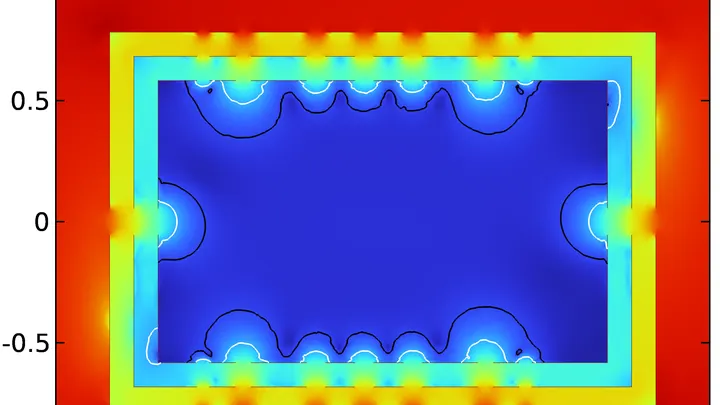
The magnetic field in this setup must be as smooth as glass: the slightest ripple would blur the signal. The engineers built two coils that cancel each other's field externally and packed them in three layers of ferromagnetic plates.
Radio astronomy began with the mysterious noise caught by the antenna of Karl Jansky and the rhythmic pulses that Jocelyn Bell Burnell playfully called 'little green men'.
At the center of a distant galaxy, where a supermassive black hole weighing a hundred million suns spins, space is threaded with magnetic fields. They coil into tight vortices, like a drain in a sink, but instead of water, there's plasma whipped up to near-light speeds.
Superconductivity and magnetic field are age-old foes: the field barges in like a whirlwind, tearing apart the delicate pairing of Cooper pairs, destroying order.
Red giants are swollen, aging stars. Deep inside, an ocean of plasma churns: heat forces its way from the core to the surface, generating waves like a mighty surf. The star's magnetic field acts like an invisible seabed – it steers these waves, changing their height and speed.
A child on a swing: too strong a push and they fly off. Roughly this is how powerful light tears electrons out of an atom. It would seem that the stronger the push, the more certain the destruction. But in the quantum world it is different: when the field strength crosses a certain threshold, the atom suddenly freezes.
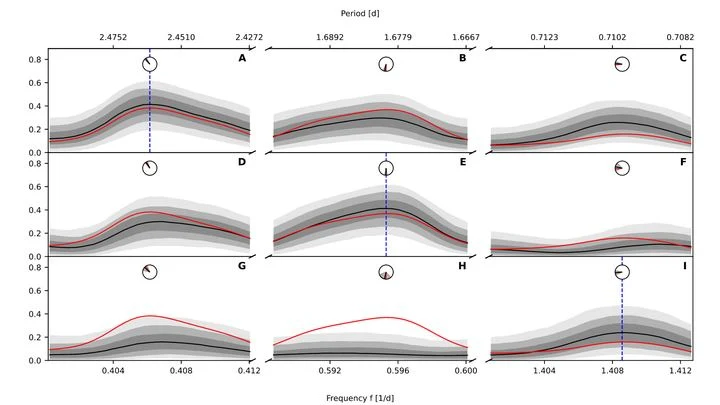
The star GJ 436 is a dim red dwarf, and orbiting it is a Neptune-sized planet on a nearly vertical, tilted orbit. Astronomers spent 18 years taking spectra of this star to track its spots and flares. Suddenly, a rhythm emerged in the data that matched neither the star's rotation nor its 8-year activity cycle. This rhythm exactly followed the planet's orbit.
An electron beam in an accelerator is like a flock of birds: it flies in a tight group, but over time it spreads out. To keep particles together, heavy magnets are usually used. Here they did without them — the beam squeezed itself.
When cooled strongly, a uranium-telluride crystal stops resisting current. Before that happens, at a slightly higher temperature, its resistance can still be measured — and it tells about the shape of the invisible paths along which electrons run.
In a regular battery, the electrolyte is liquid, and charged particles (ions) move freely. In the solid-state version, they squeeze through atomic 'corridors', like pedestrians in narrow passages. For a battery to work quickly, you need a material with high ionic conductivity.
Two taut strings plucked at the same time sound different if they are connected by a rubber band. Energy starts to flow from one to the other, and the pitch of the combined sound shifts slightly. Two nanomechanical bridges, microscopic beams etched into a crystal, behave much the same way.
Two stars orbit so closely that their outer layers merge into a shared envelope. Matter flows from one to the other, like water spilling from an overfull cup into its neighbor. In this cosmic dance, where stars literally touch each other, astronomers have for the first time detected magnetic fields in large numbers.
A magnetic field is invisible, but you can make it 'glow'. To do that, take a tiny diamond with defects — places where a carbon atom is replaced by nitrogen and a neighboring lattice site is vacant. These defects, like sensitive compass needles, respond to the slightest changes in the magnetic field and emit light of varying brightness.
An ordinary magnetic compass freezes when lightning strikes nearby. A sudden jump in the magnetic field throws the needle off. A similar problem has been hindering scientists trying to measure magnetism in strong pulsed fields: those that switch on for a thousandth of a second.
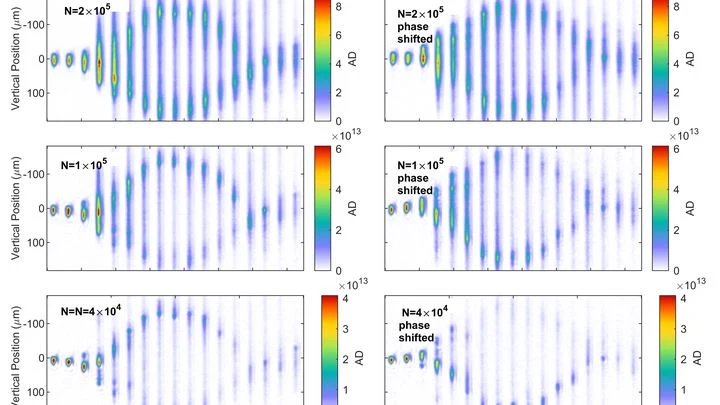
The new setup tackles this with a laser beam.
Using a method similar to spectroscopy (magnetic sensing), scientists pass a current through a multilayer film and observe the orientation of the microscopic magnetic arrows inside. Previously, everything was predictable: in some materials, the arrows aligned only along the current, in others — strictly across it. But in bismuth ferrite with a platinum coating, a glitch occurred.